
TL;DR:
UPI hit a record 23.2 billion transactions worth Rs 29.9 trillion in May 2026. NPCI is now extending its 24/7 settlement model beyond India, with 8-9 countries live and more in the pipeline.
India’s Unified Payments Interface (UPI), already the largest real-time payments network on the planet by transaction count, is extending its always-on architecture into a growing list of countries, and the numbers behind that expansion, both domestic and international, are large enough to reshape how the payments industry talks about cross-border infrastructure.
A Decade of Scale, Compressed Into One Rail
UPI, built and operated by the National Payments Corporation of India (NPCI), launched in April 2016 with just 21 participating banks and a first-month volume of 373 transactions. A decade on, the platform now handles more than 66 crore (roughly 660 million) transactions every single day. In May 2026, NPCI data showed UPI processed 23.2 billion transactions in a single month, worth Rs 29.9 trillion, the highest monthly volume and value on record, and a figure NPCI itself notes excludes Credit Card on UPI and Credit Line on UPI activity, meaning true usage is higher still.
For calendar year 2025 as a whole, UPI processed roughly 228.3 billion transactions worth Rs 299.7 lakh crore, up 29.3% in volume and 20.3% in value year-on-year, according to NPCI data compiled through independent analysis. Monthly volume crossed 2,000 crore (20 billion) transactions for the first time in August 2025 and climbed to 2,163 crore transactions in December 2025, the highest monthly figure in the platform’s history at that point, before May 2026’s record broke it again. Average daily transaction counts have moved from roughly 682 million in November 2025 to 737.79 million by May 2026.
The average UPI transaction size has also shifted meaningfully, falling from more than Rs 1,600 in early 2023 to around Rs 1,293 today, driven by a surge in small-ticket retail usage, grocery transactions have grown 2.5x over two years, and cigarette-shop transactions have jumped 8x, according to industry tracking. That shift matters for the international story: UPI’s core value proposition has always been processing very large numbers of very small payments cheaply and instantly, which is precisely the model NPCI is now trying to replicate for cross-border traffic.
At the domestic market level, UPI now accounts for somewhere between 75% and 90% of India’s retail digital payment volume depending on the measure used, and multiple industry trackers cite UPI as responsible for roughly 49% of global real-time payment transaction volume, a figure attributed to IMF and ACI Worldwide analysis. NPCI and the Government of India have set a public target of 1 billion UPI transactions per day by FY2026-27, which would put annual volume in the range of 300–350 billion transactions if current growth trends hold.
The App Layer Is Shifting Too
One statistic worth flagging for anyone tracking the competitive landscape: the long-standing duopoly between PhonePe and Google Pay showed its first real crack in May 2026, when their combined market share slipped below 80% for the first time, as smaller apps, BHIM, Navi, and super.money among them, gained ground. PhonePe still leads by a wide margin, holding roughly 45-46% of transaction volume and processing over 9,400 million monthly transactions on some estimates, with Google Pay around 32-33%. NPCI has previously floated a 30% market-cap rule intended to prevent any single app from dominating the network indefinitely, a policy that continues to shape how the ecosystem develops even as it hasn’t been enforced with a hard deadline.
The International Rollout: Where UPI Actually Works Today
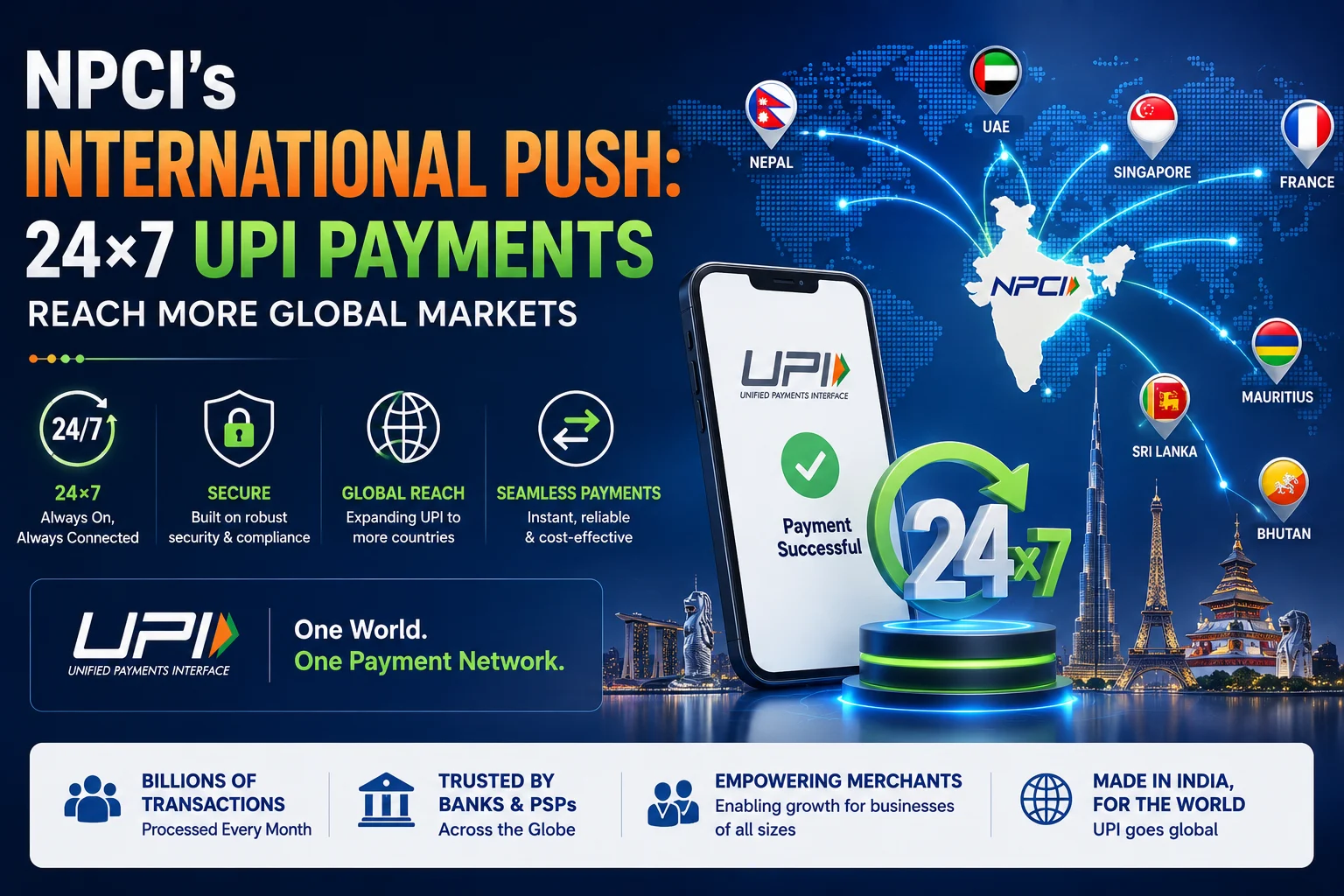
NPCI International Payments Limited (NIPL), the arm responsible for taking UPI abroad, has been building out bilateral agreements country by country since 2020, rather than pursuing a single global launch. As of mid-2026, UPI acceptance is live and operational in eight countries, the UAE, Singapore, France, Mauritius, Bhutan, Nepal, Sri Lanka, and Qatar, with Cambodia reported as a ninth addition in June 2026, live through a partnership between NPCI International and ACLEDA Bank via Cambodia’s national KHQR system, reportedly reaching more than 4.5 million merchant locations in its first phase. Greece has also been cited in more recent coverage as newly enabled through a partnership with Eurobank, though reporting on exactly which corridors count as fully “live” versus “MoU signed but not yet operational” varies meaningfully between sources, a distinction worth taking seriously given how often the two get conflated in coverage of UPI’s expansion.
Corridor-specific detail illustrates the pattern:
- UAE: integrated through Mashreq Bank’s NeoPay platform and the AANI payment system, with acceptance reported across more than 60,000 merchant locations including Dubai Duty Free and Lulu Hypermarket.
- Singapore: linked via PayNow and HitPay, covering roughly 12,000 merchant locations.
- Nepal: one of the deepest integrations, reportedly reaching more than 200,000 point-of-sale terminals.
- France: accessible through the Lyra network at tourist-heavy locations, including landmark sites in Paris.
- Qatar: live at high-traffic locations including Hamad International Airport and LuLu Hypermarket outlets.
Countries in earlier stages include Cyprus and Oman, where MoUs have reportedly been signed, and Japan, which has also been named as a target market. NIPL is separately described as exploring bilateral linkages with Indonesia, Malaysia, and Thailand, though Malaysia specifically has been reported as “not operational” despite earlier announcements, underscoring how far apart an MoU announcement and a functioning merchant network can be in practice.
Against this backdrop, NPCI’s own framing of the timeline is notably unhurried: the organization has stated it expects to need roughly 20 to 25 years to build a complete network of bilateral payment “pipes” with interested countries, with seven to eight such corridors operational as of mid-2026. That’s a meaningfully longer horizon than the pace of individual country announcements might suggest to a casual observer.
The Growth Curve, Still Small in Absolute Terms
International UPI transaction volume crossed the one-million mark for the first time in the 2025–26 financial year, a milestone, but a tiny fraction of UPI’s domestic scale, where the platform clears roughly 660 million transactions daily. Reported figures show international volume nearly doubling to 1.48 million transactions in FY26 (as of December 2025) from 0.75 million in FY25, with transaction value rising to ₹330.43 crore from ₹258.53 crore over the same period. For context, FY24 recorded just 37,060 international UPI transactions worth ₹19.7 crore, meaning the international corridor, while still small, has grown roughly 40-fold in transaction count over two fiscal years.
What “24×7” Actually Means for Global Commerce
The headline framing of NPCI’s push, “24×7 payments”, is easy to read as a marketing phrase, but it describes a genuine structural difference from how most cross-border payment rails function. Traditional international transfers, whether routed through correspondent banking networks or card-scheme settlement, are frequently bound by business-hours processing windows even when authorization happens instantly. UPI’s domestic architecture has operated with true real-time, round-the-clock settlement since 2016, with no cutoff times or batch-processing delays, and NIPL’s strategy is to extend that same settlement model, not just UPI’s brand, into each new bilateral corridor.
For merchants and payment providers operating in newly UPI-enabled markets, this changes the integration calculus: accepting UPI means plugging into a rail with no downtime window, which is architecturally distinct from adding another card scheme on top of existing payment gateways. Retailers in the UAE, Singapore, and Cambodia are onboarding UPI acceptance specifically to capture high-spending Indian traveler and diaspora traffic without requiring those customers to hold local bank accounts or convert currency in advance.
There are hard limits worth noting for anyone assuming “24×7 real-time” translates into universal capability: UPI transactions remain restricted from certain regulated categories under Indian rules, including gambling and casino-related payments, and UPI has no role in cryptocurrency settlement, since it is fundamentally a fiat, bank-account-linked rail. Merchants operating in those verticals continue to rely on the specialist high-risk payment providers that already serve them; NPCI’s international expansion does not change that picture.
Why NPCI Is Betting on Bilateral Corridors Over a Single Global Launch
NPCI’s approach to international expansion is deliberately incremental, built one government-to-government or bank-to-bank agreement at a time rather than through a single multilateral rollout. Ritesh Shukla, Managing Director and CEO of NPCI International, has described the UAE expansion specifically as bringing “unparalleled convenience to millions of Indian travelers and residents while strengthening the digital bridge between the two economies,” framing each corridor as both a payments upgrade and a diplomatic and economic-integration exercise. That framing matters for understanding NPCI’s pace: unlike a private payment network that can add merchant acceptance unilaterally, UPI’s cross-border corridors depend on local banking partners, regulatory sign-off, and often direct government involvement, which is part of why NPCI has set expectations around a multi-decade build-out rather than a rapid global rollout.
The diplomatic dimension shows up clearly in recent announcements: India’s Ministry of External Affairs confirmed UPI is expected to become operational in Cyprus, while separate reporting has named Japan, the Maldives, and Greece among the nations NPCI is actively working to bring online. Each of these corridors reflects a mix of strategic priorities, some driven by tourism volume (Greece, France), some by remittance and diaspora density (UAE, Qatar, Singapore), and some by regional trade and connectivity goals (Nepal, Bhutan, Sri Lanka, Cambodia).
This corridor-specific logic also explains why coverage of “how many countries accept UPI” varies so widely across sources, a count built around remittance corridors will differ from one built around tourist-merchant acceptance, and both differ again from a count that includes MoUs not yet translated into live merchant networks. For payments-industry observers, the more useful metric than the country tally is the mix of live merchant locations within each corridor: Nepal’s 200,000-plus point-of-sale terminals and the UAE’s 60,000-plus merchant locations represent meaningfully deeper integration than a bilateral agreement that hasn’t yet reached retail acceptance.
The Road Ahead
NPCI has said its ongoing priorities include strengthening security and fraud-prevention systems alongside expanding cross-border linkages, a pairing that matters given UPI fraud cases domestically rose to roughly 6.32 lakh incidents worth ₹485 crore in FY2024-25, a figure that underscores the scale challenges of running a payments network processing hundreds of billions of transactions annually. Longer-range projections cited by industry analysts put UPI’s transaction value at roughly ₹532 lakh crore (about $6.4 trillion) by 2029, with annual transaction counts potentially reaching 379 billion by FY2026-27.
Whether NPCI’s patient, corridor-by-corridor international strategy ultimately positions UPI as genuine global payment infrastructure, or remains a regionally significant but globally modest presence relative to established card networks and real-time payment systems like Brazil’s Pix, will depend heavily on how quickly the pipeline of announced-but-not-yet-operational corridors, Cyprus, Oman, Japan, and the broader Southeast Asian markets under exploration, actually convert into functioning merchant networks over the next few years.
Comments
No comments yet. Be the first to share your thoughts.
Leave a comment