
Introduction
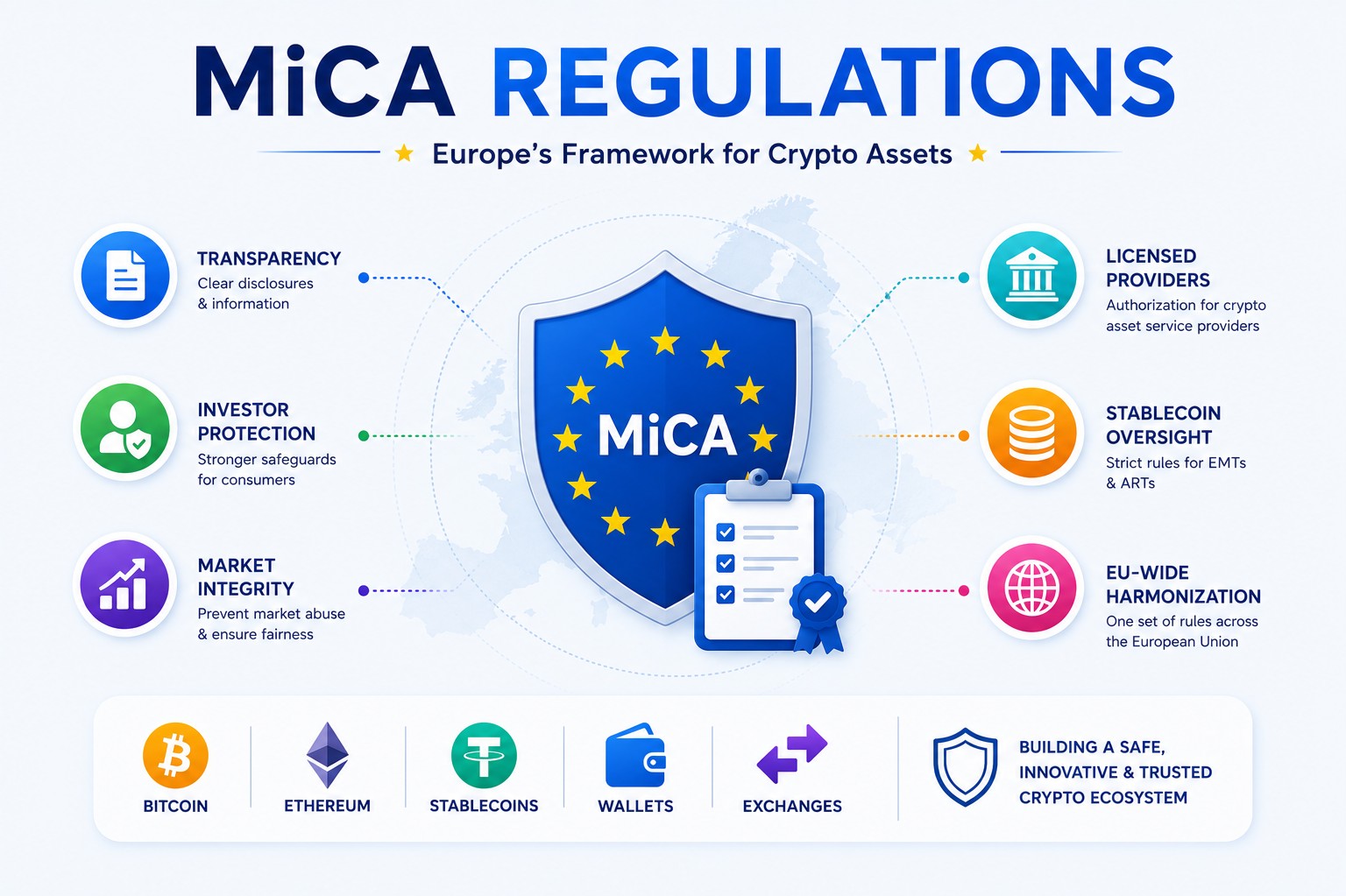
The rapid growth of cryptocurrencies and digital assets has created both opportunities and challenges for regulators worldwide. While blockchain technology has introduced new ways to transfer value, raise capital, and build financial services, the lack of consistent regulation has often created uncertainty for businesses, investors, and consumers.To address these concerns, the European Union introduced the Markets in Crypto-Assets Regulation (MiCA), one of the most comprehensive regulatory frameworks for digital assets globally. MiCA aims to establish clear rules for crypto asset issuers, service providers, and market participants operating within the European Union.
As cryptocurrency adoption continues to expand, MiCA regulations are expected to play a significant role in shaping the future of digital finance by promoting transparency, consumer protection, financial stability, and innovation.
For crypto companies, fintech firms, financial institutions, and investors, understanding MiCA is becoming increasingly important in navigating the evolving digital asset landscape.
What Is MiCA?
MiCA, short for Markets in Crypto-Assets Regulation, is a regulatory framework developed by the European Union to govern crypto assets and related services.
The regulation was designed to create a unified legal framework across EU member states, replacing fragmented national regulations with a consistent set of rules.
MiCA applies to:
- Crypto asset issuers
- Crypto exchanges
- Custody providers
- Trading platforms
- Wallet providers
- Stablecoin issuers
- Crypto service providers
The primary objective is to ensure that crypto businesses operate under clear and transparent rules while protecting consumers and maintaining financial stability.
Why MiCA Was Introduced
Before MiCA, crypto regulations varied significantly across European countries.
This created several challenges:
- Regulatory uncertainty
- Inconsistent compliance requirements
- Limited consumer protection
- Increased fraud risks
- Barriers to cross-border operations
As crypto markets expanded, regulators recognized the need for a standardized framework that could support innovation while addressing potential risks.
MiCA was introduced to provide:
- Legal certainty
- Market integrity
- Investor protection
- Financial stability
- Regulatory consistency
The regulation is considered a major milestone in the development of the digital asset industry.
Key Objectives of MiCA Regulations
Consumer Protection
One of MiCA’s primary goals is protecting consumers from misleading practices and excessive risks.
Crypto companies must provide clear information about their products and services, helping investors make informed decisions.
Market Transparency
MiCA introduces disclosure requirements that improve transparency across crypto markets.
Issuers must provide detailed information regarding crypto assets offered to the public.
Financial Stability
The regulation seeks to reduce systemic risks associated with large-scale crypto adoption, particularly in relation to stablecoins.
Innovation Support
Rather than restricting innovation, MiCA aims to create a predictable regulatory environment that encourages responsible growth within the digital asset sector.
Regulatory Harmonization
A single regulatory framework allows crypto businesses to operate more easily across EU member states.
Crypto Assets Covered Under MiCA
MiCA categorizes crypto assets into different groups.
Asset-Referenced Tokens (ARTs)
These tokens derive value from multiple assets, including currencies, commodities, or other crypto assets.
They are designed to maintain relatively stable value.
E-Money Tokens (EMTs)
E-Money Tokens are stablecoins linked to a single fiat currency, such as the euro or US dollar.
These tokens are subject to stricter regulatory oversight due to their potential impact on payment systems.
Other Crypto Assets
MiCA also covers a wide range of cryptocurrencies and utility tokens that do not fall within traditional financial regulations.
This broad scope helps ensure comprehensive oversight of the crypto ecosystem.
Requirements for Crypto Asset Issuers
Organizations issuing crypto assets within the European Union must comply with various obligations.
White Paper Requirements
Issuers must publish a crypto asset white paper that includes:
- Project details
- Associated risks
- Rights and obligations
- Technology information
- Governance structure
This improves transparency for investors.
Disclosure Obligations
Companies must provide accurate and non-misleading information regarding their crypto assets.
Operational Standards
Issuers are required to maintain appropriate governance and risk management frameworks.
These measures help protect investors and strengthen market confidence.
Crypto Asset Service Providers (CASPs)
MiCA introduces specific requirements for Crypto Asset Service Providers.
Examples include:
- Exchanges
- Trading platforms
- Custodians
- Wallet providers
- Brokerage services
To operate within the EU, CASPs must obtain authorization from relevant regulatory authorities.
Key obligations include:
- Maintaining adequate capital
- Protecting customer assets
- Implementing cybersecurity measures
- Establishing complaint handling procedures
- Preventing market abuse
These requirements align crypto businesses more closely with traditional financial institutions.
MiCA and Stablecoins
Stablecoins receive significant attention under MiCA because of their potential impact on financial systems.
Issuers of Asset-Referenced Tokens and E-Money Tokens must meet stricter requirements, including:
- Reserve management standards
- Governance controls
- Risk management frameworks
- Redemption rights for holders
Large stablecoin issuers may face additional oversight from European authorities.
This reflects concerns about the role stablecoins could play in payment systems and financial markets.
Impact on Crypto Businesses
Increased Compliance Requirements
Crypto companies operating within the EU must invest in compliance programs, governance structures, and regulatory reporting.
Greater Market Credibility
Regulatory clarity can improve trust among investors, consumers, and institutional participants.
Easier Cross-Border Operations
Authorized providers may benefit from regulatory passporting across EU member states.
This can simplify expansion strategies and reduce operational complexity.
Competitive Advantages
Businesses that successfully comply with MiCA may gain a stronger reputation and attract institutional partnerships.
Benefits of MiCA Regulations
Enhanced Investor Confidence
Clear rules improve trust in digital asset markets.
Reduced Fraud Risks
Stronger oversight helps combat scams and misleading practices.
Regulatory Certainty
Businesses gain greater clarity regarding legal obligations and operational requirements.
Institutional Adoption
Financial institutions may become more comfortable engaging with regulated crypto markets.
Market Growth
A transparent regulatory framework can support sustainable industry development.
Challenges Associated with MiCA
Despite its benefits, MiCA also presents challenges.
Compliance Costs
Meeting regulatory requirements may increase operational expenses, particularly for smaller crypto firms.
Regulatory Complexity
Businesses must adapt their operations to align with evolving legal obligations.
Innovation Concerns
Some industry participants worry that excessive regulation could slow innovation.
Global Regulatory Differences
Crypto firms operating internationally must navigate multiple regulatory frameworks beyond MiCA.
Balancing compliance and innovation remains a key challenge.
MiCA’s Global Influence
MiCA is widely viewed as a pioneering regulatory framework.
Its influence extends beyond Europe because regulators in other regions are closely monitoring its implementation.
Many experts believe MiCA could serve as a model for future crypto regulations worldwide.
As digital asset markets continue to mature, global regulatory convergence may become increasingly important.
The Future of MiCA Regulations
The crypto industry continues to evolve rapidly.
Future developments may include:
- Expanded regulatory guidance
- Greater oversight of decentralized finance (DeFi)
- Enhanced stablecoin supervision
- Increased international cooperation
- New rules for emerging digital asset technologies
As adoption grows, regulators will likely continue refining frameworks to address evolving risks and opportunities.
Conclusion
MiCA regulations represent a landmark development in the global digital asset industry. By establishing clear rules for crypto asset issuers, service providers, and stablecoin operators, the European Union is creating a more transparent, secure, and predictable environment for crypto innovation.
While compliance requirements may increase operational responsibilities for businesses, the benefits of regulatory certainty, investor protection, and market credibility are expected to support long-term industry growth.
As digital assets become increasingly integrated into mainstream finance, MiCA is likely to play a central role in shaping the future of crypto regulation, not only within Europe but across the global financial ecosystem.
Comments
No comments yet. Be the first to share your thoughts.
Leave a comment