
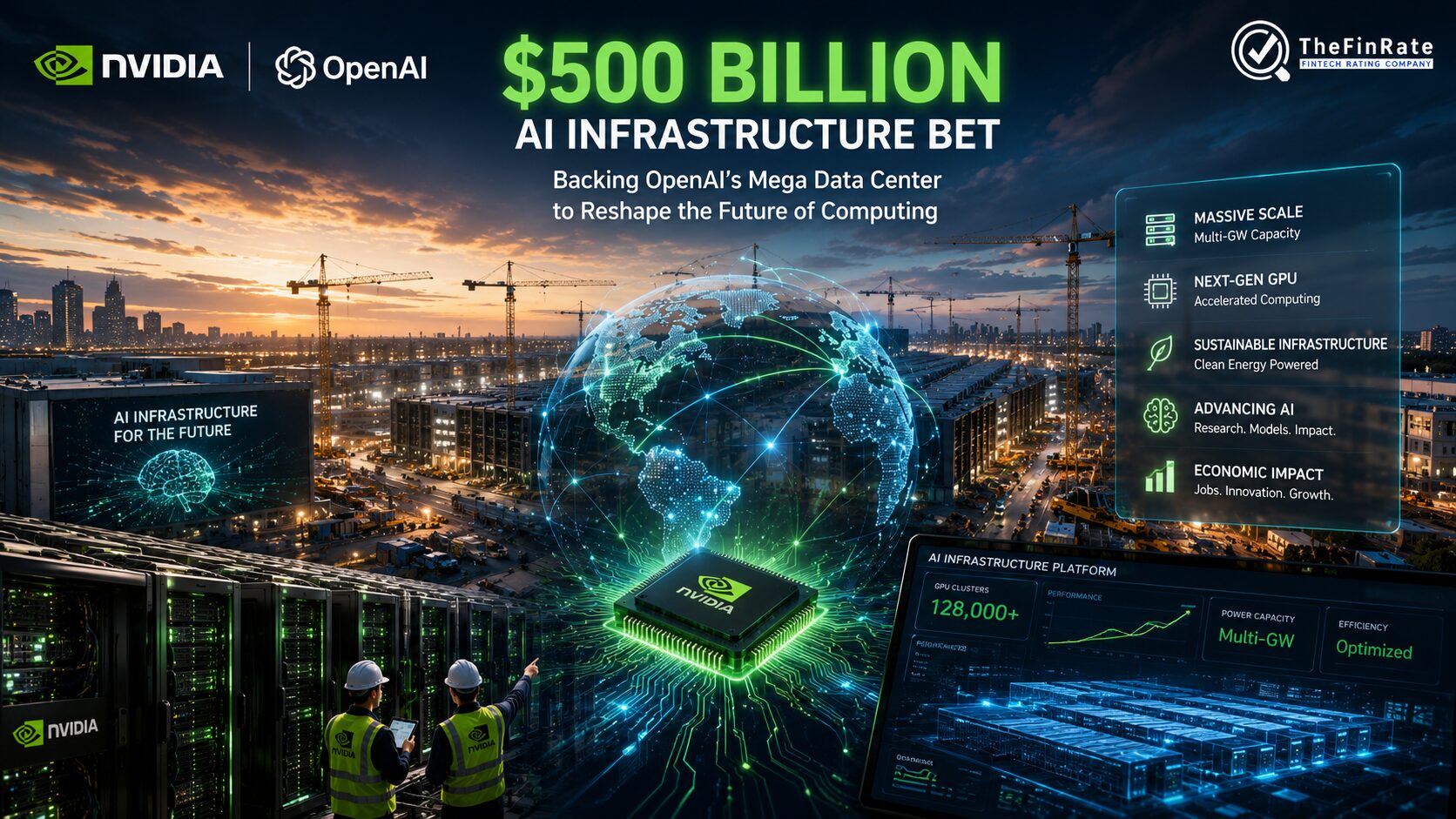
Nvidia’s $500 Billion AI Infrastructure Bet: Why Backing OpenAI’s Mega Data Center Could Reshape the Future of Computing
Artificial intelligence is entering a new era—one where success depends as much on power grids, financing, and data centers as it does on breakthrough AI models.
That shift is becoming clear as Nvidia reportedly explores a role in supporting OpenAI’s proposed 10-gigawatt data center campus in Ohio. According to reports, the project could cost more than $500 billion once fully built, making it one of the largest technology infrastructure investments ever proposed.
Nvidia’s involvement goes far beyond supplying GPUs. The company is reportedly discussing a financial backing role that could help secure funding for OpenAI’s long-term lease, highlighting how AI infrastructure is becoming one of the world’s biggest investment opportunities.
If the project moves forward, it could redefine how future AI systems are financed, built, and operated.
What Is Happening?
OpenAI is reportedly negotiating a 20-year lease for a massive AI data center campus in Ohio.
Rather than purchasing the entire facility outright, the company would lease computing capacity while infrastructure partners finance and build the project.
The proposed campus would deliver approximately 10 gigawatts of computing power, with the first phase expected to become operational around 2028.
According to reports, Nvidia is discussing a role that could include financial backing for the project, helping strengthen lender confidence and improve financing conditions.
This is no ordinary data center expansion.
It represents a long-term commitment to building the physical infrastructure needed for the next generation of artificial intelligence.
Why This Deal Matters
The AI race is no longer being won by software alone.
Today, companies must also secure:
- Massive computing capacity
- Reliable electricity supplies
- Advanced cooling systems
- Large-scale data center space
- Long-term financing
Those resources are becoming just as valuable as AI algorithms.
This project shows that future AI leadership may depend on who controls the infrastructure behind the models—not just the models themselves.
How the Deal Could Work
The reported structure centers on a long-term lease rather than outright ownership.
That approach offers several advantages.
OpenAI can:
- Secure long-term computing capacity
- Reduce upfront capital spending
- Focus investment on AI development
- Avoid owning large physical assets
Meanwhile, project developers and infrastructure investors finance and manage construction.
Nvidia’s proposed role would add another layer.
Rather than acting only as a hardware supplier, Nvidia could provide financial support that helps attract lenders and investors.
Its involvement would effectively signal confidence in both the project and future AI demand.
The Numbers Behind the Project
Several figures illustrate the extraordinary scale of the proposal.
Key figures include:
- Estimated project value: More than $500 billion
- Campus capacity: 10 gigawatts
- Potential Nvidia financial support: Approximately $250 billion
- Lease duration: Around 20 years
- First operational phase: Expected around 2028
To put that into perspective, a 10-gigawatt AI campus would rank among the largest technology infrastructure projects ever planned.
This is far bigger than a traditional cloud expansion.
It is an industrial-scale computing platform.
Why It Matters for OpenAI
For OpenAI, the biggest advantage is certainty.
Training increasingly advanced AI models requires enormous computing resources.
Demand for GPUs and data center capacity continues to outpace supply.
By securing long-term infrastructure today, OpenAI can:
- Lock in future compute capacity
- Reduce infrastructure uncertainty
- Support larger AI models
- Accelerate product launches
- Scale enterprise AI services more efficiently
Reliable infrastructure could become one of OpenAI’s strongest competitive advantages over the coming decade.
Why It Matters for Nvidia
For Nvidia, the opportunity extends far beyond selling chips.
Helping finance AI infrastructure creates several strategic benefits.
It allows Nvidia to:
- Secure long-term GPU demand
- Deepen relationships with major AI customers
- Expand beyond hardware into infrastructure financing
- Strengthen its influence across the AI ecosystem
In effect, Nvidia would not simply power AI.
It would help build the financial foundation that enables AI growth.
That is a much bigger strategic role.
Why Investors Are Watching Closely
Investors see this as more than one large transaction.
It could become a blueprint for financing future AI infrastructure.
Instead of relying only on cloud providers or traditional lenders, AI companies may increasingly partner with hardware suppliers, infrastructure developers, banks, and institutional investors.
That would create a new funding model for artificial intelligence.
In this model:
- Chipmakers become strategic investors.
- Infrastructure becomes a competitive advantage.
- Financing becomes part of AI strategy.
The boundaries between technology companies and capital providers continue to blur.
The Risks Behind the Project
Projects of this size also carry significant risks.
Execution Risk
Building a multi-hundred-billion-dollar AI campus requires:
- Reliable power generation
- Regulatory approvals
- Construction expertise
- Skilled labor
- Long-term coordination
Delays in any area could increase costs significantly.
Financial Risk
Long-term lease commitments depend on sustained AI demand.
If market conditions change or AI investment slows, maintaining such large financial commitments could become more difficult.
Credit Risk
Reports suggest Nvidia’s backing may help strengthen financing.
While that improves lender confidence, it also highlights the project’s financial complexity.
Concentration Risk
The proposal links one major AI developer, one dominant chip supplier, and one enormous infrastructure project.
Any disruption affecting one participant could have broader consequences across the ecosystem.
The Bigger Picture for AI
The AI economy is rapidly becoming an infrastructure economy.
Success increasingly depends on access to:
- Electricity
- Data centers
- High-speed networking
- Advanced semiconductors
- Long-term capital
Software remains essential.
But software alone is no longer enough.
Companies that control computing infrastructure may ultimately shape the future of artificial intelligence.
That could widen the gap between the industry’s largest players and smaller AI startups that lack similar financial resources.
What Most People Miss
Most headlines focus on the project’s eye-catching $500 billion price tag.
The more important story is about control. controls computing capacity?
Who finances the infrastructure?
Who secures long-term access before demand overwhelms supply?
Those questions may determine the next generation of AI leaders.
This project is not simply about building another data center.
It is about building the foundation of tomorrow’s AI economy.
A Real-World Way to Think About It
Think of this project like an airline ordering aircraft decades in advance.
The airline is not simply buying planes.
It is securing financing, maintenance, delivery schedules, and long-term operating capacity.
OpenAI appears to be pursuing a similar strategy.
The only difference is that the critical asset is not aircraft.
It is AI computing power.
Final Thoughts
Nvidia’s reported discussions to support OpenAI’s proposed Ohio data center highlight how dramatically artificial intelligence is evolving.
The next phase of AI competition will not be decided solely by better models or faster chips.
It will also be shaped by who can finance, build, and secure the world’s largest computing infrastructure.
If this project becomes reality, it could establish a new blueprint for AI investment—one where technology companies, financial institutions, and infrastructure developers work together to power the next generation of artificial intelligence.
The AI race has entered a new chapter.
It is no longer just about building smarter models.
It is about building the industrial foundation that makes those models possible.
Nvidia in Talks to Back OpenAI Lease of $500 Billion Data Center – Bloomberg
Comments
No comments yet. Be the first to share your thoughts.
Leave a comment