
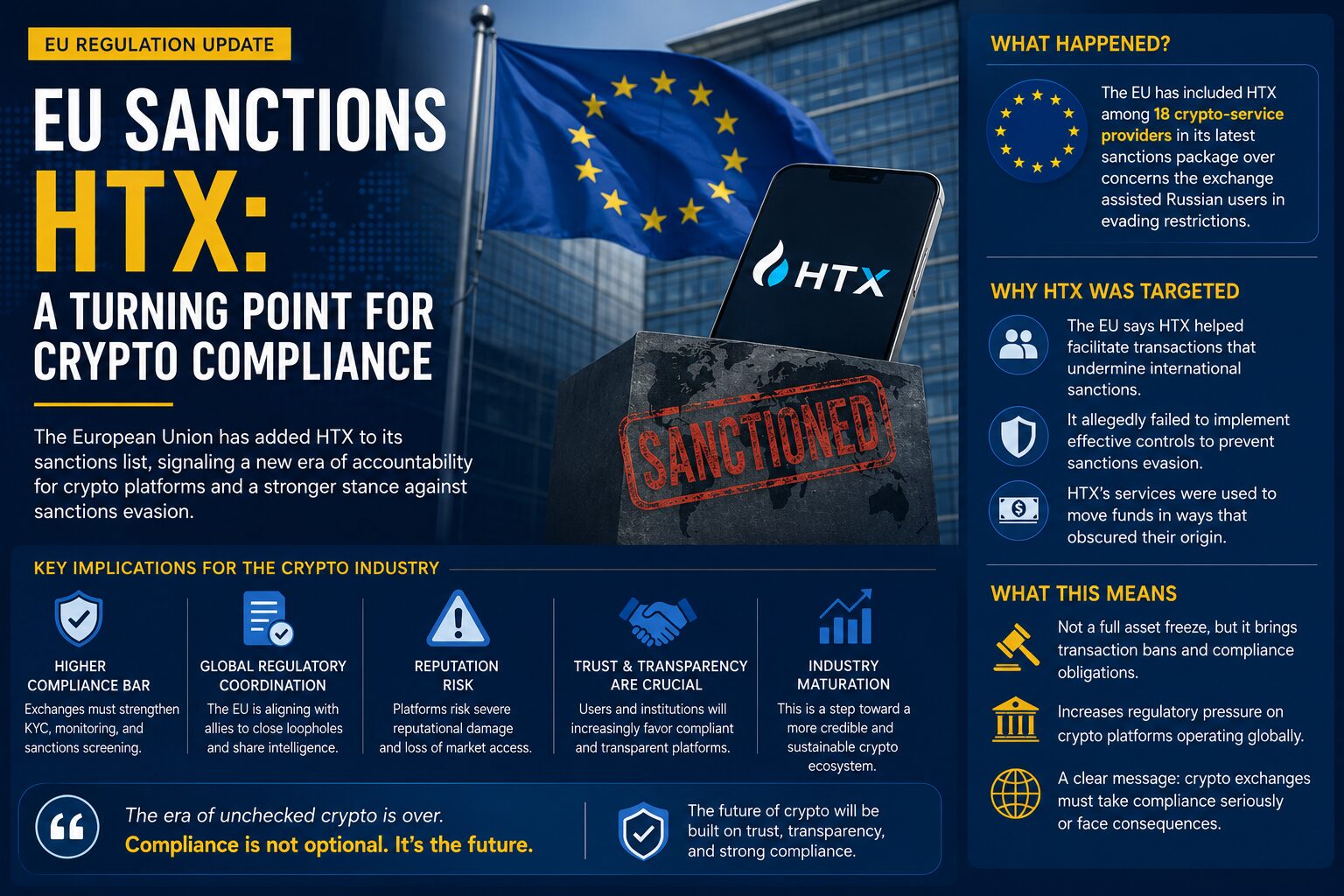
HTX EU Sanctions: Why Europe’s Latest Crackdown Could Reshape Crypto Compliance
The European Union has taken another major step in its campaign to tighten sanctions enforcement—and this time, one of the world’s largest cryptocurrency exchanges is in the spotlight.
As part of its 21st sanctions package against Russia, the EU added HTX to a list of crypto service providers it says have helped undermine sanctions through digital asset services. While the measure is not a blanket asset freeze, it significantly raises the cost of doing business with the exchange inside Europe and sends a strong signal to the wider crypto industry.
The decision is about more than one exchange. It reflects a broader shift in global regulation, where crypto platforms are increasingly treated as critical financial infrastructure rather than simply trading venues. For exchanges, compliance is becoming just as important as technology. For users, sanctions exposure is now a practical liquidity risk—not just another headline.
Why the EU Targeted HTX
According to the European Union, HTX was included because it allegedly provided crypto-asset services that “significantly frustrated” the bloc’s sanctions regime against Russia.
The sanctions package also targeted 18 crypto service providers, highlighting the EU’s determination to close digital channels that could be used to bypass financial restrictions.
The decision follows growing international scrutiny of HTX.
Authorities and investigative reports have linked the exchange to broader Russia-related crypto activity, including transactions associated with sanctioned entities and networks connected to A7 and Garantex. UK authorities have also previously alleged that infrastructure linked to HTX facilitated the movement of funds connected to Russian interests.
Although HTX has not been completely shut out of global markets, the latest sanctions substantially increase regulatory pressure on the platform.
What the Sanctions Mean
The EU action does not automatically freeze HTX’s assets worldwide or prohibit every user from accessing the exchange.
Instead, it introduces restrictions that can make operating far more difficult.
If fully implemented, the sanctions could result in:
- EU users losing the ability to transact with HTX.
- Banks and payment providers reducing or ending business relationships.
- Greater compliance reviews for transfers involving HTX-linked wallets.
- Higher due diligence requirements for institutional counterparties.
- Reduced access to European financial infrastructure.
In practice, these indirect effects often become more damaging than the legal restrictions themselves.
Financial institutions generally prefer to avoid sanctions-related exposure altogether, making “de-risking” a common response.
Immediate Business Impact on HTX
The sanctions create operational challenges that extend well beyond Europe.
For HTX, the immediate consequences could include:
- Lower trading activity from European customers.
- Reduced institutional participation.
- Increased transaction monitoring.
- More blocked payments and delayed settlements.
- Pressure on banking relationships.
- Greater compliance costs.
Even without a global asset freeze, reputational damage can quickly affect liquidity.
Institutional investors, payment partners, and market makers typically avoid platforms carrying elevated sanctions risk because the compliance burden becomes significantly higher.
What It Means for Users
For many customers, the impact may appear gradually rather than overnight.
Users could experience:
- Slower deposits and withdrawals.
- Additional identity verification.
- More source-of-funds checks.
- Restrictions on transfers involving HTX addresses.
- Higher counterparty risk when moving assets between exchanges.
Users outside the European Union may still access the platform, depending on local regulations.
However, interacting with a sanctioned exchange can create additional compliance scrutiny when funds move to regulated banks or other exchanges.
Why This Matters for the Crypto Industry
The HTX sanctions represent something much larger than enforcement against one exchange.
They highlight how regulators increasingly view crypto infrastructure as part of the global financial system.
Several broader trends are becoming clear:
Compliance is becoming a competitive advantage
Exchanges with strong sanctions screening, AML controls, and transparent governance are more likely to maintain banking relationships and institutional trust.
Crypto is moving closer to traditional finance
As digital assets become more integrated with mainstream payment systems, regulators expect crypto firms to meet standards similar to banks and payment institutions.
Sanctions enforcement is becoming global
Regulators are increasingly coordinating across jurisdictions, making it harder for exchanges to rely on regulatory gaps between countries.
Together, these trends are reshaping how crypto businesses operate worldwide.
Key Numbers Behind the Story
Several figures illustrate the scale of the issue:
- The EU targeted 18 crypto service providers in its latest sanctions package.
- The measures form part of the 21st EU sanctions package against Russia.
- Research cited in public reporting estimates approximately $21.06 billion in high-risk flows involving HTX between 2021 and May 2026.
- Of that amount, roughly $7.64 billion was reportedly linked to Russian high-risk entities and darknet markets.
- UK authorities have previously alleged infrastructure linked to HTX helped move approximately $1.5 billion connected to Kremlin-linked interests.
While these figures continue to be debated, they explain why regulators are paying closer attention to crypto transaction networks.
Risks Facing HTX
The sanctions increase several types of risk for the exchange.
Operational risk
Additional compliance reviews, blocked payments, and slower cross-border settlements could increase operational complexity.
Financial risk
Reduced liquidity, declining trading volumes, and the loss of banking partners could affect long-term growth.
Regulatory risk
Other jurisdictions could introduce similar restrictions if concerns over sanctions evasion continue to grow.
Reputational risk
Institutional clients and compliance-focused investors may avoid platforms viewed as high-risk, even if legal restrictions remain limited.
A Different Way to View the Sanctions
Many people assume sanctions immediately shut down a business.
That is not what happened here.
The more important effect is economic.
When banks, payment providers, institutional investors, and counterparties begin distancing themselves from a platform, operating costs rise while liquidity gradually falls.
In many cases, losing trust can prove more damaging than the sanctions themselves.
That is why compliance has become one of the industry’s most valuable competitive assets.
What Comes Next?
The HTX case is likely to become an important reference point for regulators worldwide.
Expect exchanges across the industry to strengthen:
- Sanctions screening.
- Wallet monitoring.
- Transaction surveillance.
- AML controls.
- Jurisdiction-based compliance programs.
At the same time, banks and payment providers are expected to increase due diligence for crypto businesses with potential sanctions exposure.
The broader direction is clear: crypto firms will increasingly be judged not only by the products they build, but also by the quality of their compliance infrastructure.
Summary
The EU’s action against HTX is about far more than one cryptocurrency exchange.
It reflects a fundamental change in how regulators view digital assets. Crypto platforms are no longer treated solely as marketplaces—they are increasingly seen as part of the global financial system, carrying the same responsibilities as other financial institutions.
For HTX, the immediate challenge is maintaining trust, liquidity, and banking relationships under heightened scrutiny.
For the wider crypto industry, the message is even clearer: robust compliance, effective sanctions screening, and strong governance are no longer optional. They have become essential for long-term growth in an increasingly regulated global market.
Comments
No comments yet. Be the first to share your thoughts.
Leave a comment