
Introduction
In today’s digital economy, customers expect payments to be fast, secure, and effortless. Whether shopping online, subscribing to a digital service, booking travel, or paying through a mobile app, users no longer tolerate slow or complicated payment processes.
A poor payment experience can lead to abandoned carts, failed transactions, customer frustration, and lost revenue. On the other hand, seamless payments improve customer satisfaction, increase conversion rates, and strengthen brand loyalty.
As digital commerce continues expanding globally, businesses are realizing that payment experience is no longer just a technical process happening at checkout. It has become a major part of the overall customer journey.
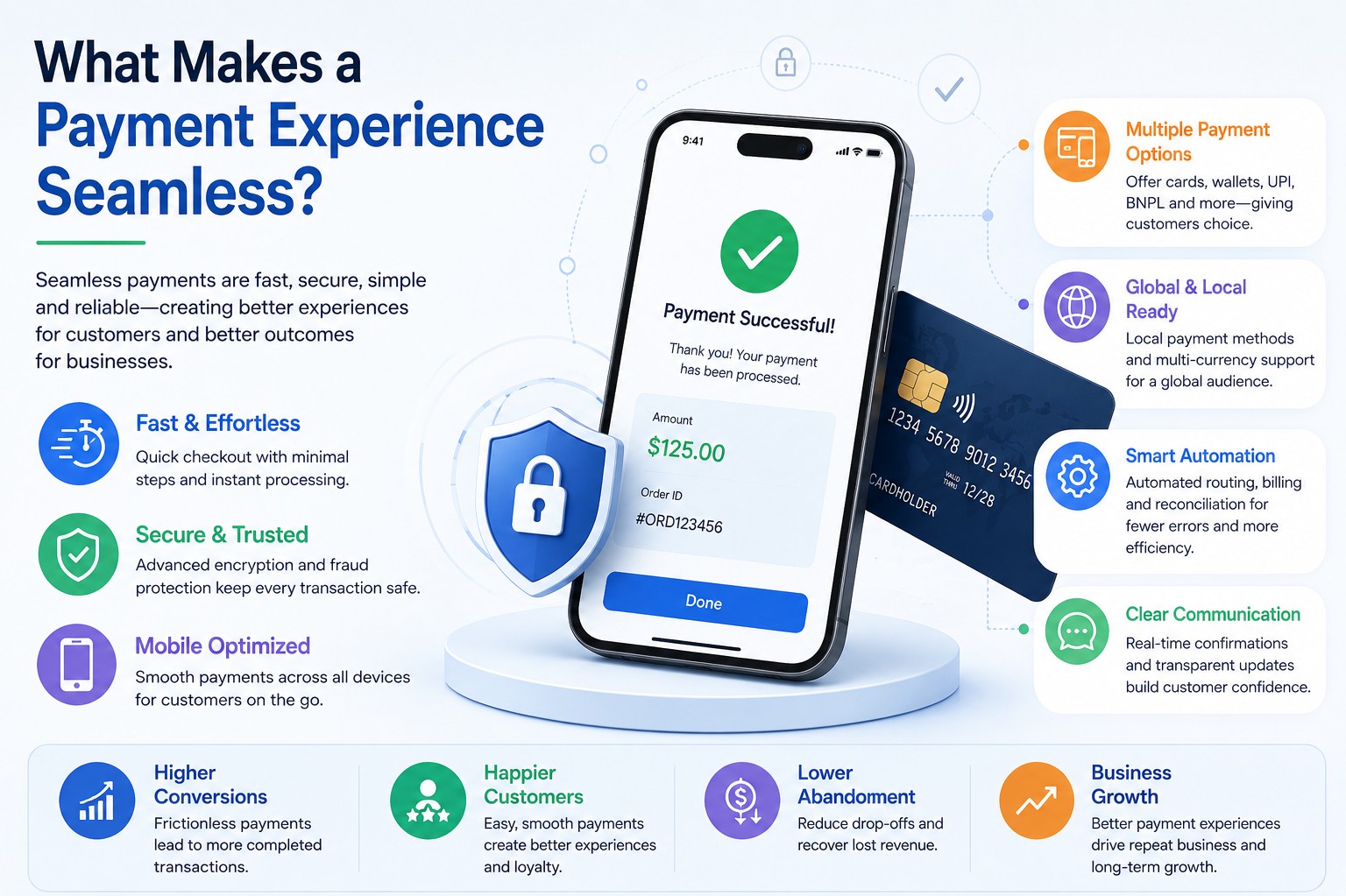
Creating seamless payments requires a combination of speed, convenience, security, reliability, and intelligent technology working together behind the scenes.
Speed Is One of the Most Important Factors
Customers expect payments to happen instantly.
Long checkout forms, slow page loading, and delayed payment confirmations create friction that can push customers away before they complete a transaction.
Fast payment processing improves:
- Checkout completion rates
- Customer satisfaction
- Mobile shopping experiences
- Repeat purchases
Modern payment systems focus heavily on reducing unnecessary steps and making the transaction process as smooth as possible.
One-click checkout solutions, digital wallets, and autofill technologies have become increasingly popular because they minimize delays during checkout.
Businesses that optimize payment speed often see measurable improvements in revenue and customer retention.
Simple Checkout Experiences Reduce Friction
Complex checkout flows are one of the biggest reasons customers abandon purchases.
Many users become frustrated when they are forced to:
- Create accounts
- Fill long forms
- Enter repetitive information
- Navigate multiple pages
Seamless payments rely on simplifying the checkout process as much as possible.
Modern businesses increasingly use:
- Guest checkout options
- One-page checkouts
- Saved payment methods
- Express payment buttons
- Autofill functionality
The fewer obstacles customers face during payment, the more likely they are to complete transactions successfully.
Simple checkout experiences are especially important in mobile commerce where long forms are more difficult to complete.
Mobile Optimization Is Essential
Mobile devices now account for a large percentage of global online transactions.
However, mobile users are also more likely to abandon purchases if payment systems are poorly optimized.
Seamless payments require:
- Responsive checkout design
- Fast mobile loading speeds
- Easy navigation
- Mobile wallet integration
- Minimal typing requirements
Digital wallets such as Apple Pay and Google Pay help improve mobile payment experiences by reducing manual data entry.
Businesses that prioritize mobile payment optimization often achieve higher conversion rates and better customer engagement.
Payment Security Builds Trust
Customers will not complete payments if they do not trust the platform handling their financial information.
Strong security is a critical part of seamless payments because customers expect both convenience and protection.
Modern payment systems use:
- Encryption
- Tokenization
- PCI DSS compliance
- Multi-factor authentication
- Fraud detection systems
Visible trust signals and secure payment environments help reduce customer hesitation during checkout.
Businesses that maintain strong payment security can improve both customer confidence and transaction success rates.
Multiple Payment Options Improve Flexibility
Different customers prefer different payment methods.
Some users prefer credit cards, while others rely on digital wallets, bank transfers, Buy Now Pay Later services, or local payment methods.
Seamless payments depend heavily on offering flexibility.
Modern businesses increasingly support:
- Credit and debit cards
- Digital wallets
- UPI payments
- BNPL services
- Bank transfers
- Cryptocurrency options in some markets
Providing multiple payment options improves accessibility and allows businesses to serve customers across different regions and preferences.
Payment flexibility is especially important for international businesses operating in diverse global markets.
Reliable Payment Infrastructure Matters
Payment reliability plays a major role in customer experience.
Failed transactions, payment delays, or system downtime can damage trust and lead to lost sales.
Seamless payments require infrastructure capable of handling:
- High transaction volumes
- Real-time authorization
- Global transactions
- Secure processing
- Minimal downtime
Businesses increasingly use multiple payment gateways and cloud-based infrastructure to improve reliability and reduce operational risks.
Customers expect transactions to work instantly and consistently regardless of location or device.
Personalization Improves Payment Experiences
Modern payment systems are becoming more personalized.
Businesses now use customer data and behavioral insights to create smoother payment journeys.
Personalized payment experiences may include:
- Saved payment preferences
- Local currency display
- Preferred payment methods
- Faster repeat checkout experiences
- Dynamic fraud prevention
Returning customers especially benefit from personalized payment systems because transactions become faster and more convenient over time.
Personalization helps businesses improve customer loyalty while reducing checkout friction.
Cross-Border Payments Must Feel Local
As global e-commerce grows, businesses increasingly serve customers across multiple countries.
However, international payments often create friction because of:
- Currency conversion issues
- Local banking limitations
- Payment method differences
- Compliance challenges
Seamless payments in global commerce require localization.
Businesses improve international payment experiences by offering:
- Multi-currency pricing
- Local payment methods
- Regional acquiring
- Faster settlement systems
Customers are more likely to complete purchases when payment experiences feel familiar and localized.
Automation Improves Efficiency
Automation plays a major role in creating seamless payments behind the scenes.
Modern payment systems automate:
- Payment routing
- Fraud detection
- Subscription billing
- Invoice generation
- Reconciliation processes
Automation improves operational efficiency while reducing payment errors and manual intervention.
Businesses that automate payment operations often deliver faster and more reliable customer experiences.
Automation is especially important for subscription businesses and platforms handling large transaction volumes.
The Role of AI in Seamless Payments
Artificial intelligence is transforming payment experiences.
AI-powered systems can:
- Detect fraud in real time
- Optimize payment routing
- Predict failed transactions
- Personalize checkout experiences
- Improve authorization rates
AI helps businesses create payment experiences that are both secure and frictionless.
As digital commerce evolves, AI-driven payment optimization will become even more important for improving customer experiences and operational performance.
Customer Experience Beyond Checkout
Seamless payments do not end after the transaction is completed.
Customers also expect:
- Instant confirmations
- Easy refunds
- Transparent billing
- Subscription management
- Real-time payment notifications
Post-payment experiences play a major role in overall customer satisfaction.
Businesses that simplify refund processing and payment communication often build stronger long-term customer relationships.
Why Seamless Payments Matter for Businesses
Seamless payments directly impact business performance.
Optimized payment experiences help businesses:
- Increase conversion rates
- Reduce cart abandonment
- Improve customer loyalty
- Lower failed transaction rates
- Enhance global scalability
In competitive digital markets, payment experience has become a major differentiator.
Customers increasingly choose businesses that provide fast, secure, and convenient payment interactions.
The Future of Seamless Payments
The future of seamless payments will focus even more on invisible and embedded financial experiences.
Emerging trends include:
- One-click commerce
- Embedded finance
- Biometric authentication
- Real-time payments
- Voice commerce
- AI-powered payment systems
Payments are becoming less visible and more integrated into the overall digital experience.
Businesses that adopt modern payment technologies early will likely gain stronger competitive advantages in customer experience and operational efficiency.
Conclusion
Seamless payments are no longer just a convenience—they are becoming essential for digital business success.
Customers expect payment experiences that are fast, secure, simple, and flexible across all devices and markets. Businesses that fail to optimize payment systems risk losing revenue, damaging customer trust, and falling behind competitors.
Creating seamless payments requires a combination of efficient checkout design, strong security, mobile optimization, payment flexibility, automation, and reliable infrastructure.
As digital commerce continues evolving, businesses that prioritize frictionless payment experiences will be better positioned to improve customer satisfaction, increase conversions, and support long-term growth.
Comments
No comments yet. Be the first to share your thoughts.
Leave a comment