
Starling Bank Launches Agentic AI Assistant to Help Small Businesses Cut Admin
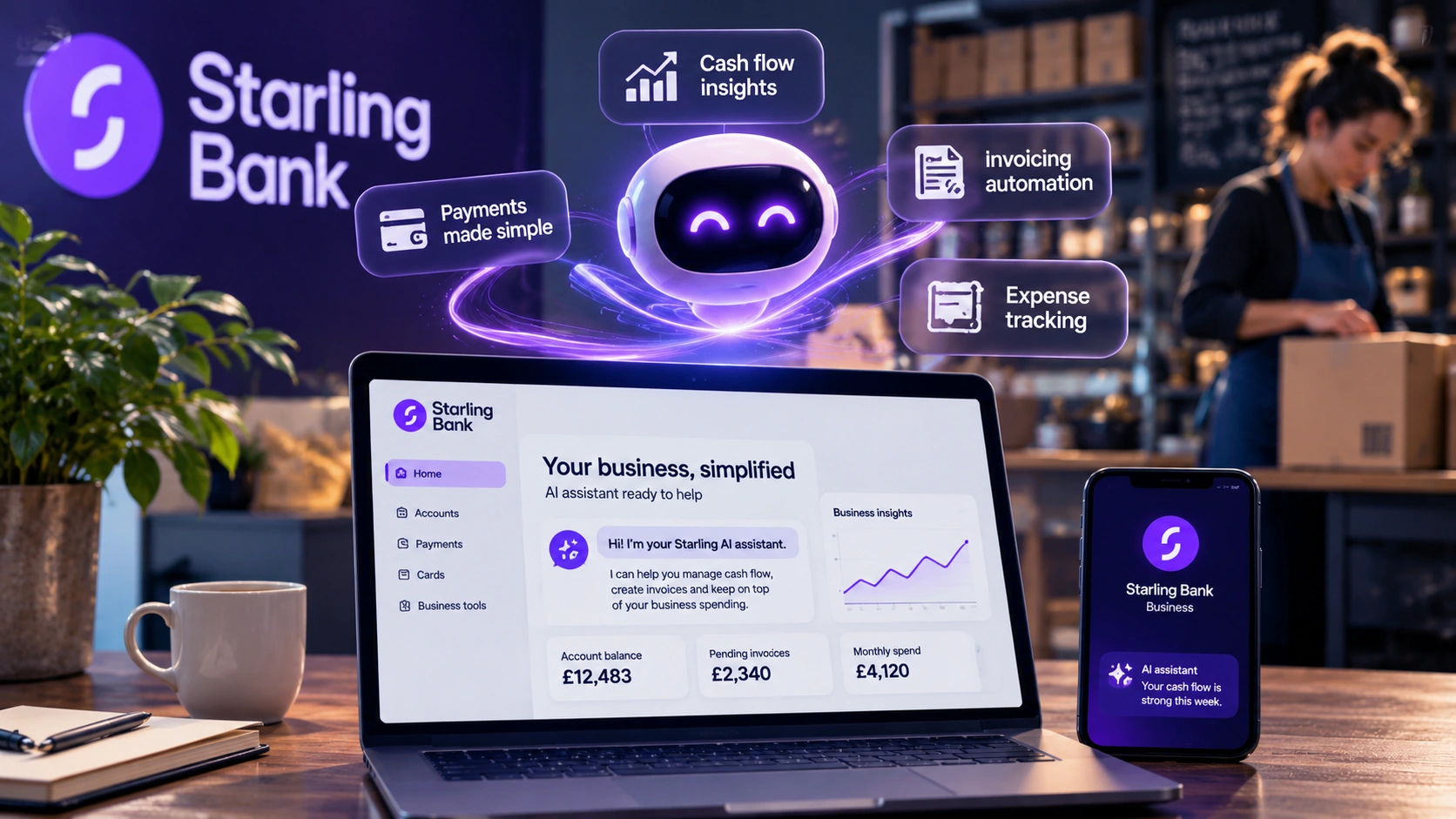
Starling Bank has launched Starling Assistant, an agentic AI-powered financial assistant for business customers, giving small businesses a new way to manage transactions, identify scams, set aside tax money and plan their finances through natural-language commands.
Starling Bank announced the launch on August 24, 2026, making Starling Assistant available to all of its business customers. The free in-app tool is designed to go beyond traditional banking chatbots by allowing customers to use simple text or voice prompts to carry out certain banking tasks.
The launch marks the latest step in Starling’s push to bring artificial intelligence into everyday banking. The bank previously launched an agentic AI financial assistant for personal customers in March 2026. It has now adapted the technology for the needs of small businesses.
Starling Assistant Goes Beyond Traditional Banking Chatbots
Traditional banking assistants generally answer questions or direct customers to information. Starling Assistant takes a more proactive approach.
The tool can understand natural-language instructions and execute selected banking commands. As a result, business owners can use the assistant to handle routine financial tasks without navigating multiple screens in the app.
For example, a business owner could ask the assistant to set aside 20% of the previous month’s earnings for VAT. Starling Assistant can calculate the amount using account history and move the money into a dedicated Space.
That functionality could help small businesses manage tax obligations while reducing the amount of manual work involved.
AI Helps Businesses Spot Invoice Scams
Security is another major part of the new assistant.
Starling Assistant can help business customers review supplier invoices and identify potential warning signs of fraud. If an invoice contains changed payment details, for example, the assistant can flag the issue and advise the business owner to contact the supplier directly to verify the information.
The feature comes as invoice fraud remains a significant concern for UK businesses. According to the UK Finance data cited by Starling, invoice fraud cost businesses more than £41 million in 2025.
By combining financial assistance with scam detection, Starling is positioning its AI assistant as both a productivity tool and an additional layer of protection for SMEs.
Starling Adds Support for Making Tax Digital
The assistant also aims to help sole traders and landlords understand their Making Tax Digital (MTD) for Income Tax obligations.
Starling Assistant can ask users questions about their income and use the answers to indicate when they may need to comply with MTD requirements.
The assistant can also direct customers to HMRC resources and explain the steps they need to take on the government website. However, users remain responsible for confirming their own tax obligations.
This feature could become increasingly useful as more businesses prepare for changes to the UK’s digital tax system.
Receipt Tracking Will Get an AI Upgrade
Starling is also planning to expand the assistant’s ability to work with receipts.
Businesses can already attach receipts to transactions through Starling. Later in 2026, the bank plans to allow Starling Assistant to analyse those receipts and extract financial information.
A business owner could then ask a question such as how much they spent on paint during the previous week. The assistant would cross-reference information from the receipts with transaction data to produce a spending summary.
This could make expense tracking easier for small businesses that currently rely on spreadsheets or manual bookkeeping.
Accounting Integration Is Coming
Starling plans to connect the assistant more closely with its accounting software later this year.
The planned integration will allow businesses to use natural-language instructions to manage more financial processes. One example is asking the assistant to create and send invoices to customers.
Starling also plans to introduce a new tool for the Assistant every week for the remainder of 2026. Customers will also be able to request new capabilities for Starling’s AI team to develop.
The approach suggests that Starling sees the assistant as an evolving financial platform rather than a one-time AI feature.
Google Gemini Powers Starling Assistant
Under the hood, Starling Assistant uses Google Gemini running on Google Cloud.
The bank says the technology builds on models it previously developed for its Spending Intelligence and Scam Intelligence tools.
Privacy remains a key part of the rollout. Customers must opt in before using Starling Assistant, and they are not required to use the service.
Starling also says customer data remains within its cloud environment and is not used to train the AI models.
The assistant supports both natural-language text and voice prompts, with voice functionality enabled through the user’s mobile keyboard.
Starling Targets SME Productivity
The launch reflects Starling’s broader focus on helping small businesses manage financial administration digitally.
Harriet Rees, Group Chief Information Officer at Starling, said the assistant is designed to reduce the time businesses spend on routine financial management.
Starling has previously argued that wider adoption of digital financial tools could provide a significant boost to the UK economy. The bank’s own research estimates that greater use of digital financial tools by small businesses could contribute £25.3 billion to the UK economy.
For small businesses, the appeal is straightforward. Owners often have to balance sales, payments, invoices, taxes and cash flow while running the wider business.
An AI assistant that can automate some of those tasks could give business owners more time to focus on customers and growth.
What Starling’s AI Launch Means for Business Banking
Starling’s latest move highlights a broader shift in digital banking.
Banks are increasingly moving from simple digital self-service tools toward agentic AI, where software can understand an instruction and take action on a customer’s behalf.
For Starling, that means turning the banking app into more than a place to check balances and make payments. The bank is building an AI layer that can help customers manage financial tasks directly from the same environment.
The strategy also creates an important distinction between an AI chatbot and an AI financial assistant. Rather than simply answering questions, Starling Assistant can interact with account information and perform selected actions.
However, financial AI also requires strong controls. Starling’s opt-in approach, privacy commitments and emphasis on scam detection show that security remains central to the rollout.
TheFinRate Take
Starling Assistant represents a significant step toward agentic banking for UK businesses. By combining banking data, AI-powered financial insights and task automation, Starling is giving SMEs a new way to manage everyday financial administration.
The next stage will be particularly important. Integration with accounting software, receipt analysis and the planned weekly rollout of new tools could significantly expand what business customers can accomplish through the assistant.
If Starling delivers on that roadmap, the banking app could evolve from a place where businesses manage money into a platform where AI actively helps them run their finances.
Comments
No comments yet. Be the first to share your thoughts.
Leave a comment