
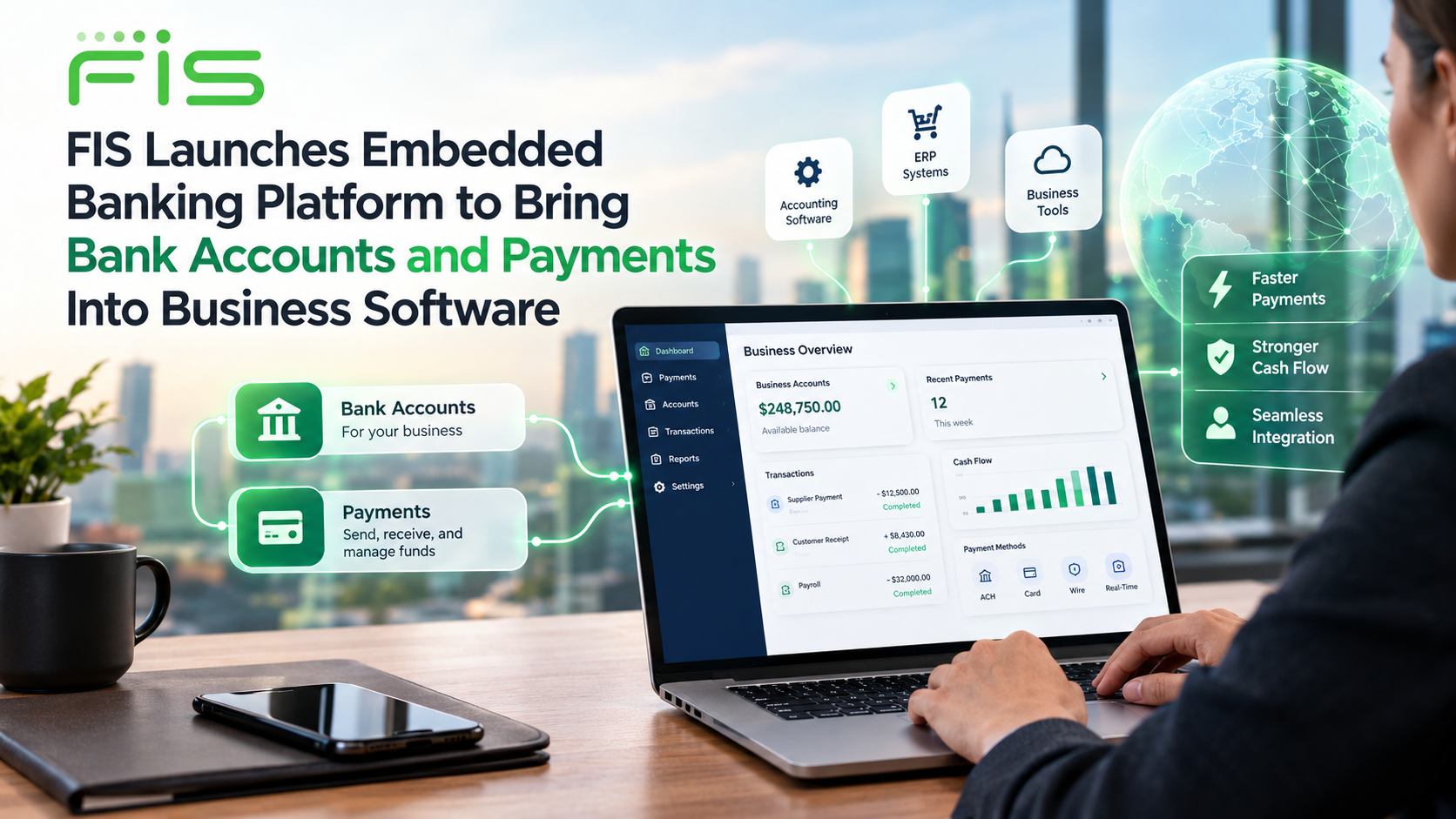
FIS has launched a new embedded banking platform that allows U.S. banks to offer accounts, payments, and other financial services directly inside the business software their corporate customers already use.
The move puts banks at the center of the embedded finance model while giving software providers a way to integrate banking services into accounting, operational, and financial workflows.
FIS said its new Embedded Banking Platform enables banks to provide accounts, card issuing, accounts receivable and payable, and expense management capabilities through software used by businesses every day.
The platform is launching with pilot banks, including Cogent Bank, Commercial Bank of California, and M&T Bank, with account and payment capabilities planned for the fourth quarter of 2026.
FIS Targets the Next Stage of Embedded Banking
Corporate banking has traditionally required businesses to move between accounting systems, enterprise software, and separate bank portals.
FIS wants to change that model by bringing banking directly into the software businesses already use to manage their operations.
Under the new platform, a bank partners with a vertical software provider or fintech. The software partner then embeds the bank’s account and payment capabilities into its own product.
The roles remain clearly separated.
The bank keeps the customer relationship and accounts, the software provider manages the user experience, and FIS supplies the underlying technology infrastructure.
This structure allows businesses to access banking services without leaving their existing software environment.
For example, account opening and money movement can become part of an accounting or business-management workflow rather than requiring users to open a separate banking portal.
Bank Accounts Stay on the Bank’s Balance Sheet
One of the most important features of the FIS model is where customer accounts sit.
FIS said accounts remain on the bank’s own balance sheet rather than on a third-party ledger. That allows banks to retain customer ownership and regulatory control while using software companies as a new distribution channel.
That distinction could matter as banks look for ways to participate in embedded finance without handing the core banking relationship to a fintech intermediary.
FIS argues that the structure can support a cleaner regulatory position and simpler compliance model compared with arrangements that depend on third-party ledgers.
The approach also gives banks greater control over the underlying financial relationship while allowing software companies to focus on the customer-facing experience.
APIs, SDKs, and White-Label Options
FIS is designing the platform to support different integration models.
Banks can make their capabilities available through APIs, software development kits, embeddable widgets, or white-labeled applications, depending on the requirements of the software provider.
That flexibility could make the platform relevant across different types of business software.
Accounting platforms, vertical SaaS providers, and fintech applications can potentially integrate banking functionality without requiring customers to leave their existing workflows.
For banks, the model also creates another route to reach business customers.
Rather than relying entirely on direct banking channels and sales teams, banks can distribute their services through software platforms that already have established relationships with businesses.
Pilot Banks Will Test the Model
FIS is starting with three pilot institutions: Cogent Bank, Commercial Bank of California, and M&T Bank.
Accounts and payments are planned for deployment in the fourth quarter of 2026.
The pilot phase will provide an early test of whether banks can use embedded distribution while maintaining control over customer relationships and regulatory responsibilities.
It will also show how software providers and banks divide responsibilities across the customer journey.
The involvement of M&T Bank alongside smaller institutions also gives FIS an opportunity to test the platform across different banking environments.
Why Embedded Banking Matters for Banks
Embedded finance has increasingly shifted financial services away from standalone banking interfaces and into the applications where customers already work.
For businesses, that can mean fewer systems to manage and less friction when moving money or accessing financial products.
For banks, however, the shift creates a strategic question: how can they participate in embedded finance without losing ownership of the customer relationship?
FIS is positioning its platform as one answer.
By keeping accounts on the bank’s balance sheet, the bank remains the financial institution behind the service. The software provider becomes the distribution and experience layer rather than the owner of the underlying banking relationship.
That could become increasingly important as more business software platforms add payments, accounts, expense management, and other financial capabilities.
FIS Expands Its Embedded Finance Strategy
The launch also fits into FIS’s broader push to modernize financial infrastructure.
In August, FIS launched Digital One Commercial in APAC, highlighting API-first architecture and direct connectivity with ERP and accounting platforms as part of its commercial banking strategy.
The company’s new Embedded Banking Platform takes that idea further by making the software environment itself part of the banking distribution model.
FIS is effectively betting that the future of business banking will not always involve customers visiting a bank website or application.
Instead, banking services could increasingly appear inside the tools businesses already use to invoice customers, manage expenses, reconcile accounts, and operate their companies.
Banks Could Become More Invisible—and More Central
The rise of embedded banking does not necessarily mean banks become less important.
In the FIS model, the opposite is true.
The bank can become less visible to the end user while remaining central to the underlying financial relationship. Software handles the interface, while the bank provides the regulated account and financial infrastructure.
That creates a different form of digital banking competition.
Banks may increasingly compete not only through their own applications, products, and branches, but also through the software ecosystems where businesses conduct their daily operations.
Jon Briggs, Global Head of Embedded Solutions and Money Movement at FIS, said customers want banking built into the software they use to run their businesses, while banks still need to maintain regulatory control and customer ownership.
What Comes Next
The next major milestone will be the planned Q4 2026 rollout of accounts and payments with FIS’s pilot banks.
The results could provide an important signal for the broader banking industry.
If banks can successfully distribute their services through vertical software while maintaining ownership of accounts and customer relationships, embedded banking could become a more attractive growth channel for traditional financial institutions.
For FIS, the opportunity is equally significant. Its platform puts the company between banks and the growing software ecosystems that are becoming financial distribution channels.
The broader shift is clear: business banking is moving closer to the workflows where companies actually operate.
FIS is betting that banks can move with it without giving up control of the financial relationship.
Comments
No comments yet. Be the first to share your thoughts.
Leave a comment