
Introduction
The financial industry is experiencing one of its most significant transformations since the emergence of digital banking. Blockchain technology, once associated primarily with cryptocurrencies, is now reshaping how real-world assets are owned, traded, and managed. At the center of this evolution is Real-World Asset (RWA) Tokenization, a concept that is attracting attention from banks, asset managers, fintech companies, and institutional investors worldwide.
Traditionally, assets such as real estate, bonds, commodities, artwork, and private equity investments have existed within conventional financial systems. These assets often involve complex ownership structures, lengthy settlement processes, and limited accessibility for smaller investors.
Real-World Asset (RWA) Tokenization aims to solve these challenges by converting ownership rights into digital tokens recorded on blockchain networks. This innovation has the potential to create more efficient, transparent, and accessible financial markets.
As the demand for digital financial infrastructure grows, RWA tokenization is emerging as one of the most promising developments in modern finance.
What Is Real-World Asset (RWA) Tokenization?
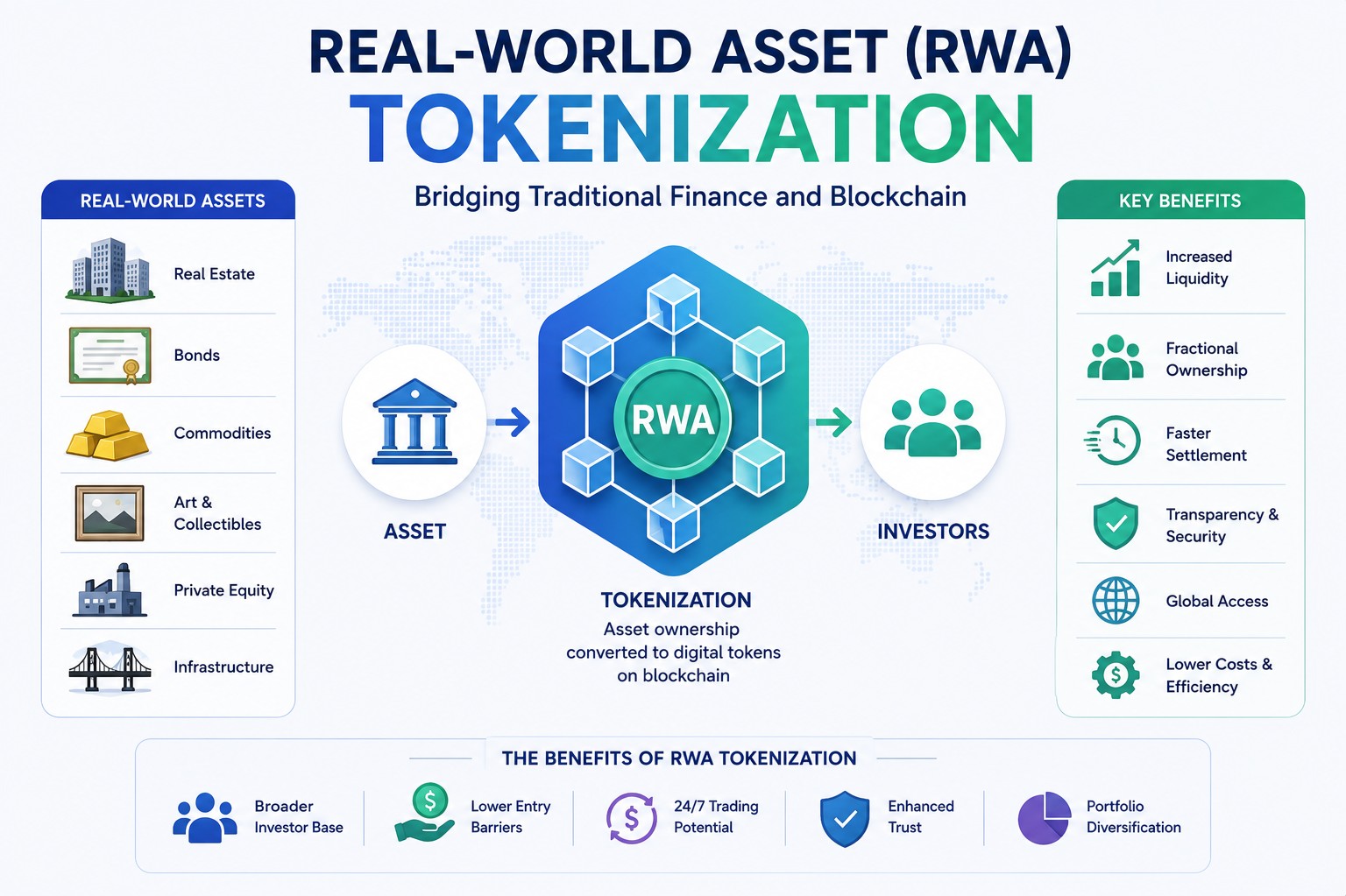
Real-World Asset (RWA) Tokenization refers to the process of representing ownership or economic rights of physical or traditional financial assets through blockchain-based digital tokens.
These tokens act as digital representations of underlying assets and can be transferred, traded, or managed on blockchain platforms.
Assets commonly tokenized include:
- Real estate
- Government bonds
- Corporate debt
- Commodities
- Precious metals
- Private equity
- Infrastructure investments
- Fine art and collectibles
The goal is to create a digital version of ownership while maintaining a connection to the real-world asset.
Why RWA Tokenization Is Gaining Attention
Traditional asset markets often suffer from inefficiencies.
Many investments require large capital commitments, involve extensive paperwork, and rely on intermediaries for settlement and administration. These limitations can restrict market participation and reduce liquidity.
RWA tokenization addresses these challenges by leveraging blockchain technology to create digital ownership structures that are easier to manage and transfer.
Investors, financial institutions, and regulators are increasingly exploring tokenization because it offers opportunities to improve market accessibility and operational efficiency.
As financial markets continue their digital transformation, tokenized assets are becoming an important area of innovation.
How Real-World Asset Tokenization Works
The tokenization process typically begins with identifying a physical or financial asset suitable for digital representation.
The asset is legally structured to support tokenized ownership, and blockchain-based tokens are issued to represent ownership rights or economic interests.
Once created, these tokens can be:
- Bought and sold
- Held by investors
- Transferred digitally
- Tracked transparently
- Managed through smart contracts
Blockchain technology provides an immutable record of ownership and transaction history, increasing transparency and reducing administrative complexity.
This process enables assets that were traditionally difficult to trade to become more accessible and liquid.
The Role of Blockchain Technology
Blockchain serves as the foundation for Real-World Asset (RWA) Tokenization.
Its decentralized ledger records transactions securely while providing transparency and traceability.
Several blockchain characteristics make tokenization attractive:
Transparency
Ownership records can be verified in real time.
Security
Cryptographic protections help secure asset ownership data.
Efficiency
Transactions can be processed faster than traditional settlement systems.
Automation
Smart contracts automate administrative processes and compliance requirements.
These advantages contribute to the growing interest in blockchain-based asset management.
Key Benefits of Real-World Asset Tokenization
One of the primary reasons organizations are exploring RWA tokenization is its potential to unlock new efficiencies within financial markets.
Major benefits include:
- Increased liquidity
- Fractional ownership opportunities
- Faster settlement
- Greater transparency
- Improved accessibility
- Reduced operational costs
- Enhanced market efficiency
- Expanded investment opportunities
These benefits have the potential to reshape how assets are issued, traded, and managed globally.
Fractional Ownership and Accessibility
Many traditional investments require significant capital commitments.
Commercial real estate, private equity funds, and infrastructure projects often remain inaccessible to smaller investors due to high entry barriers.
Real-World Asset (RWA) Tokenization enables fractional ownership by dividing assets into smaller digital units.
Investors can purchase portions of an asset rather than acquiring the entire investment.
This democratization of access opens opportunities for a broader range of market participants and creates more inclusive investment ecosystems.
Improving Liquidity in Traditionally Illiquid Markets
Liquidity is a major challenge for many asset classes.
Assets such as real estate and private investments often require lengthy sales processes, making them difficult to convert into cash quickly.
Tokenization can improve liquidity by enabling digital trading of ownership interests.
Instead of waiting months to complete transactions, investors may be able to buy and sell tokenized assets more efficiently through digital marketplaces.
Improved liquidity benefits both investors and asset issuers by increasing market activity and flexibility.
Real Estate and RWA Tokenization
Real estate is among the most widely discussed applications of Real-World Asset (RWA) Tokenization.
Property investments have traditionally involved substantial capital requirements, extensive legal processes, and limited liquidity.
Tokenization allows real estate ownership to be divided into digital shares that can be purchased by multiple investors.
Potential benefits include:
- Lower investment thresholds
- Increased liquidity
- Broader investor participation
- Simplified ownership management
These advantages are driving growing interest among real estate developers, investors, and financial institutions.
Institutional Adoption and Financial Markets
Institutional interest in RWA tokenization continues to grow.
Banks, asset managers, investment firms, and financial infrastructure providers are exploring tokenized versions of bonds, money market instruments, and other traditional assets.
Many institutions view tokenization as a way to modernize capital markets while improving operational efficiency.
Potential applications include:
- Tokenized government securities
- Corporate bonds
- Structured financial products
- Investment funds
- Treasury management solutions
As institutional participation increases, tokenization may become a significant component of future financial infrastructure.
Challenges Facing RWA Tokenization
Despite its potential, Real-World Asset (RWA) Tokenization faces several challenges.
Regulatory Uncertainty
Legal frameworks for tokenized assets continue to evolve across jurisdictions.
Custody and Ownership Rights
Clear ownership structures must be established to protect investor interests.
Market Infrastructure
Secondary trading platforms and settlement systems are still developing.
Technology Integration
Traditional financial systems must integrate effectively with blockchain environments.
Addressing these challenges will be essential for widespread adoption.
Compliance and Risk Management
Compliance remains a critical aspect of tokenized asset markets.
Financial institutions must ensure adherence to:
- Anti-money laundering regulations
- Know-your-customer requirements
- Securities laws
- Data protection standards
- Investor protection rules
Strong governance frameworks help build trust and support sustainable market development.
As regulators provide greater clarity, confidence in tokenized asset ecosystems is expected to increase.
The Future of Real-World Asset Tokenization
The future of Real-World Asset (RWA) Tokenization appears highly promising.
Industry analysts increasingly view tokenized assets as a major opportunity for financial modernization. Advances in blockchain infrastructure, smart contracts, digital identity solutions, and regulatory frameworks are accelerating market development.
Future trends may include:
- Tokenized financial products
- Blockchain-based securities markets
- Digital asset exchanges
- Automated compliance systems
- Cross-border tokenized investments
- Institutional-scale tokenization platforms
These developments could significantly transform global capital markets over the coming decade.
Conclusion
Real-World Asset (RWA) Tokenization is redefining how traditional assets are owned, managed, and traded. By bringing physical and financial assets onto blockchain networks, tokenization offers the potential for greater transparency, improved liquidity, faster settlements, and broader investor access.
While regulatory and operational challenges remain, the momentum behind tokenized assets continues to grow. Financial institutions, fintech companies, and investors increasingly recognize the opportunities created by blockchain-enabled ownership structures.
As digital finance evolves, Real-World Asset (RWA) Tokenization is positioned to become a cornerstone of the next generation of global financial infrastructure, connecting traditional markets with the efficiencies of blockchain technology.
Comments
No comments yet. Be the first to share your thoughts.
Leave a comment