
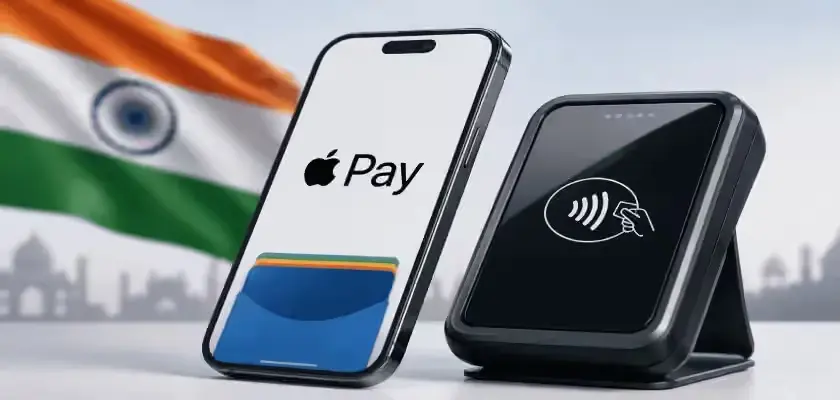
After years of on-and-off talk, Apple Pay might actually be coming to India next month. A Reuters report published September 18 says Apple is gearing up to launch the service in October 2026. Axis Bank will reportedly be its first banking partner.
Three sources familiar with the plans told Reuters the initial rollout will support Axis Bank credit cards. Apple is also working to bring more lenders on board over time. This would be a notable milestone.
Apple Pay already runs in dozens of markets worldwide, but India has been a conspicuous absence from the company’s official availability list. That’s despite years of reported talks with Indian banks.
Nothing here is official yet. Apple hasn’t confirmed a launch date. October remains a reported target based on sourcing, not a company announcement.
Starting small: cards first, more banks later
The first phase of the rollout will likely center entirely on card payments. Axis Bank credit cards are reportedly first in line. Apple has also been in talks with HDFC Bank and ICICI Bank, though nothing with either lender had been finalized as of the report.
That phased approach tracks with how Apple Pay typically enters new markets. The company launches with one solid banking partner, then expands the roster of issuers once the basic infrastructure works.
Apple says Apple Pay now has more than 11,000 bank and network partners and runs in 89 markets globally. Participating banks make eligible cards available through Apple Wallet. Apple supplies the tokenized payment infrastructure behind the contactless transactions. For Indian users, that would mean loading a supported card into Apple Wallet and paying via iPhone or Apple Watch.
The big open question: does UPI come along for the ride?
Here’s the part nobody’s confirmed yet. Will Apple Pay support India’s Unified Payments Interface, or UPI, right out of the gate?
Bloomberg’s Mark Gurman has reported that UPI support could arrive alongside card payments at launch. Several Indian tech outlets have picked that up and run with it. But Reuters’ September 18 reporting focused specifically on the Axis Bank card rollout. It stopped short of confirming UPI as part of the initial launch. So for now, UPI support sits in an odd spot. It’s plausible and reported, but not locked in.
That distinction matters a lot. UPI isn’t a nice-to-have in India’s payments landscape; it’s the backbone. Reuters has reported that UPI accounts for roughly 84% of India’s digital transaction volume. Launch without it, and Apple Pay becomes a card-payments product competing in a market that mostly runs on something else.
Launch with it, and Apple suddenly gets a much bigger footprint in everyday Indian digital payments.
Walking into a market that’s already crowded
India’s digital payments space isn’t exactly waiting around for Apple. PhonePe and Google Pay have built enormous UPI-based businesses. Paytm and a host of other fintechs already serve hundreds of millions of users between them.
Apple Pay’s edge, if it has one, comes from tighter integration with Apple’s own ecosystem. Think tokenized card storage in Wallet, device-based authentication, and the kind of seamless experience Apple users already expect on iPhone and Apple Watch. That’s likely to appeal most to people already living in the Apple ecosystem who prefer tapping a card over scanning a QR code.
Apple probably doesn’t need to unseat UPI to build something meaningful here. It could carve out a narrower lane focused on card payments and expand from there.
The tokenization model already fits India’s rules.
Apple Pay’s security model runs on tokenization. This process swaps out actual card details for a device-specific token, so merchants never see a user’s real card number during a transaction. That fits neatly with where India’s card infrastructure already stands.
The Reserve Bank of India has permitted card issuers and payment networks to offer tokenization services for a while now, with customer consent and added authentication layered on top.
India has also been expanding what counts as acceptable authentication for digital payments. The RBI released a framework for alternative authentication methods beyond the traditional SMS one-time password. That shift lines up well with how Apple has built much of its payment experience around device-based and biometric authentication.
A long time coming
This isn’t a new story. Talks between Apple and Indian banks have reportedly been going on for years. Axis Bank, HDFC Bank, and ICICI Bank have all been previously named as institutions in discussions, alongside Visa and Mastercard on the network side.
The timeline has slipped more than once. Earlier reporting pointed to a launch sometime in the first half of 2026, which obviously didn’t happen. October 2026 is simply the latest projected date, and it’s still unconfirmed by Apple.
The repeated delays likely reflect just how complicated it is to launch a global payments product inside India’s tightly regulated financial system. Apple has to coordinate with local banks, card networks, and payment infrastructure. At the same time, it needs to make sure its technology actually complies with local authentication and regulatory rules.
Why India is worth the wait for Apple
India is a big prize. It has a massive population, a fast-growing smartphone market, and one of the most active digital-payments ecosystems anywhere. It’s also become a genuinely important market for Apple itself.
Reuters reported that Apple’s smartphone market share in India has climbed to around 8% since 2022. That gives the company a real and growing base of iPhone users who could plug straight into Apple Pay once it launches.
That installed base matters because Apple Pay works best when it’s already sitting on the device people carry. The harder part is converting that device ownership into payment habits. Indian consumers are already deeply comfortable with QR codes, UPI apps, and instant bank transfers. Apple Pay will need to offer something genuinely more convenient to pull people over.
What it could mean for banks, networks, and fintechs
A launch like this ripples outward. Banks get another digital channel for their credit cards and a chance to boost contactless usage. Visa and Mastercard get another major wallet driving tokenized card transactions. Fintechs face one more competitor in an already crowded mobile-payments space.
How much any of that matters comes down to what Apple actually ships. A card-only launch keeps Apple Pay in a fairly narrow slice of India’s payments market. Add UPI, and the whole calculus changes. That’s why the eventual product configuration might end up mattering just as much as the launch date itself.
For now, October 2026 is a reported target, not a confirmed one. Apple hasn’t announced anything, and India still isn’t on its official Apple Pay availability list. But between the Axis Bank sourcing and the UPI speculation, the long-rumored arrival finally looks like it’s getting close.
Whatever shape it takes, Apple Pay’s entry into India will be a real test. It will show how well its global payments playbook holds up in one of the world’s most distinctive digital-payment markets.
Comments
No comments yet. Be the first to share your thoughts.
Leave a comment