
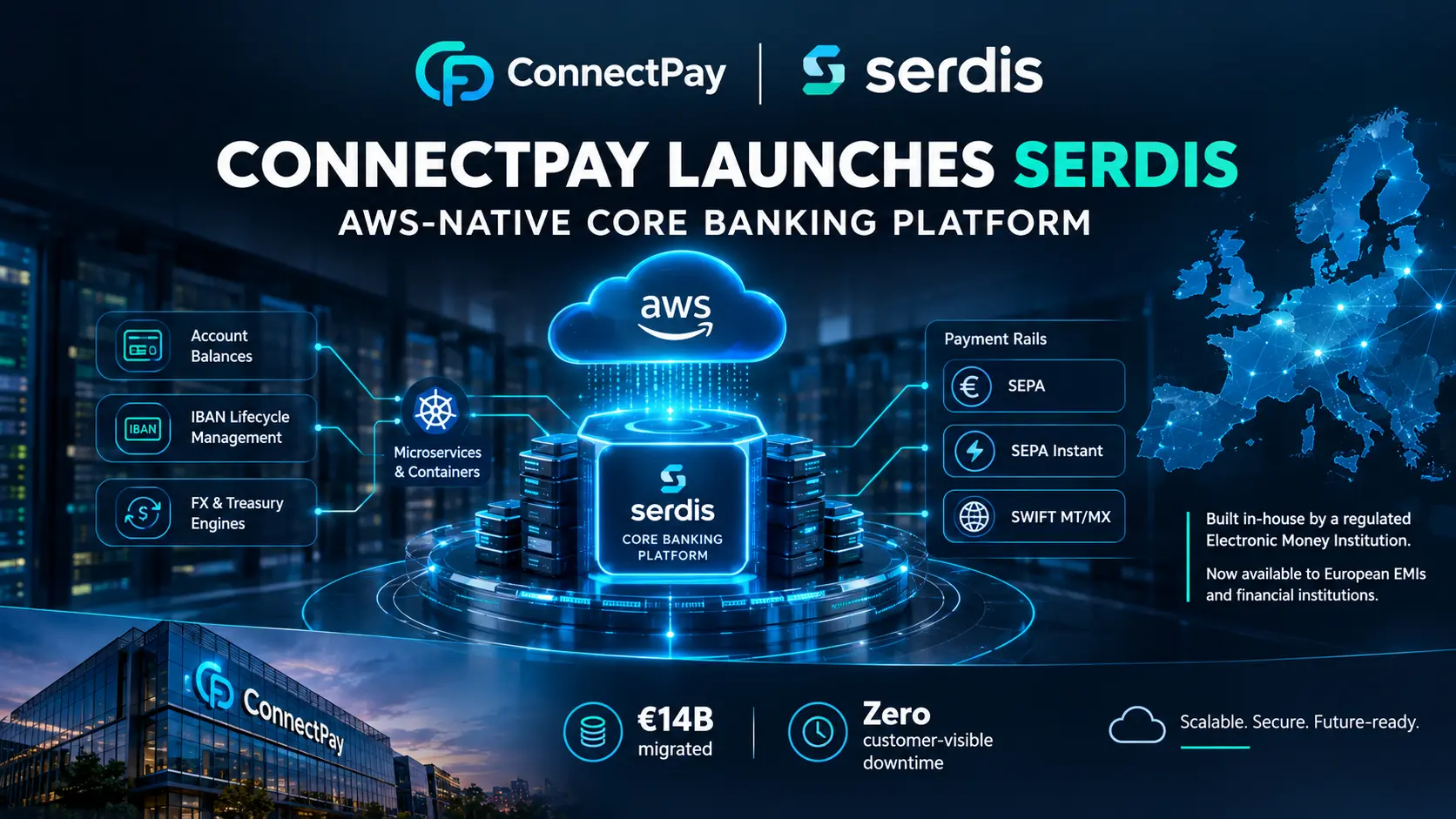
ConnectPay has launched Serdis, an AWS-native core banking platform designed for European electronic money institutions (EMIs) and financial institutions seeking greater control over their banking infrastructure.
ConnectPay originally developed the platform as an internal project called “Mars.” It aimed to reduce the company’s dependence on third-party core banking systems and give ConnectPay greater control over its technology, operations, and product development.
In July 2025, Serdis took over ConnectPay’s entire live operations. The migration involved approximately €14 billion in annual transaction volume, which was moved over a single weekend with zero customer-visible downtime.
Following that internal deployment, ConnectPay has now made Serdis available to the wider financial services market.
Serdis Was Built by a Regulated Financial Operator
ConnectPay says Serdis was developed by a regulated EMI and tested under real operating conditions. This includes the practical demands of managing safeguarding accounts, processing transactions, completing regulatory reporting, and maintaining relationships with financial authorities.
The company argues that this operator-led approach distinguishes Serdis from core banking platforms developed primarily by technology vendors.
“Most core banking platforms are engineered by developers who have never had to manage a safeguarding account, file a regulatory report, or answer to a central bank,” said Marius Galdikas, founder and CEO of ConnectPay. “Serdis was built to run, not sell.”
According to ConnectPay, compliance and operational improvements developed through its own experience can be incorporated directly into Serdis for future clients.
Core Banking Infrastructure Built on AWS
Serdis operates on a distributed microservices architecture deployed through Amazon Web Services Elastic Kubernetes Service (AWS EKS).
The platform combines core banking, account management, payment processing, and treasury functionality within one infrastructure layer.
Its capabilities include:
- A tree-based general ledger
- Real-time account balances
- Automated IBAN lifecycle management
- Foreign-exchange and treasury engines
- Native SEPA payments
- SEPA Instant connectivity
- SWIFT MT and MX support
- Pre-integrated white-label web and mobile banking front-ends
These features are designed to support financial institutions managing balances, accounts, payment flows, settlement, liquidity, and customer-facing banking services.
Nine-Month Parallel Testing Before Migration
ConnectPay says it ran Serdis in parallel with its legacy core banking provider for nine months before completing the final migration.
The parallel deployment allowed the team to identify and resolve reconciliation risks before the platform became the company’s primary operational system. This was particularly important because core banking infrastructure acts as the central source of truth for account balances and transactions.
“Core banking is the single source of truth for every balance and transaction,” said Tadas Bakutis, CTO of ConnectPay and technical architect of the migration.
“By designing, building, and migrating to this core ourselves, we proved a financial institution can reclaim its technical freedom without disrupting its users,” Bakutis added.
ConnectPay says the final migration transferred €14 billion in annual transaction volume during one weekend without customer-visible downtime.
Addressing Legacy Core Banking Dependency
The launch of Serdis comes as financial institutions reassess the resilience, flexibility, and long-term costs of legacy core banking systems.
ConnectPay cites industry research indicating that approximately 70% of Tier 1 banks continue to operate on legacy core systems. The company also points to growing regulatory scrutiny of third-party technology dependencies and operational resilience under the European Union’s Digital Operational Resilience Act (DORA).
DORA places greater emphasis on ICT risk management, business continuity, incident reporting, and oversight of technology service providers supporting financial institutions.
Against this backdrop, Serdis is positioned as a platform for institutions seeking greater ownership of their infrastructure, data, uptime, and technology roadmap.
“We want a European fintech ecosystem built on resilient infrastructure institutions actually own, rather than dependencies they rent,” Galdikas said.
Acquisition and Commercialization Strategy
ConnectPay’s approach is to commercialize technology that it first developed and operated internally.
The company’s own migration provides a practical reference point for financial institutions considering a move away from third-party core banking providers. Rather than presenting migration as a purely technical deployment, ConnectPay places emphasis on data mapping, reconciliation, operational continuity, and risk management before cutover.
Serdis is designed to inherit and map a legacy system’s data model, helping institutions address reconciliation issues before migration is completed.
The platform is now available to European EMIs and financial institutions seeking to modernize their core banking infrastructure while retaining greater control over their operating environment.
Deployment and Source-Code Ownership
Serdis is deployed within the client’s own AWS environment. ConnectPay says this model gives institutions more control over their infrastructure and operational setup.
The platform also includes a contractual source-code buyout option, providing clients with a potential route to greater technology ownership beyond a conventional vendor relationship.
This structure is intended to appeal to financial institutions that want the benefits of a modern core banking platform without creating another long-term dependency on an external technology provider.
What Does the Name Serdis Mean?
The name Serdis comes from the Lithuanian word “šerdis,” meaning “core.”
The name reflects the platform’s role as the central infrastructure layer supporting financial accounts, balances, payments, settlement, and banking operations.
The Next Phase of European Banking Infrastructure
ConnectPay’s launch reflects a broader shift in financial services technology. Regulated financial institutions are increasingly looking to modernize legacy systems, improve operational resilience, and reduce reliance on fragmented third-party infrastructure.
By building Serdis for its own regulated operations before offering it commercially, ConnectPay is positioning the platform around practical banking experience rather than software functionality alone.
For European EMIs and financial institutions, the key question will be whether platforms such as Serdis can provide a smoother migration path while delivering the flexibility, resilience, and regulatory control required in a rapidly changing financial services environment.
ConnectPay Spins Off Serdis: The €14B Core Banking Platform Built by an EMI for EMIs
Comments
No comments yet. Be the first to share your thoughts.
Leave a comment