
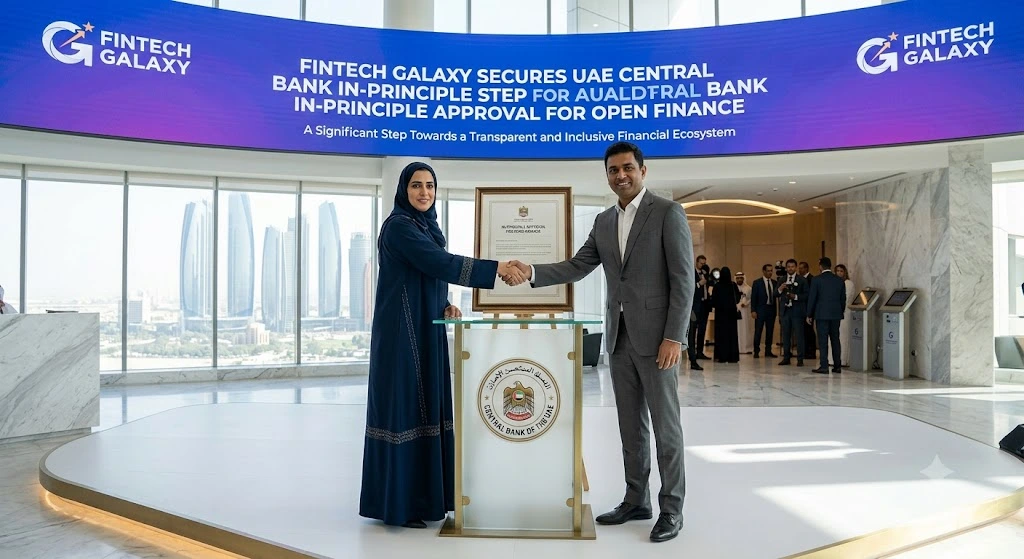
Fintech Galaxy Secures UAE Central Bank In-Principle Approval for Open Finance
Fintech Galaxy has secured In-Principle Approval (IPA) from the Central Bank of the United Arab Emirates (CBUAE) to operate as an Open Finance provider in the UAE, marking a significant step in the fintech company’s expansion within the country’s regulated financial-data ecosystem.
The approval, announced by Fintech Galaxy on August 20, allows the company to participate in Al Tareq, the UAE’s Open Finance scheme. The framework provides a regulated environment for consent-based financial data sharing and financial-service initiation.
However, the regulatory milestone does not represent a full Open Finance licence. Fintech Galaxy says its broader platform and planned services will be delivered once it is fully licensed. That distinction is important as the company moves from regulatory approval in principle toward operational readiness.
CBUAE Opens Another Path for Fintech Galaxy
Fintech Galaxy’s IPA places the company among the home-grown UAE fintechs to reach this stage of the Open Finance licensing process, according to the company’s announcement. Its participation in Al Tareq will allow it to operate within the UAE’s regulated Open Finance infrastructure once the remaining licensing requirements are completed.
The development comes as the UAE continues to build out a more connected digital financial system.
The CBUAE’s 2025 annual report says Al Tareq went live in 2025. The centralised infrastructure supports Open Finance services, with banks and third-party providers meeting regulatory operational requirements to use Open Banking APIs.
The central bank has continued to highlight the expansion of Al Tareq as part of its broader financial infrastructure transformation agenda. In April 2026, the CBUAE said work was progressing on expanding the services offered through the Open Finance platform.
What Fintech Galaxy’s Approval Covers
The IPA enables Fintech Galaxy to participate in Al Tareq, which is designed around secure, consent-based financial data sharing and service initiation.
For the company, that creates a regulatory foundation for combining Open Finance connectivity with its existing fintech infrastructure and planned AI capabilities.
Fintech Galaxy says its strategy is to connect financial data with AI-powered financial intelligence. The company also plans to develop digital business-finance solutions for financial institutions, fintechs and businesses.
The company’s announcement describes Open Finance as an infrastructure layer for areas including financial-data connectivity, embedded financial services, payment initiation and AI-driven financial intelligence.
Still, these should be treated as planned capabilities, rather than services that the IPA itself confirms are already live.
SME Finance Is a Major Focus
Small and medium-sized businesses are expected to be a key target for Fintech Galaxy’s next phase.
The company is developing a Business Financial Management platform designed to bring several financial functions into a single experience. These include:
- Banking
- Invoicing
- Payments
- Reconciliation
- Cash-flow management
- Embedded financing
Fintech Galaxy says the platform is intended to help SMEs automate financial operations, improve liquidity management and make better financial decisions.
The approach reflects a broader shift in fintech toward combining financial connectivity with operational tools.
Rather than treating Open Finance simply as a mechanism for accessing account data, Fintech Galaxy wants to use connected data as the foundation for financial-management and intelligence products.
That could be particularly relevant for SMEs, where banking, invoicing, payments and cash-flow management often remain fragmented across multiple platforms.
AI and Open Finance Move Closer Together
Fintech Galaxy is also positioning artificial intelligence as part of its Open Finance strategy.
The company says its planned platform will combine secure Open Finance connectivity, AI-powered financial intelligence and digital business-finance solutions. The objective is to turn connected financial information into actionable insights and automated financial workflows.
That strategy places Fintech Galaxy at the intersection of two major fintech trends.
The first is the development of regulated Open Finance infrastructure. The second is the growing use of AI to analyse financial information and support business decision-making.
For financial institutions, this combination could create new ways to deliver personalised financial services. For fintech companies, it could also provide a regulated route to build applications around financial data and service initiation.
However, the commercial opportunity will depend on the final regulatory scope, integrations and operational readiness of the platform.
UAE Builds Out Its Open Finance Infrastructure
Fintech Galaxy’s approval arrives as the UAE continues to develop its national financial infrastructure.
The CBUAE has placed Al Tareq within its broader financial infrastructure transformation programme. Its 2025 annual report identifies Open Finance alongside initiatives such as the Digital Dirham, Jisr and domestic financial-market infrastructure.
The central bank has also continued to discuss the expansion of Al Tareq during 2026.
In April, the CBUAE said financial institutions were progressing with the implementation of its major digitalisation initiatives, including the expansion of services available through Al Tareq.
This creates an increasingly important environment for regulated third-party providers.
As more financial institutions connect to Open Finance infrastructure, providers can potentially build services that rely on consented access to financial information and authorised service initiation.
For the UAE, the broader objective is to create a more connected financial ecosystem while keeping data access within a regulated framework.
Why the IPA Matters for UAE Fintech
The approval is significant because it moves Fintech Galaxy further into the regulated side of the UAE’s Open Finance market.
Open Finance requires more than technical API connectivity. Providers must operate within defined regulatory and security requirements, particularly when they handle sensitive financial information or initiate financial services.
The IPA therefore represents a regulatory milestone rather than simply a technology announcement.
It also gives Fintech Galaxy a clearer path toward expanding its Open Finance infrastructure in one of the Middle East’s most active fintech markets.
FinTech Futures reported on August 25 that the company is seeking full approval from the CBUAE but has not provided a timeline for obtaining that authorisation.
The Paypers likewise reported that Fintech Galaxy had received in-principle approval and linked the development to its participation in Al Tareq.
The Full Licence Is Still the Next Milestone
For customers, banks and fintech partners, the distinction between IPA and full licensing remains important.
Fintech Galaxy itself states that its integrated Open Finance and AI-powered platform will come once fully licensed. The company has not announced that the full licence has already been granted.
That means the latest development should be viewed as progress through the UAE regulatory process rather than confirmation of a fully operational Open Finance service.
The next stage will involve completing the remaining licensing requirements and moving toward operational deployment.
Only after full licensing and the relevant operational steps are completed will the market be able to assess the final scope of Fintech Galaxy’s UAE Open Finance services.
What the Development Means for SMEs and Financial Institutions
For SMEs, the potential benefit lies in bringing fragmented financial tasks closer together.
A platform that combines banking information, payments, invoices, reconciliation and cash-flow management could reduce the need to move between separate systems. AI could then provide additional analysis or automation based on connected financial information.
For banks and other financial institutions, the opportunity is different.
Open Finance providers can become part of a broader ecosystem through which financial institutions expose services and data through regulated interfaces. That can support new customer experiences and partnerships without requiring every institution to build every financial application internally.
Fintech Galaxy says it wants to work with financial institutions, fintechs and ecosystem partners as the UAE’s Open Finance market develops.
The commercial impact, however, will depend on execution, regulatory permissions and the depth of institutional connectivity.
Fintech Galaxy’s Regional Expansion
The UAE approval also adds to Fintech Galaxy’s wider regional regulatory footprint.
A recent statement from the MENA Fintech Association said the company already holds an Open Finance licence from the Central Bank of Bahrain and is progressing through the Central Bank of Jordan’s regulatory sandbox.
That gives the company experience across multiple regulatory environments as Open Finance develops across the Middle East.
The UAE remains particularly important because of the scale of its financial sector and the CBUAE’s broader push to modernise financial infrastructure.
For Fintech Galaxy, obtaining full UAE authorisation would therefore represent more than another market entry. It would add a major regulated market to its regional Open Finance strategy.
What Happens Next
The immediate priority is clear: Fintech Galaxy must move from in-principle approval toward full licensing.
Once that process is complete, the company plans to advance its integrated Open Finance and AI-powered financial platform. SMEs are expected to remain a central target, with banking, invoicing, payments, reconciliation, cash-flow management and embedded financing forming the core of the proposed business-finance experience.
Meanwhile, the UAE’s wider Open Finance ecosystem will continue to develop through Al Tareq.
The CBUAE’s progress on the platform suggests that Open Finance is becoming part of the country’s broader financial infrastructure rather than remaining a standalone fintech experiment.
Conclusion
Fintech Galaxy’s In-Principle Approval from the CBUAE represents an important step in the company’s push into regulated Open Finance in the UAE.
The approval enables participation in Al Tareq, the country’s Open Finance scheme, and provides a regulatory path for Fintech Galaxy to combine financial-data connectivity with AI-powered financial intelligence and digital business-finance tools.
For SMEs, the company’s planned platform could eventually bring banking, payments, invoicing, reconciliation and cash-flow management into a more integrated financial workflow.
However, the regulatory status must remain clear. Fintech Galaxy has not received a full Open Finance licence yet. The company still needs to complete the licensing process before its planned integrated platform can move into its fully licensed operating phase.
As the UAE expands Al Tareq and builds out its digital financial infrastructure, Fintech Galaxy’s progress will be worth watching. The next major milestone will be full CBUAE authorisation and the transition from regulatory approval in principle to operational Open Finance services.
Comments
No comments yet. Be the first to share your thoughts.
Leave a comment