
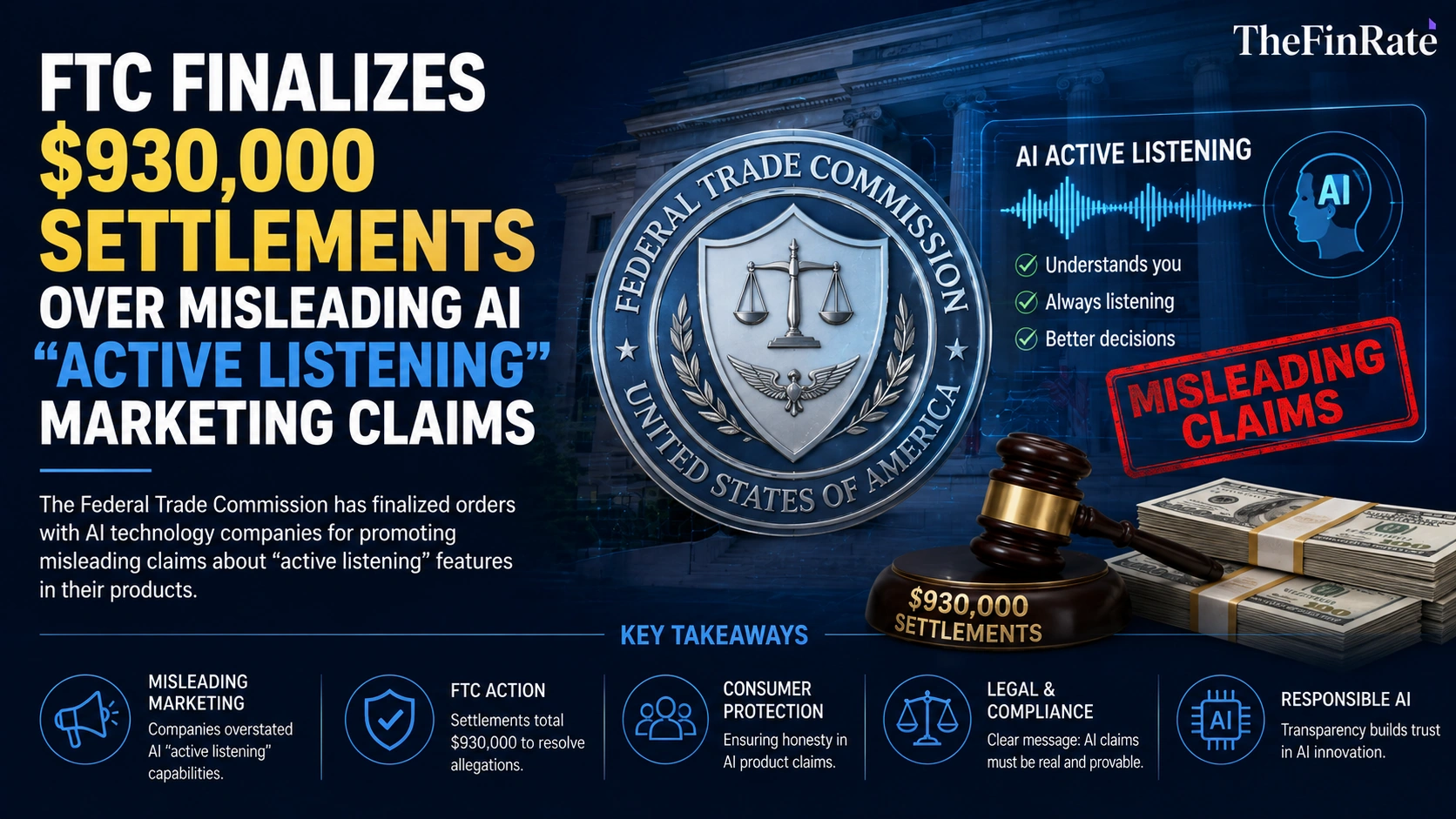
FTC Finalizes $930,000 Settlements Over Misleading AI “Active Listening” Marketing Claims
The U.S. Federal Trade Commission (FTC) has finalized orders requiring Cox Media Group and two marketing firms to pay a combined $930,000 to settle allegations that they misled customers about an AI-powered advertising service marketed as “active listening.”
The companies allegedly claimed that their technology could identify relevant conversations captured through consumers’ smart devices and use that information to deliver geographically targeted advertising.
According to the FTC, however, the service was not actually based on voice data, and consumers had not opted into the alleged voice-based targeting.
The case highlights growing regulatory scrutiny around artificial intelligence, consumer data and advertising claims, particularly when companies describe technology as capable of monitoring or analyzing highly sensitive information.
Cox Media Group Faces $880,000 Settlement
The FTC finalized three separate orders involving CMG Media Corporation, doing business as Cox Media Group (CMG), New Hampshire-based MindSift LLC, and Wisconsin-based 1010 Digital Works LLC.
Under the final orders, CMG will pay $880,000, while MindSift and 1010 Digital Works will each pay $25,000.
The combined $930,000 will be used to provide redress to CMG customers affected by the practices described in the FTC’s complaints.
The companies are also prohibited from making misleading representations about their advertising and marketing services.
That includes claims concerning the collection, use or disclosure of voice data, whether consumers have provided consent, and the geographic targeting capabilities of their services.
What the FTC Alleged About “Active Listening”
The FTC said the companies promoted a marketing service using claims that a special algorithm could listen for and identify relevant conversations from consumers’ smart devices.
The alleged purpose was to use those insights to target advertisements to consumers within particular geographic areas.
The regulator said those representations were deceptive because the marketing service did not rely on voice data as claimed.
The FTC also said consumers had not opted into the service.
That distinction is important because the regulator noted that if the service had actually operated as described—collecting and using consumers’ voice data without adequate consent—the conduct could itself have violated the FTC Act.
The case therefore involves two separate concerns: whether the technology worked as represented and whether consumers had meaningfully consented to the collection and use of their information.
FTC Finalizes Three Separate Orders
The enforcement action involves three companies that worked together in connection with the marketing service.
| Company | Settlement amount | Key requirement |
|---|---|---|
| Cox Media Group | $880,000 | Pay redress and comply with restrictions on marketing claims |
| MindSift | $25,000 | Pay settlement and comply with restrictions |
| 1010 Digital Works | $25,000 | Pay settlement and comply with restrictions |
| Total | $930,000 | Final FTC orders |
The final orders prohibit each defendant from making misrepresentations about the qualities or features of advertising and marketing services.
They also specifically address claims involving voice-data collection and use, consumer consent and geographic targeting.
A Broader Warning for AI-Powered Advertising
The enforcement action comes as advertisers and technology companies increasingly use AI and data analytics to personalize marketing.
AI can help companies identify customer segments, predict behavior, and automate campaign targeting.
But the technology also creates a difficult transparency challenge.
Consumers may not always understand what information is being collected, how it is being analyzed or whether it is being used to influence the advertising they see.
Claims that imply a device is listening to private conversations can raise an especially high level of concern.
The FTC’s action demonstrates that companies cannot simply rely on the sophistication of AI terminology to support marketing claims.
If a business says its technology can collect, analyze or act on a particular type of consumer data, those representations need to be accurate and properly supported.
Consumer Consent Remains a Critical Issue
Consent is another major element of the case.
According to the FTC, consumers had not opted into the voice-data targeting described in the companies’ marketing claims.
For businesses deploying AI-based advertising technologies, obtaining appropriate consent is therefore not simply a technical or legal checkbox.
It is part of the broader relationship between companies and consumers.
Consumers need to understand what data is being collected and how it will be used, particularly when the information could reveal sensitive aspects of their lives.
The case reinforces the importance of clear disclosures and accurate representations around data practices.
What the Final Orders Require
Beyond the financial payments, the FTC’s orders impose restrictions on how the companies can describe their marketing services.
The defendants cannot make misleading claims about:
- The qualities or features of their advertising and marketing services
- The collection, use or disclosure of voice data
- Whether consumers have provided consent for voice-data collection or use
- The geographic targeting capabilities of their services
The financial penalties are therefore only one part of the enforcement action.
The restrictions are designed to prevent similar representations from being made in the future.
FTC Vote Gives Final Approval
The FTC initially announced the three complaints in May 2026.
Following the proposed settlement orders, the Commission received two comments before voting 2-0 to give final approval to the consent agreements.
The finalization turns the proposed settlements into formal FTC orders governing the companies’ conduct.
The case adds to the growing body of regulatory activity surrounding AI, advertising, privacy and consumer protection.
Why This Matters for Fintech and Financial Services
Although the case centers on advertising technology rather than a financial product, its implications extend into fintech and financial services.
Banks, fintech companies, lenders and payment providers increasingly use AI to personalize offers, assess customer behavior and automate marketing.
These applications often depend on large amounts of customer data.
The FTC’s action highlights an important principle for financial institutions: AI-driven personalization does not remove the need for accurate disclosures, appropriate consent, and responsible data governance.
A financial company that claims its AI system analyzes customer information in a particular way needs to ensure that the claim reflects how the system actually operates.
This becomes even more important as financial institutions deploy AI across mobile banking, customer service, fraud prevention, and product recommendations.
AI Transparency Is Becoming a Business Requirement
The broader lesson from the FTC case is that AI transparency is increasingly becoming a business requirement, not merely a technology issue.
Companies may use sophisticated algorithms behind the scenes, but consumers still need understandable information about what those systems do.
Marketing language that exaggerates AI capabilities can create regulatory exposure.
For companies building or selling AI-powered products, that means marketing, legal, compliance and technology teams need to work together before making claims about how a system collects or uses data.
The risks can be particularly significant when claims involve microphones, smart devices, voice data or other potentially sensitive information.
The Road Ahead for AI Advertising
AI-powered advertising is likely to continue expanding as businesses search for more precise ways to reach customers.
At the same time, regulators are paying closer attention to whether companies accurately describe their technology and respect consumer privacy.
The FTC’s final orders send a straightforward message: companies need to be able to substantiate their AI claims.
Calling a service “AI-powered” or describing it as capable of listening to conversations does not remove the obligation to ensure that the underlying technology and data practices match those representations.
For consumers, the case also underlines the importance of understanding how personal data may be used in digital advertising.
Final Thoughts
The FTC’s $930,000 settlement involving Cox Media Group, MindSift and 1010 Digital Works is another reminder that the rapid development of AI is happening alongside an equally important evolution in consumer-protection oversight.
The regulator alleged that the companies misrepresented how their advertising technology worked and whether consumers had consented to voice-data targeting.
The final orders now prohibit the companies from making similar misleading claims.
For the wider technology and fintech industries, the takeaway is clear:
AI innovation needs to be matched by transparency, accurate marketing and responsible data practices.
As AI becomes more deeply embedded in advertising, banking and financial services, companies will need to prove not only that their technology works—but that they are telling customers the truth about what it does.
Comments
No comments yet. Be the first to share your thoughts.
Leave a comment