
Kraken Launches Multi-Asset Crypto Debit Card in the US
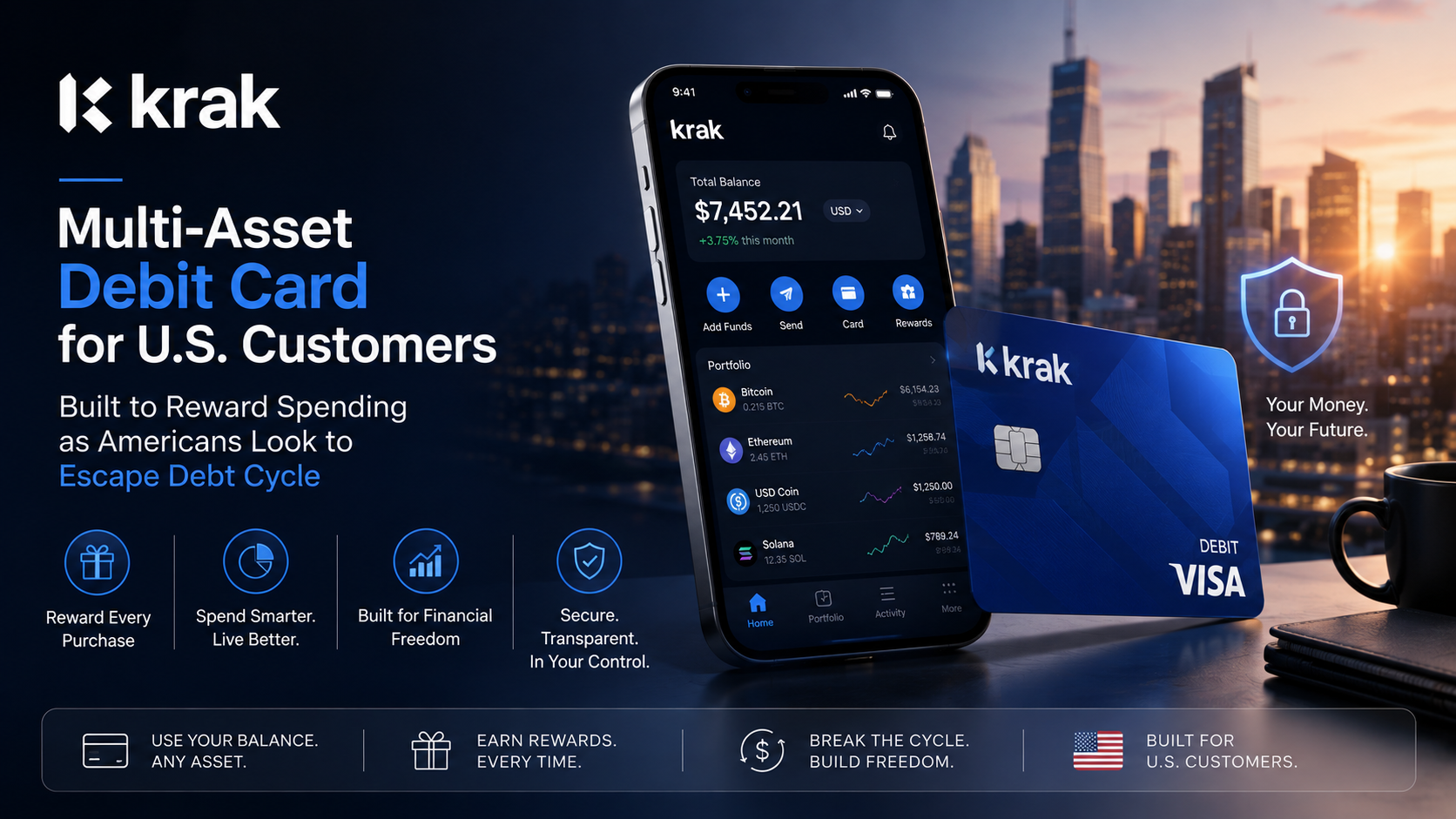
Kraken has launched its Krak Card in the United States, giving eligible customers a new way to spend crypto and traditional currencies through a single debit card. The card supports more than 600 currencies and assets, converts selected balances into U.S. dollars at checkout and offers up to 2% cashback in either USD or Bitcoin.
The launch expands Kraken’s push beyond crypto trading and into everyday financial services. Available through the Krak app in both virtual and physical formats, the card is designed to let users turn a broad range of digital and traditional holdings into spending power without first moving funds into a separate bank account.
The U.S. rollout follows Krak’s expansion across the UK and European Economic Area. Kraken says more than 135,000 multi-asset cards have been issued across those markets since December 2025.
Kraken Brings the Krak Card to American Consumers
The U.S. launch marks an important step for Kraken’s consumer payments strategy. The company has increasingly positioned Krak as a broader money app rather than simply an extension of its cryptocurrency exchange.
The new card allows eligible U.S. customers to hold and spend value across more than 600 currencies and assets. These include fiat currencies and cryptoassets. At the point of purchase, selected balances are converted into U.S. dollars to settle the transaction.
Customers can also decide which balances should be used first. That gives cardholders more control over whether they spend cash, crypto or another supported asset.
The Krak support center confirms that the card is currently available to individual clients in the U.S., UK and EEA.
One Card Can Draw From Multiple Balances
One of the more distinctive features of the Krak Card is its multi-balance spending model.
A customer does not necessarily have to fund an entire purchase from one currency or asset. According to Krak, a single transaction can draw from multiple balances, with each balance converted into U.S. dollars in real time.
For example, a $100 purchase could theoretically be funded with $80 from a dollar balance and the remaining $20 from another currency or cryptoasset.
Users can establish a spending priority and block particular assets from being used. That means someone holding Bitcoin as a long-term investment could choose to leave BTC outside the spending order while using dollars or another balance for everyday purchases.
This distinction is important for crypto users. Instead of automatically liquidating whatever asset is available, the card gives customers greater control over which holdings become spending funds.
Up to 2% Cashback Paid in Dollars or Bitcoin
Rewards are another central part of the U.S. launch.
The Krak Card offers up to 2% cashback on eligible everyday spending. Customers can receive rewards in U.S. dollars or choose Bitcoin instead. Unlike traditional card rewards programs built around points, miles or gift cards, Krak says the cashback is delivered as money.
The maximum cashback rate depends on the value of assets held across Krak, Kraken and Kraken Pro, while geographic restrictions and other eligibility conditions apply.
That structure connects the card’s rewards program to the broader Kraken ecosystem. Customers who hold more assets across the company’s platforms can qualify for higher reward tiers.
The model also reflects a wider shift in the payments market. Debit cards traditionally provide access to existing funds but often offer fewer rewards than credit cards. Krak is attempting to close that gap without requiring customers to borrow.
Kraken Targets Consumers Looking for Rewards Without Debt
Krak’s U.S. launch is accompanied by consumer research commissioned by the company.
A Morning Consult survey of 2,001 U.S. adults conducted from July 2 to July 5 found that 63% said they felt financially behind compared with where they expected to be at their age. The survey also found that 60% would consider switching to a debit card offering meaningful rewards without requiring them to take on debt.
The research also highlighted frustration with existing rewards programs. Krak reported that 64% of credit card holders surveyed were frustrated with their rewards programs.
These findings are company-commissioned research, rather than an independent assessment of the U.S. payments market. Still, they help explain the positioning behind the product.
Arjun Sethi, Co-CEO of Payward, said the Krak Card is designed to turn assets customers already hold into spendable money while returning rewards as cash rather than points.
Stripe and Visa Power the U.S. Card
The U.S. product is being built with established payments infrastructure.
Krak says the card is powered by Stripe and Visa, while Lead Bank issues the card under a Visa license. That gives the product access to Visa’s merchant acceptance network.
This infrastructure is important because the card’s value depends partly on making crypto and multi-currency balances usable at ordinary merchants.
Rather than requiring merchants to accept cryptocurrency directly, Krak handles the conversion process before the transaction settles. The merchant therefore interacts with a conventional card payment while the customer chooses which assets fund the purchase.
The model represents one of the more practical ways for crypto platforms to connect digital assets with existing payment infrastructure.
The U.S. Rollout Has Geographic Restrictions
Although Krak has launched the card in the United States, availability is not nationwide.
According to the launch disclosure, the card is available to eligible U.S. residents but is not available in New York, Maine, Massachusetts and Indiana. Other eligibility and geographic restrictions may also apply.
Krak’s support documentation also confirms that customers must be eligible individual clients to access the card.
The distinction is worth noting because the phrase “U.S. launch” does not mean that every American consumer can immediately obtain the card.
Crypto Spending Can Have Tax Implications
The convenience of spending crypto through a debit card does not eliminate the underlying tax considerations.
When a cryptoasset is converted into U.S. dollars to fund a purchase, that conversion can potentially create a taxable event. Krak explicitly warns customers that spending crypto may create capital gains or losses and recommends consulting a tax adviser regarding individual circumstances.
That issue separates crypto debit cards from conventional debit products.
A customer spending dollars from a bank account generally does not have to consider whether the payment itself represents a disposal of an appreciating investment. With crypto, converting an asset into fiat at checkout can have tax consequences depending on the user’s circumstances.
As a result, the ability to spend hundreds of assets does not necessarily mean every asset is equally suitable for everyday purchases.
From Crypto Exchange to Broader Financial Platform
The card launch fits into Kraken’s broader expansion beyond cryptocurrency trading.
The company has been building Krak as a global money app, with features covering payments, balances, rewards and other financial services. Kraken’s July launch of its card in the UK and EEA described the product as a way to connect crypto and cash balances with everyday spending.
The international rollout provides an early indication of the strategy’s traction. Kraken says more than 135,000 multi-asset Krak cards have been issued in the UK and EEA since December 2025.
The U.S. market is potentially much larger, but it is also more competitive. Consumers already have access to established debit, credit, fintech and digital-wallet products.
Krak therefore needs to convince users that multi-asset spending offers a meaningful advantage over simply using a traditional bank account or a conventional rewards card.
What the Launch Means for Crypto Payments
The U.S. launch illustrates how crypto companies are increasingly focusing on the payment experience rather than simply cryptocurrency trading.
For consumers, the important change is not necessarily that merchants can accept crypto. Most merchants do not need to handle crypto directly.
Instead, the crypto platform handles the conversion behind the scenes. Customers can hold digital assets while paying through familiar card infrastructure.
That approach could make crypto more practical for everyday financial activity. At the same time, it keeps traditional payment networks at the center of the transaction.
The development also reflects growing competition among crypto platforms to become broader financial hubs. Exchanges are increasingly combining trading, payments, rewards, custody and other financial services within a single ecosystem.
What Comes Next for Krak
Krak says the U.S. card is part of a wider financial offering that includes peer-to-peer payments, opportunities to earn on assets and travel-related rewards through Krak Concierge. The company also plans to expand its multi-asset card and broader account features into additional markets.
For now, the U.S. launch gives Kraken another entry point into consumers’ everyday financial lives.
The biggest test will be whether users actually want to spend crypto and other assets through a card frequently, rather than simply viewing the feature as an additional option within their exchange account.
If adoption grows, the Krak Card could strengthen Kraken’s position as a broader digital-finance platform. It could also add pressure on traditional banks and fintech companies to offer more flexible rewards and multi-currency spending options.
Conclusion
Kraken’s U.S. launch of the Krak Card brings crypto and traditional currencies closer to everyday card payments. With support for more than 600 assets, multi-balance transactions, real-time conversion and up to 2% cashback, the product is designed to make a wide range of holdings spendable through familiar payment infrastructure.
The launch also marks another stage in Kraken’s evolution from a crypto trading platform toward a broader financial-services ecosystem. Its success in the U.S. will depend on consumer adoption, reward economics, regulatory requirements and the practical appeal of spending digital assets.
For the wider fintech market, however, the direction is clear: crypto payment products are increasingly being designed to operate inside existing financial infrastructure rather than replace it.
Comments
No comments yet. Be the first to share your thoughts.
Leave a comment