
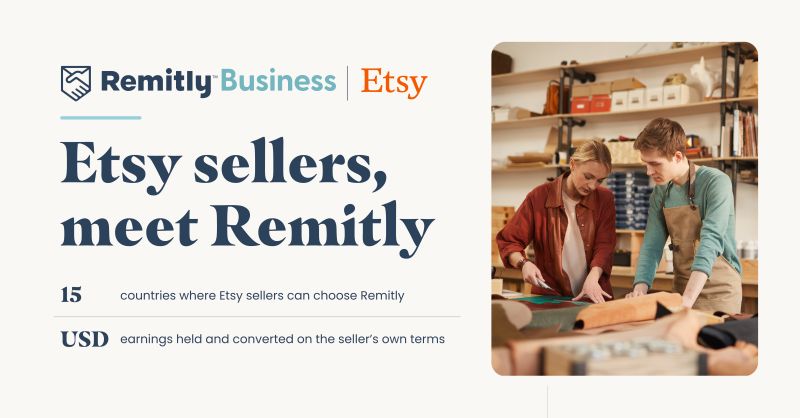
Remitly has partnered with Etsy to give new sellers in 15 countries another way to receive marketplace earnings through local bank accounts and mobile wallets. The partnership marks Remitly’s first deal with an e-commerce marketplace and expands its cross-border payments business from consumer remittances into services for small and medium-sized businesses.
The new payout option is expected to become available in autumn 2026. New international Etsy sellers in eligible markets will be able to select Remitly as their payout provider during the onboarding process.
Remitly Extends Its Cross-Border Network to Etsy Sellers
Under the partnership, Etsy sellers using Remitly will be able to hold their earnings in US dollars and convert those funds into their local currency when they choose.
The converted money can then be sent directly to a bank account or mobile wallet that the seller already uses in their home market.
This gives sellers more control over when they convert their marketplace income rather than automatically depending on a single payout route.
For small businesses selling internationally, that flexibility can be useful because exchange rates, local banking infrastructure, and payout timing can all affect the value of cross-border revenue.
Instead of treating international payouts as a separate financial process, Remitly wants to make them part of the seller’s existing workflow.
Etsy Adds Another Local Payout Option
For Etsy, the partnership adds another payout provider to Etsy Payments.
The marketplace already supports different payment and payout arrangements across its international seller base. Its seller documentation shows that payout methods can vary by market, with some countries using local bank deposits and others relying on providers such as Payoneer.
Remitly’s addition gives eligible sellers another route into local banking and wallet infrastructure.
Etsy said the goal is to offer sellers a dependable way to receive funds through the banks and wallets they already use.
That could be particularly relevant for smaller merchants that operate from countries where access to international financial infrastructure is more limited.
A New Direction for Remitly Business
The partnership is also important for Remitly itself.
The company built its business around cross-border money transfers for individual consumers. It now increasingly wants to serve businesses that need to move money internationally.
Remitly says the Etsy deal represents the next stage in its expansion from serving millions of individual customers toward powering payments for small and medium-sized businesses worldwide.
The move gives Remitly access to a different type of customer.
Etsy sellers may operate as independent creators, small retailers, or micro-businesses, but many have the same basic need as larger businesses: getting paid reliably across borders.
For Remitly, that creates a natural extension of its existing payments network.
Why Local Payouts Matter to Global Sellers
International marketplaces create a straightforward problem for sellers.
A business may generate revenue in one currency while its expenses, employees, and household spending are in another.
That can make payout timing and foreign-exchange management important parts of the business.
Remitly’s model allows Etsy sellers to receive earnings in USD and decide when to convert them into their local currency. Funds can then be deposited into local bank accounts or mobile wallets.
That approach gives sellers greater control over their cash flow.
For a small business, even relatively small differences in exchange rates or payout timing can matter when margins are tight.
Local payout infrastructure can also reduce dependence on unfamiliar international payment arrangements.
The Broader Growth of Cross-Border Commerce
The partnership comes as cross-border e-commerce continues to expand.
Online marketplaces allow small businesses to sell internationally without establishing physical operations in every country where they have customers.
But selling globally creates a second challenge: receiving the money efficiently.
Payments providers are therefore increasingly becoming part of the infrastructure behind international commerce.
The seller experience now depends not only on finding customers but also on how easily revenue can move from a marketplace into the seller’s local financial system.
Remitly is positioning itself around that problem.
Its cross-border network spans more than 175 countries, according to the company, and it has built a large customer base around international money movement.
The Etsy partnership gives that infrastructure a new commercial use case.
From Remittances to Business Payments
Remitly’s broader evolution is worth watching.
The company has traditionally been closely associated with remittances, helping individuals send money internationally to friends and family.
But cross-border financial needs extend well beyond personal transfers.
Businesses also need to receive international payments, pay suppliers, manage cash across currencies, and move funds into local accounts.
By working with Etsy, Remitly is entering that business-to-business and business-to-consumer payments environment without moving too far from its core strength.
The company already understands international money movement. The next step is applying that infrastructure to commercial flows.
Mobile Wallets Become More Important
The ability to pay sellers into mobile wallets is another important part of the partnership.
Wallets have become major financial interfaces in many emerging markets, particularly where smartphone-based payments can reach consumers without requiring traditional banking infrastructure.
For marketplace sellers, the ability to receive business income into an existing mobile wallet can make payouts more convenient.
It also reflects a wider shift in global payments.
Businesses increasingly expect payment providers to connect banks, wallets, local payment rails, and digital financial services through a single infrastructure layer.
Remitly is attempting to position its network in that direction.
Competition in Marketplace Payments
The Etsy partnership places Remitly alongside a broader group of payment providers serving marketplace sellers.
Etsy Payments already supports multiple payment methods and payout arrangements, depending on the seller’s market. In India, for example, new Etsy shops currently use Payoneer for Etsy Payments, with sellers receiving USD and withdrawing through the provider into local currencies.
This highlights why local payout options matter.
There is no single payments model that works equally well across every market.
Banking infrastructure, currency rules, wallet adoption, and regulatory requirements differ from country to country.
A global marketplace therefore needs a network of providers that can connect its merchants with local financial systems.
Remitly’s role is to become another part of that network.
Building a Payments Platform Beyond Remittances
The Etsy agreement follows a broader evolution in Remitly’s product strategy.
In 2026, the company also introduced products aimed at customers with cross-border financial needs, including its Global Card.
Its latest earnings update shows the scale of the underlying business: Remitly reported more than 10 million active customers in the second quarter of 2026, while send volume increased 27% year over year.
That gives the company an established global network from which to build additional services.
Moving into merchant and marketplace payouts could therefore become an important part of Remitly’s long-term diversification.
The company does not need to reinvent cross-border payments.
It can extend an infrastructure and customer network it has already spent years building.
What the Partnership Means for Sellers
For eligible Etsy sellers, the main benefit is choice.
They will have another payout provider that can hold earnings in USD, convert them into local currency when they choose, and send the money to a local bank account or mobile wallet.
That flexibility could make a difference for sellers managing international revenue.
It also reduces one of the less visible barriers to cross-border e-commerce.
Selling a product abroad is only one part of operating an international online business. Getting the proceeds back into the local financial system is equally important.
A smoother payout process can make global marketplace selling more practical for smaller businesses.
TheFinRate Take
The Remitly-Etsy partnership is significant because it takes a familiar consumer cross-border payments network and extends it into marketplace payouts.
For Etsy, the deal adds another option for international sellers looking to receive earnings through local banking and wallet infrastructure.
For Remitly, it opens a new business line built around the same cross-border capabilities that have powered its consumer business for years.
The bigger trend is clear.
As more small businesses sell across borders, payments infrastructure needs to work just as smoothly as e-commerce platforms do.
Local payout options, multi-currency flexibility, and access to bank and wallet networks are becoming part of the basic infrastructure required to run a global online business.
Remitly’s move into Etsy payouts suggests the next stage of cross-border payments may be less about sending money between people and more about helping businesses earn, hold, convert, and receive money wherever they operate.
Comments
No comments yet. Be the first to share your thoughts.
Leave a comment