
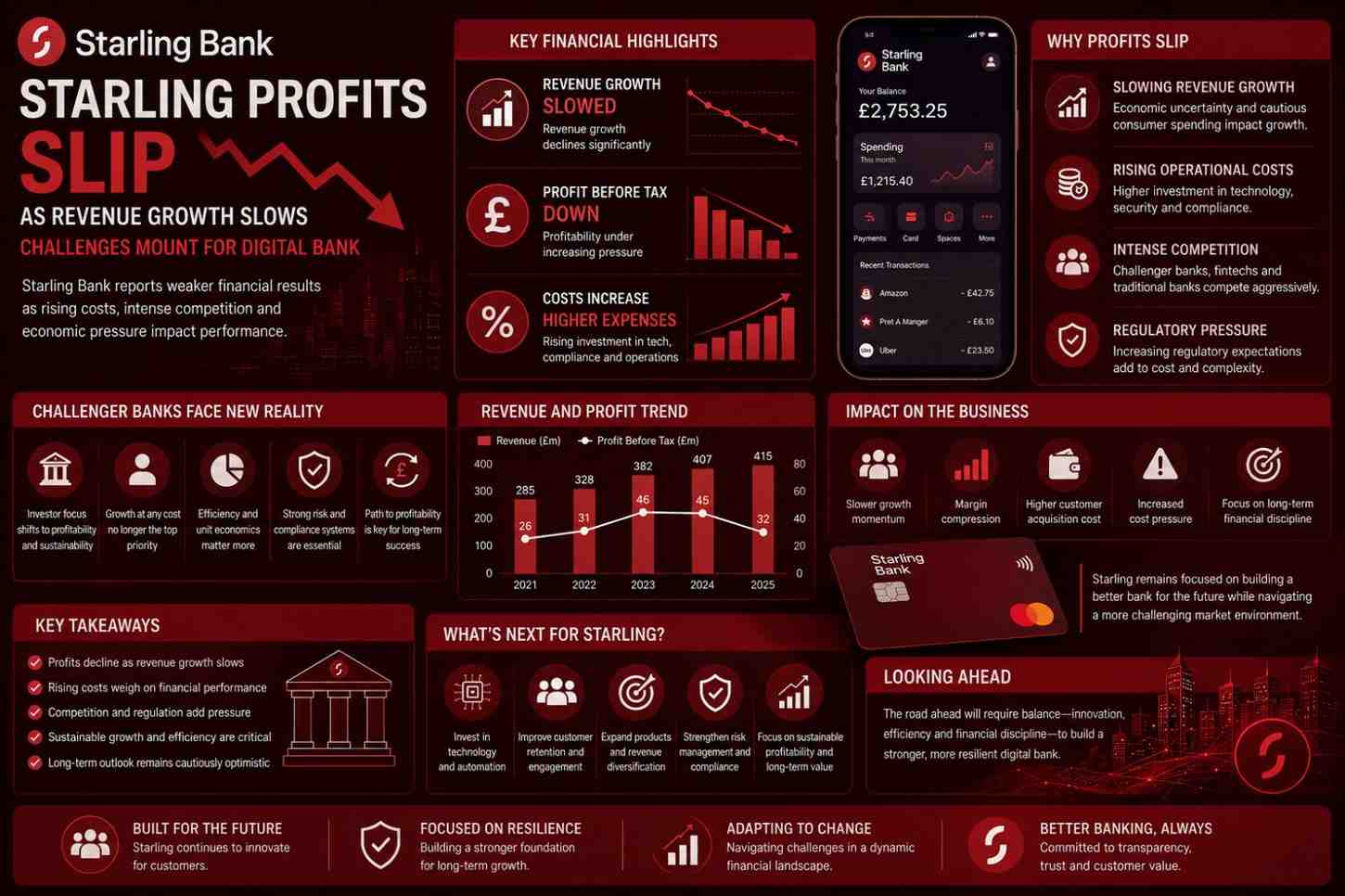
Starling Bank has reported weaker financial results as revenue growth slowed and profitability came under pressure. The latest update shows that Starling profits slip amid a challenging environment for digital banks and fintech companies across the UK market.
Over the past few years, challenger banks have experienced rapid expansion driven by digital adoption, mobile banking growth, and changing consumer behaviour. However, the fintech industry is now entering a more competitive and economically uncertain phase.
Consequently, many digital banks are facing pressure from rising operational costs, tighter regulations, and slower consumer spending. As a result, the latest financial results highlight the growing challenges facing the sector.
Moreover, investors and analysts are increasingly focusing on profitability and sustainable growth rather than customer acquisition alone. Therefore, financial performance metrics have become more important for fintech firms seeking long-term stability.
Why Starling Profits Slip Matters for Fintech
The latest earnings update reflects broader changes happening across the digital banking industry.
Initially, challenger banks focused heavily on rapid customer growth and technology expansion. However, investors are now demanding stronger financial discipline and consistent profitability.
Because of this shift, the fact that Starling profits slip may signal wider pressure across the fintech ecosystem.
Additionally, digital banks continue facing rising expenses linked to:
- Technology infrastructure
- Regulatory compliance
- Cybersecurity investment
- Customer acquisition
- Operational scaling
At the same time, competition within digital finance continues to intensify rapidly.
Consequently, many fintech companies are balancing growth ambitions with the need to improve operational efficiency and profitability.
Starling Revenue Decline Reflects Market Pressure
Revenue growth has become more challenging for many fintech firms as economic conditions remain uncertain.
Higher interest rates, inflation pressure, and cautious consumer spending are affecting financial activity across multiple sectors.
Because of these conditions, Starling profits slip alongside slowing revenue momentum.
Moreover, digital banks are facing increased competition from:
- Traditional high-street banks
- Fintech startups
- Payment platforms
- Embedded finance providers
- Neobanking apps
As a result, customer retention and monetisation strategies are becoming increasingly important.
Furthermore, many fintech companies are now focusing more heavily on long-term customer value instead of rapid expansion alone.
Challenger Bank Performance Faces New Challenges
The challenger banking sector remains highly competitive despite years of strong growth.
Digital banks initially gained popularity by offering:
- Mobile-first banking
- Lower fees
- Faster account setup
- Improved customer experiences
- Modern financial tools
However, maintaining profitability at scale remains difficult.
The fact that Starling profits slip highlights the financial pressures that can emerge even for well-established digital banks.
Additionally, fintech companies must continue investing heavily in:
- Security systems
- Product innovation
- Regulatory compliance
- Fraud prevention
- Customer support infrastructure
Consequently, operational costs remain high across the sector.
How Economic Conditions Impact Starling Profits
The broader economic environment is also affecting fintech earnings worldwide.
Consumers and businesses are becoming more cautious with spending and borrowing decisions. Meanwhile, financial institutions continue managing higher funding costs and regulatory expectations.
As a result, many fintech firms are adjusting growth strategies to prioritise sustainability and profitability.
The latest results showing Starling profits slip reflect these wider economic pressures affecting digital finance companies globally.
Moreover, investors are becoming increasingly selective about fintech valuations and long-term business models.
Therefore, companies that demonstrate stable earnings and disciplined growth may gain stronger market confidence moving forward.
Digital Banking Competition Continues to Increase
Competition across digital finance remains intense as more companies enter the market.
Today, consumers can choose from:
- Challenger banks
- Traditional banking apps
- Fintech payment platforms
- Embedded finance services
- Digital wallet ecosystems
Because of this crowded environment, customer loyalty and engagement have become increasingly important.
At the same time, fintech companies are investing aggressively in product development and user experience improvements.
Consequently, profitability challenges may continue affecting many digital banking firms in the near future.
The latest results showing Starling profits slip highlight how difficult it can be to balance innovation, expansion, and profitability simultaneously.
Investors Focus More on Sustainable Growth
Over recent years, fintech investors prioritised rapid expansion and customer acquisition metrics.
However, market sentiment has shifted significantly.
Today, investors are paying closer attention to:
- Revenue quality
- Profit margins
- Operational efficiency
- Cash flow performance
- Regulatory resilience
As a result, fintech companies are under greater pressure to demonstrate sustainable financial performance.
The fact that Starling profits slip may therefore attract attention beyond the UK digital banking market because it reflects broader industry trends.
Furthermore, financial discipline is becoming increasingly important as fintech funding conditions remain tighter than in previous years.
Future Outlook for Starling and Challenger Banks
Looking ahead, digital banks are expected to continue evolving as competition and regulatory expectations increase.
Several trends may shape the future of challenger banking, including:
- AI-powered financial tools
- Embedded finance integration
- Personalised banking experiences
- Open banking expansion
- Automated financial management systems
Because of these developments, fintech firms will likely continue investing heavily in technology and product innovation.
At the same time, profitability and operational sustainability are expected to remain critical priorities.
The recent results showing Starling profits slip may encourage fintech companies to focus more heavily on efficiency and revenue diversification strategies.
Final Thoughts
The latest financial update from Starling highlights the growing challenges facing challenger banks and fintech companies worldwide.
Although digital banking adoption continues growing, the industry is now entering a more mature and competitive phase where profitability and operational discipline matter increasingly more.
The fact that Starling profits slip reflects broader market pressures affecting digital finance, including rising costs, economic uncertainty, and stronger competition.
Ultimately, the future success of challenger banks may depend on their ability to balance innovation, customer growth, and long-term financial sustainability.
Comments
No comments yet. Be the first to share your thoughts.
Leave a comment