
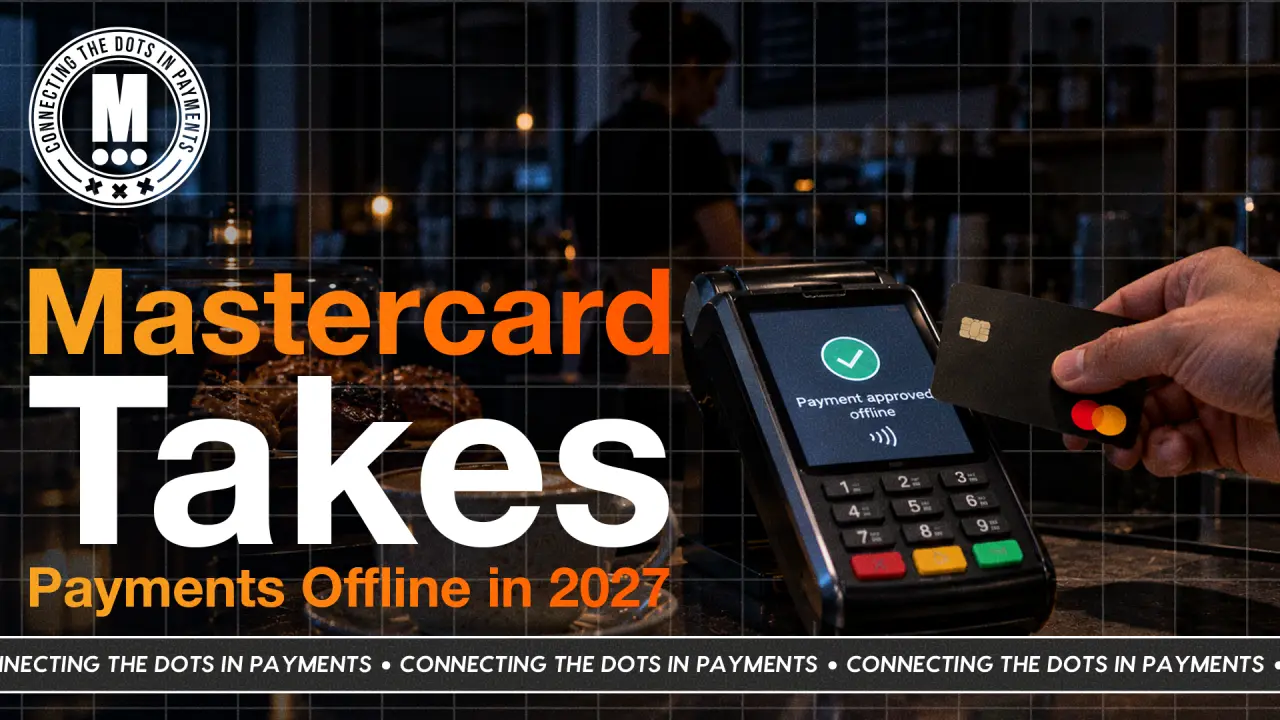
Mastercard will require newly issued cards across Europe to support offline payments from February 2027, followed by new and replacement payment terminals from May, as the company moves to keep essential transactions working during power and network outages.
A power blackout can do more than switch off lights. It can disrupt card terminals, interrupt connectivity, and leave consumers unable to pay for food, fuel, or medicine. Mastercard is now expanding a payment capability designed to reduce that risk across Europe.
The payments company announced new offline payment requirements for its European network, with the rollout beginning in February 2027. From that month, all newly issued Mastercard cards across Europe will be enabled for offline payments. By May 2027, all new and replacement payment terminals will also be required to support the capability.
The initiative follows growing attention to the resilience of digital payment systems during infrastructure failures. Mastercard cited the blackout that hit Spain and Portugal in April 2025, saying an estimated 55 million people were suddenly unable to make digital payments.
The company's approach is intended to let consumers continue making certain in-person payments even when a terminal cannot connect to the wider payment network. Transactions can be authorized locally using information stored securely on a card's chip, subject to controls established in advance by the cardholder's bank.
Mastercard says the capability will help people pay for essentials at supermarkets, grocery stores, service stations, and pharmacies. It could also support transactions at travel and ticket machines during disruptions.
The rollout does not mean every card payment will work in every outage. Offline transactions depend on compatible cards and terminals, the applicable spending controls, and the circumstances of the disruption. However, expanding support across the payment network could provide another layer of resilience when conventional online authorization is unavailable.
Mastercard Sets February and May 2027 Deadlines
Mastercard's European rollout will take place in two main stages.
From February 2027, all newly issued Mastercard cards across Europe will be enabled to make offline payments. From May 2027, all new and replacement payment terminals will be required to support offline transactions. The staggered approach addresses both sides of the in-person payment process: the card used by the customer and the terminal used by the merchant.
Offline payments require compatible technology at the point of sale. A card that supports offline authorization cannot deliver the intended experience if the merchant's terminal does not support the relevant transaction process. Likewise, upgrading terminals alone would not be sufficient if the customer's card lacks the necessary capability. By setting requirements for newly issued cards and new or replacement terminals, Mastercard aims to expand compatibility as payment products and equipment are introduced or replaced.
The dates are important because they describe requirements for new issuance and terminal deployment, rather than an immediate upgrade of every card and terminal already in use. The announcement does not state that all existing cards or terminals will automatically become compatible on those dates.
The rollout also reflects the coordination required across a payments ecosystem. Issuers, acquirers, merchants, terminal providers, and other participants must support the relevant processes for offline transactions to work as intended. Mastercard said it had coordinated with partners, national governments, regulators, and central banks as it prepared to expand the capability across Europe.
How Offline Card Payments Work
Ordinary card transactions generally rely on electronic communication between the payment terminal and the systems involved in authorizing the payment. Depending on the transaction, the terminal may need to connect through a merchant's network and payment provider to obtain authorization.
If the connection fails, that process can be interrupted. A merchant may have a functioning terminal and a customer may have a valid card, yet the payment cannot proceed through the usual online route. Offline payments provide an alternative for eligible transactions.
According to Mastercard, the card's chip securely stores spending limits that allow a compatible terminal to approve a transaction locally when a connection is unavailable. The transaction is then submitted for clearing once connectivity is restored. Mastercard says the offline transaction can be approved up to a limit of €200 per transaction, set in advance by the cardholder's bank. This is a limit described in the company's announcement, not a guarantee that every offline transaction up to €200 will be accepted.
The process changes where the initial authorization decision takes place. Instead of relying entirely on a live connection to the wider payment system, the transaction can be assessed locally under predefined controls. That distinction matters during an outage. It can give consumers and merchants another way to complete eligible transactions without waiting for the wider network to recover.
However, offline authorization is not the same as eliminating risk. The system must operate within the controls stored on the card and supported by the terminal. Issuers and other payment participants must also manage the subsequent processing and clearing of transactions. Offline capability therefore adds resilience to the payment process rather than replacing the broader card payment infrastructure.
Why Europe's Blackout Experience Matters
Mastercard's announcement points to the April 2025 blackout in Spain and Portugal as an example of how infrastructure failures can disrupt digital payments.
The company said an estimated 55 million people were suddenly unable to make digital payments during the blackout. The figure illustrates the potential scale of disruption when electricity and connectivity problems affect payment systems across a large area.
For consumers, the consequences can be immediate. People may need to buy groceries, fill a vehicle with fuel, or obtain medicine even when payment networks are unavailable. For merchants, the impact can include interrupted sales, queues, uncertainty about accepting cards, and pressure to find alternative payment methods. Businesses that rely heavily on digital transactions may have limited options if their terminals cannot connect to the systems required for authorization.
Such disruptions also expose a broader issue for the payments industry: digital payment availability depends on more than the card itself. It relies on electricity, communications networks, terminal hardware, payment processors, and other supporting infrastructure.
Offline transactions are designed to address one part of this problem. They cannot restore electricity to a closed store or guarantee that every merchant can continue operating. They can, however, allow certain compatible transactions to proceed when the payment terminal has lost its connection. The distinction is especially important during widespread emergencies, when access to essential goods may become more urgent and alternative payment options may be limited.
Mastercard Points to Experience in Northern Europe
Mastercard says offline payments have already been implemented in Denmark, Sweden, Estonia, and Latvia.
The company highlighted two examples of how the capability has been used during disruptions. In Latvia, Mastercard said card payments continued in shops powered by local generators during a recent storm. In Denmark, a technical outage isolated terminals from the wider payment system this spring. Mastercard said its crisis procedures enabled many transactions to continue at critical merchants.
These examples provide context for the company's wider European rollout. They suggest that offline payments can be useful when local businesses remain operational but their payment systems cannot reach the wider network.
The Latvian example also highlights an important condition: a merchant still needs the basic infrastructure to operate. A generator can keep a shop running during a power failure, while offline payment functionality can help compatible transactions continue despite a loss of network connectivity. Neither measure alone solves every problem. If a merchant cannot operate its equipment, if a terminal is incompatible, or if a transaction falls outside the applicable controls, an offline payment may not be possible.
Mastercard's plan is therefore best understood as one element of a broader resilience strategy. It adds a fallback payment option in circumstances where the merchant can continue trading but normal electronic authorization is disrupted.
What the €200 Offline Payment Limit Means
A central detail in Mastercard's announcement is the €200 per-transaction limit. The company says the cardholder's bank sets this limit in advance.
A predefined limit helps constrain the amount that can be approved through the offline process. It gives the issuing bank a role in determining how much spending the card can support when the usual online connection is unavailable. For consumers, this means offline payment functionality should not be interpreted as unrestricted spending during an outage. A transaction may still be declined if it exceeds the applicable limit or fails other requirements.
For merchants, the capability provides a potential route to accept certain payments without a live connection. Yet businesses will need to understand the conditions that apply to their terminals and transactions.
There is also a distinction between authorization and final settlement. The terminal can approve an eligible transaction locally, but the transaction still needs to be submitted for clearing after connectivity returns, according to Mastercard's description. That means offline payments do not eliminate the need for the payment system to recover. They allow selected transactions to take place before the normal connection is restored, with later processing still required.
The approach balances availability with controls. It aims to keep some payments moving while limiting the circumstances in which local authorisation can be used.
Why Payment Resilience Matters to Merchants
For merchants, payment continuity is an operational issue as much as a technology question.
A supermarket may have functioning checkout systems and stock available but still face problems if card terminals cannot communicate with payment networks. A service station may be able to dispense fuel but struggle to accept electronic payments. Pharmacies and other essential retailers may also need to continue serving customers during local disruptions.
Offline card payments can offer another option in these circumstances, provided the merchant's equipment and the customer's card support the relevant process. The potential benefit is not limited to the transaction itself. A functioning fallback can help reduce uncertainty at checkout and give customers another way to complete purchases during a disruption.
Still, merchants should not assume that offline acceptance removes all operational or financial risk. They need to understand how transactions are handled, which purchases are eligible, and what happens when connectivity returns. Terminal compatibility will be particularly important as the new requirements take effect. Mastercard's May 2027 deadline applies to new and replacement payment terminals, so the rollout will depend on equipment deployment across the merchant ecosystem. For payment providers and acquirers, the change will also require preparation around terminal support, implementation, and communication with merchants.
Offline Payments and the Future of Digital Payment Infrastructure
Digital payments have expanded because they can make transactions convenient, fast, and widely accessible. But as consumers and businesses rely more heavily on electronic payments, the consequences of outages become more visible.
Payment resilience involves preparing for failures rather than assuming every part of the system will always be available. That can include investment in local infrastructure, cybersecurity, backup connectivity, operational procedures, and alternative transaction methods. Mastercard said its rollout builds on steps taken over the previous 12 months, including investment in local infrastructure and cybersecurity, to strengthen the resilience of Europe's payment networks.
Offline authorisation fits within that broader objective. It creates a way for compatible cards and terminals to complete eligible transactions without relying on a live connection at the point of sale. The technology is not a replacement for online payments, nor does it solve every cause of payment disruption. Instead, it provides a fallback for specific circumstances.
The rollout also illustrates the coordination required to improve resilience across a large payment network. Card issuers, merchants, terminal providers, payment processors, and other participants all play a role in whether offline transactions can work in practice. The new requirements are intended to expand support across Europe over time, with the first milestone covering newly issued cards in February 2027 and the second covering new and replacement terminals in May 2027.
What Happens Next?
The next stage is implementation. Mastercard's announced deadlines give issuers and payment terminal providers a timeline for enabling offline functionality in new cards and equipment.
As the rollout progresses, the practical questions will include how widely compatible cards and terminals are deployed, how merchants are prepared for outages, and how the offline process operates under different conditions.
Consumers should not assume that every card currently in their wallet will automatically support offline payments by February 2027. Mastercard's announcement specifically refers to newly issued cards, while the terminal requirement covers new and replacement equipment from May 2027. The company also has not claimed that offline functionality will make all digital payments available during every emergency. Power loss, damaged infrastructure, incompatible equipment, and other restrictions can still affect whether a transaction can proceed.
Even with those limitations, the initiative addresses a clear vulnerability in modern commerce: the ability to pay for essentials can depend on infrastructure that is not always available.
Mastercard's European offline payment rollout is an effort to make card payments more resilient when networks fail. By enabling compatible cards and terminals to approve eligible transactions locally, the company aims to keep some essential purchases moving while the wider payment system recovers.
For consumers and merchants, the real measure of success will be whether the capability works reliably when it is needed most.
Mastercard to keep payments moving during power and network outages across Europe
Comments
No comments yet. Be the first to share your thoughts.
Leave a comment