
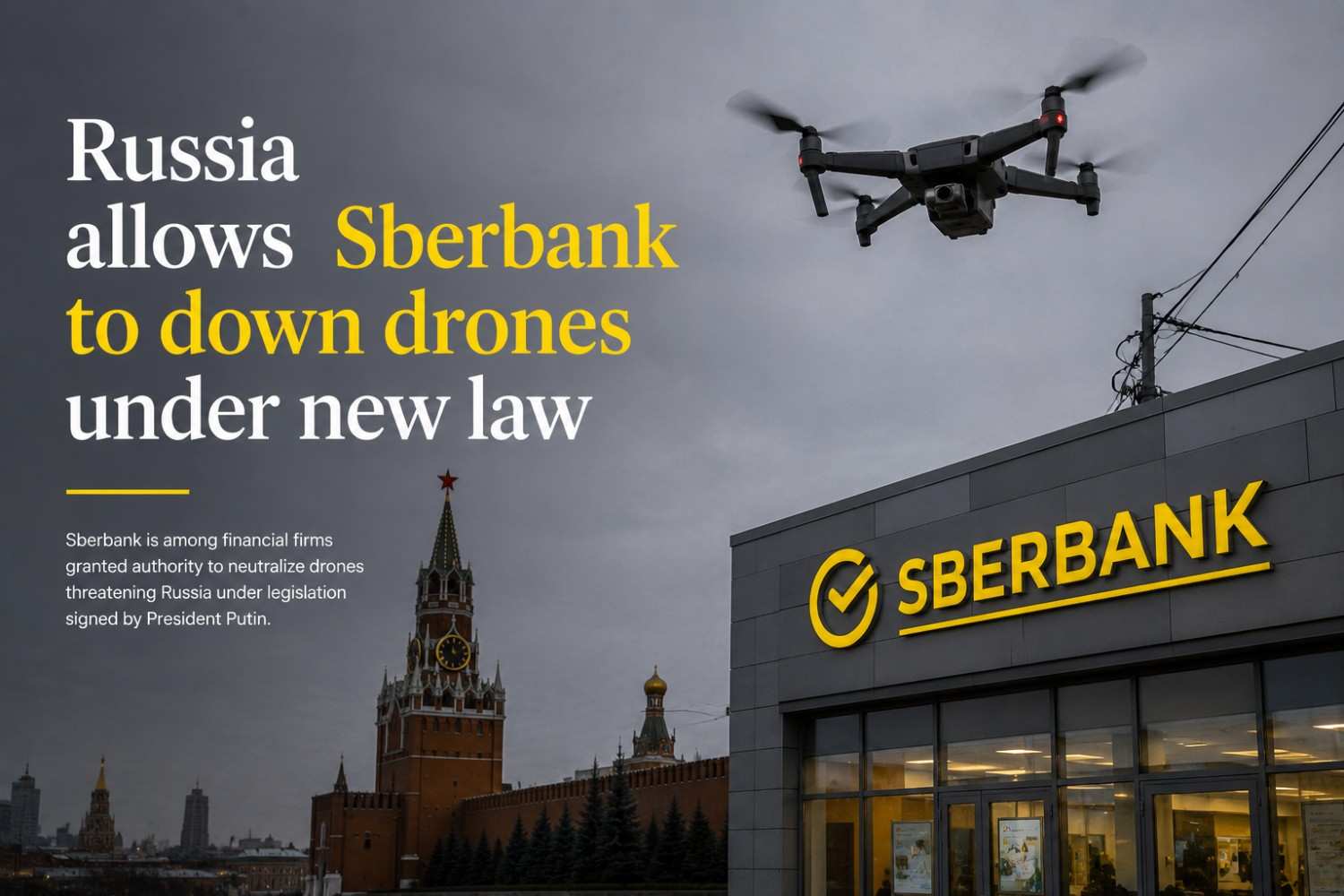
The Russian government has approved new measures after Russia allowed Sberbank to down drones directly alongside the country’s central bank and several strategic entities.
The decision expands anti-drone authority to protect critical infrastructure as drone-related security concerns continue increasing across Russia.
Moreover, the new rules reflect a growing focus on protecting financial systems, government facilities, and essential infrastructure from aerial threats.
As a result, financial institutions are becoming more directly involved in national infrastructure security measures.
Furthermore, the policy highlights how geopolitical tensions are reshaping operational risk management across banking and financial sectors.
Why does Russia allow Sberbank to down drones?
The move that Russia allows Sberbank to down drones comes amid broader concerns around drone attacks targeting infrastructure and strategic assets.
Several sectors are now viewed as critical infrastructure priorities:
- Banking systems
- Payment networks
- Energy facilities
- Government operations
Because financial systems are essential to economic stability, authorities are expanding protective measures around banking infrastructure.
Consequently, financial institutions may receive greater security responsibilities in high-risk environments.
Moreover, drone-related risks are increasingly influencing operational resilience planning globally.
Financial infrastructure protection becomes a priority
The latest Russian drone security law highlights rising concern around infrastructure vulnerability.
Critical financial infrastructure includes:
- Data centres
- Banking headquarters
- Payment processing systems
- Communication networks
Because financial disruptions can impact economic activity and public confidence, governments are strengthening protection strategies.
As a result, banks and financial institutions are becoming part of broader national security frameworks.
Furthermore, operational continuity is now considered a major component of financial stability.
Sberbank plays a major role in the Russian banking system
Sberbank remains one of Russia’s largest financial institutions and plays a critical role within the country’s banking infrastructure.
The bank supports:
- Retail banking services
- Corporate finance operations
- Digital payment systems
- Financial technology initiatives
Because of its importance within the Russian financial system, infrastructure protection measures involving Sberbank carry broader economic implications.
Consequently, security-related decisions affecting the bank attract international attention.
Anti-drone authority expands across sectors.
The decision that Russia allows Sberbank to down drones reflects the wider expansion of anti-drone policies globally.
Governments and corporations are increasingly investing in:
- Drone detection systems
- Airspace monitoring tools
- Infrastructure security technology
- Operational risk management systems
Because drone technology has become more accessible, concerns around unauthorised drone activity continue rising.
As a result, both public and private sector organisations are strengthening security capabilities.
Moreover, anti-drone technologies are becoming an important part of critical infrastructure defence strategies.
Comparison between traditional infrastructure security and anti-drone protection
| Feature: Traditional | l Security Systems Anti-Drone | e Security Systems |
|---|---|---|
| Threat focus | Ground-based risks | Aerial risks |
| Detection systems | Cameras and guards | Radar and drone tracking |
| Infrastructure coverage | Localized | Wider airspace |
| Operational complexity | Moderate | Higher |
| Technology reliance | Standard | Advanced |
This comparison highlights how infrastructure protection strategies are evolving in response to modern security threats.
The banking sector faces growing operational risks.
The banking industry globally continues adapting to a broader range of operational risks.
Major concerns include:
- Cybersecurity threats
- Physical security risks
- Infrastructure disruption
- Geopolitical instability
Because banks operate essential payment and financial systems, operational resilience remains a major industry priority.
Consequently, financial institutions are investing heavily in security infrastructure and continuity planning.
Furthermore, geopolitical developments are increasing the focus on non-traditional banking risks.
Drone security technology market expands
The broader anti-drone technology market continues to grow rapidly.
Several technologies are gaining attention:
- Drone signal jamming systems
- Radar tracking tools
- AI-powered monitoring systems
- Airspace defence platforms
Because drone-related incidents are increasing globally, governments and private organisations are expanding investment in protective systems.
As a result, infrastructure security technology is becoming a growing business sector.
Moreover, financial institutions operating critical infrastructure may increasingly adopt advanced security tools.
Regulatory and legal concerns remain.
Although anti-drone policies may improve infrastructure protection, they also raise legal and regulatory questions.
Key concerns include:
- Airspace regulations
- Civilian safety risks
- Liability issues
- Security oversight
Because drone defence systems can involve sensitive operational decisions, governments must establish clear legal frameworks.
Furthermore, authorities must balance infrastructure security with public safety considerations.
As a result, anti-drone regulations are expected to evolve further over time.
Future outlook after Russia allows Sberbank to down drones
The future impact of the policy that Russia allows Sberbank to down drones may extend beyond Russia’s banking sector.
Several trends could shape future developments:
- Expansion of infrastructure security laws
- Increased anti-drone investment
- Stronger banking resilience planning
- Greater public-private security cooperation
Additionally, financial institutions globally may reassess physical security strategies as operational risks evolve.
As a result, infrastructure defence could become more integrated into financial sector risk management.
However, regulatory complexity and geopolitical tensions may continue influencing implementation.
Final Thoughts on Russia allows Sberbank to down drones
The decision that Russia allows Sberbank to down drones reflects how security concerns are increasingly affecting financial infrastructure and operational risk planning.
As drone-related threats continue evolving, governments and financial institutions are expanding protective measures around critical infrastructure.
Moreover, the development highlights the growing overlap between national security, banking resilience, and infrastructure protection strategies.
Ultimately, future security frameworks may involve deeper cooperation between governments, regulators, and major financial institutions.
Comments
No comments yet. Be the first to share your thoughts.
Leave a comment