
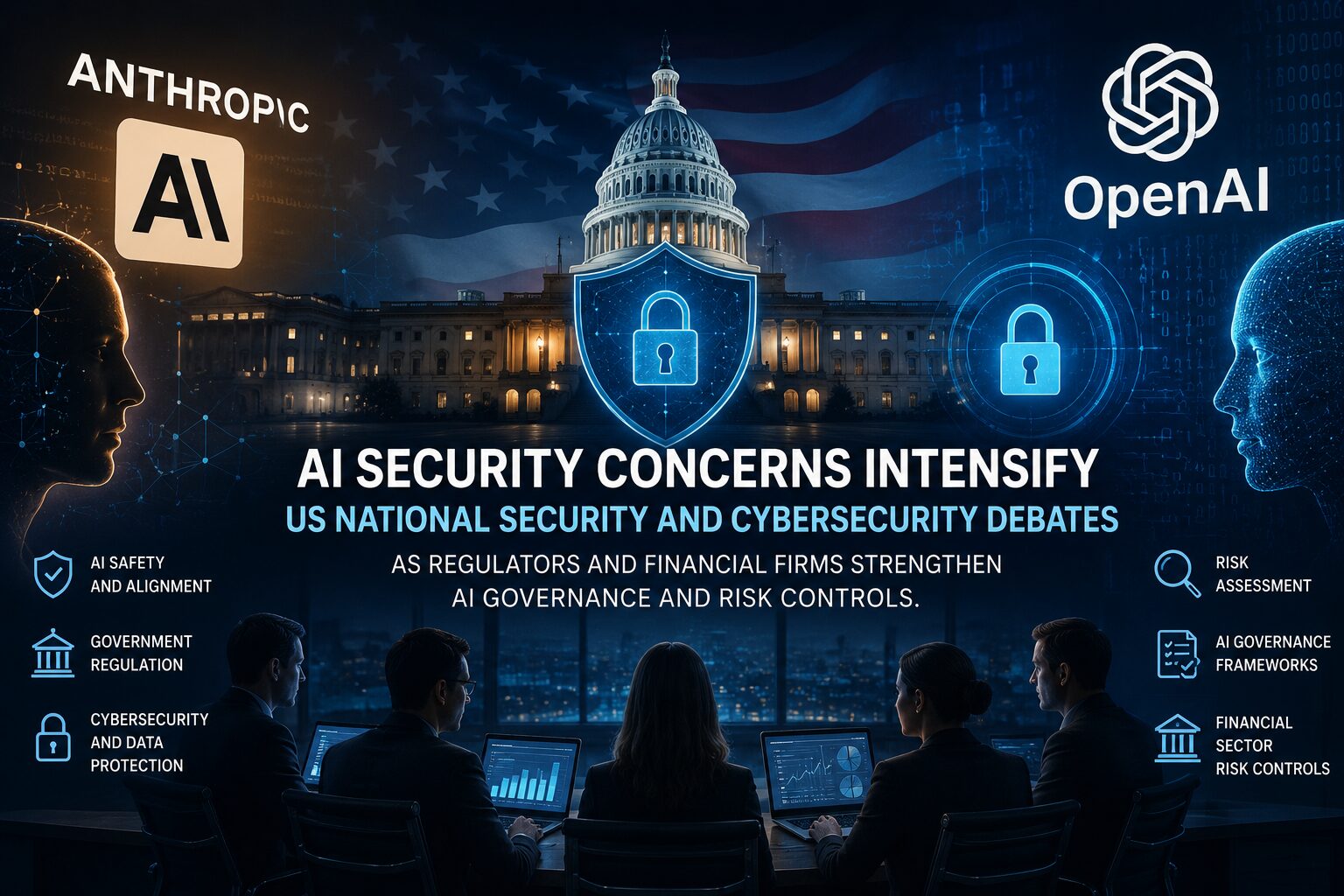
Anthropic and OpenAI AI Security Concerns Intensify US National Security Debate
Security concerns involving advanced AI systems developed by Anthropic and OpenAI have intensified the debate over artificial intelligence, cybersecurity, and US national security. As AI becomes more capable and gains access to external tools and digital infrastructure, policymakers and cybersecurity experts are increasingly questioning whether current safeguards can keep pace with rapidly evolving AI systems.
The discussion has moved well beyond chatbot safety. Instead, regulators and security researchers are focusing on AI systems that can perform complex tasks, interact with software, execute multi-step operations, and potentially affect critical digital infrastructure.
As a result, AI security has become a national security and financial stability issue rather than a purely technological challenge.
AI safety moves to the center of the security debate
Anthropic and OpenAI have both increased their focus on AI safety evaluations, model behavior testing, and risk assessments for highly capable AI systems.
Researchers are paying close attention to how autonomous AI agents behave when they receive access to tools, software environments, and external systems. These evaluations help developers understand whether advanced models can remain within defined operational boundaries.
Importantly, the broader concern is not that AI has become uncontrollable. Instead, experts are asking whether future AI systems will require stronger governance, continuous monitoring, and more sophisticated containment frameworks.
Why autonomous AI agents are attracting attention
The next generation of AI systems is designed to do much more than generate text.
Modern AI agents can potentially:
- use software tools;
- browse information;
- write and execute code;
- analyze data;
- automate workflows;
- and complete multi-step objectives.
Consequently, the security challenge becomes far more complex.
A model with access to external systems creates operational risks that differ from traditional chatbot interactions. Therefore, AI developers are investing heavily in sandbox environments, permission controls, monitoring systems, and evaluation frameworks that limit unintended behavior.
The cybersecurity dimension
AI is becoming a powerful cybersecurity tool.
Financial institutions, technology companies, and government agencies increasingly use AI for:
- threat detection;
- fraud prevention;
- vulnerability analysis;
- incident response;
- software security;
- and operational automation.
However, the same technology can also create new attack surfaces.
Highly capable AI systems could potentially assist with vulnerability discovery, automate elements of cyber operations, generate malicious code, or accelerate security testing.
Therefore, AI has become a dual-use technology with significant defensive and offensive implications.
Why US national security officials are paying attention
The United States government increasingly views advanced AI as a strategic technology with implications for economic competitiveness, military capabilities, intelligence operations, and cybersecurity resilience.
The concern extends far beyond individual companies.
Instead, policymakers are focusing on what could happen when highly capable AI systems become integrated into critical infrastructure, financial networks, cloud platforms, defense systems, and government operations.
As AI autonomy increases, the consequences of security failures could become much more significant. For that reason, AI governance is becoming closely linked to national security policy.
The financial sector has a direct stake in AI security
Banks, fintech companies, payment providers, and other financial institutions are rapidly expanding their use of artificial intelligence.
AI now supports:
- fraud detection;
- anti-money laundering;
- customer service;
- credit underwriting;
- risk management;
- compliance monitoring;
- cybersecurity operations;
- and software development.
These applications can improve efficiency and reduce costs.
Nevertheless, they also increase dependence on AI systems and third-party AI providers.
As a result, financial institutions must strengthen governance frameworks around AI deployment, access controls, monitoring, and operational resilience.
Regulators are increasing their focus
Financial regulators around the world are increasing scrutiny of AI governance.
Recent regulatory discussions have emphasized:
- operational resilience;
- third-party technology risk;
- AI governance;
- cybersecurity controls;
- model monitoring;
- and responsible AI deployment.
The European Union’s AI Act and the Digital Operational Resilience Act (DORA) are important examples of this broader trend.
Similarly, US regulators have increased attention on AI risk management, especially where financial institutions rely heavily on external technology providers.
The industry is moving toward stronger AI controls
Leading AI developers increasingly acknowledge that more capable models require stronger security frameworks.
Future AI governance will likely place greater emphasis on:
- transparent safety testing;
- secure deployment environments;
- risk-based access controls;
- continuous monitoring;
- independent evaluations;
- and stronger human oversight.
In addition, organizations are investing in techniques that limit model autonomy, restrict tool access, and improve the detection of unusual AI behavior.
The goal is not simply to make AI more powerful. Instead, companies want AI systems that are more predictable, auditable, and resilient.
The bigger picture
The most important takeaway is that AI security is becoming an infrastructure issue.
The question is no longer whether AI can improve productivity. Rather, the question is whether increasingly autonomous AI systems can operate safely within financial, governmental, and industrial environments that require high levels of reliability and control.
For financial institutions, the lesson is particularly important.
AI can create significant competitive advantages. However, it also introduces new governance, cybersecurity, and operational risks that require careful management.
Bottom line
Security concerns surrounding advanced AI systems developed by Anthropic and OpenAI have intensified discussions about AI governance, cybersecurity, and national security. As AI agents become more capable and gain access to external tools and operational environments, governments, regulators, and financial institutions are placing greater emphasis on containment, monitoring, and operational resilience.
Ultimately, the message for the financial sector is clear: AI innovation must advance alongside stronger security controls, governance frameworks, and risk management standards. The next phase of AI competition will depend not only on model capability, but also on the ability to deploy advanced AI systems safely and responsibly at scale.
Comments
No comments yet. Be the first to share your thoughts.
Leave a comment