
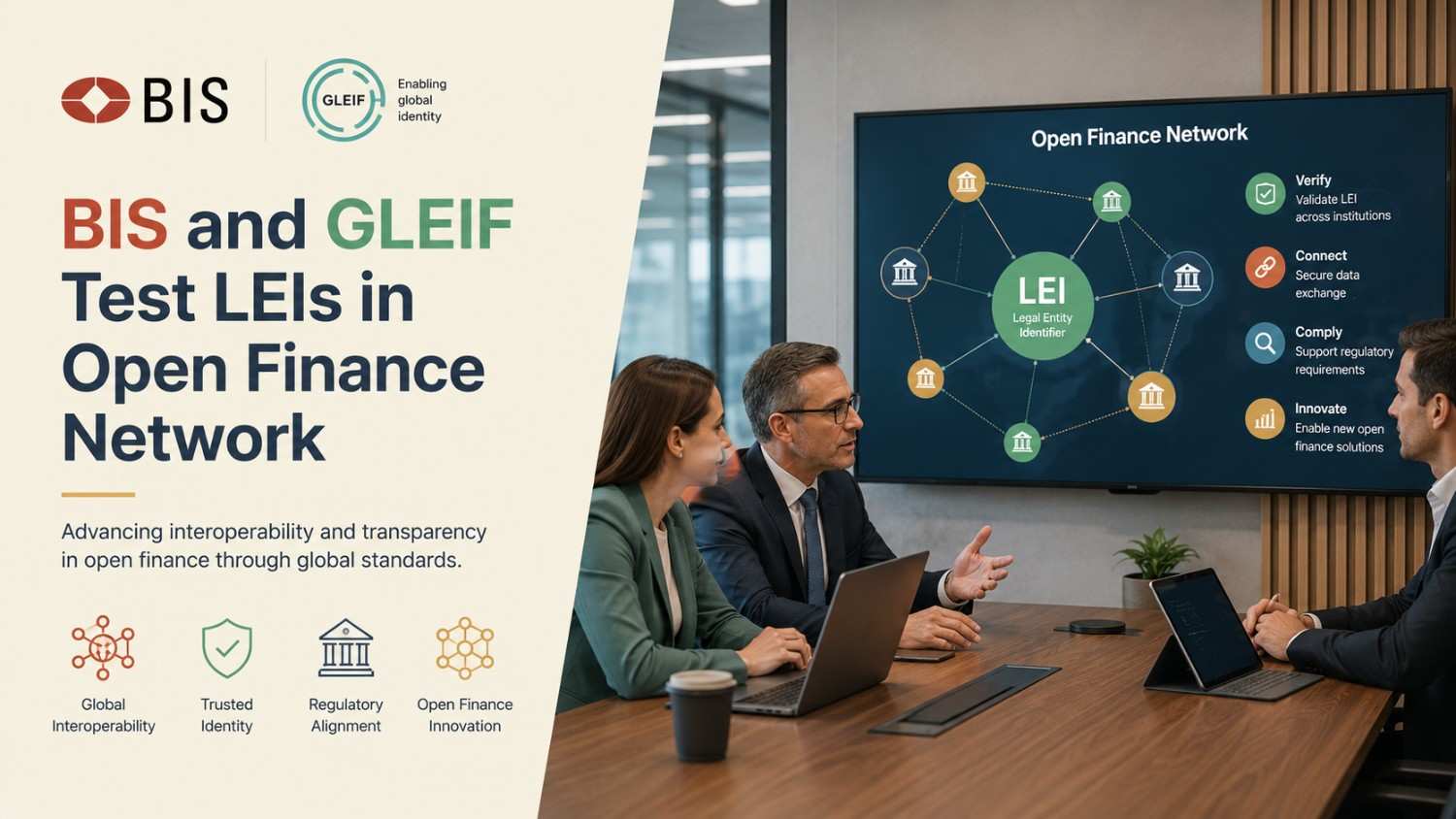
Cross-Border Open Finance Prototype demonstrates role of LEIs in global finance
The Cross-Border Open Finance Prototype developed by the Bank for International Settlements and the Global Legal Entity Identifier Foundation has demonstrated how Legal Entity Identifiers (LEIs) can simplify Know Your Business (KYB), Know Your Customer (KYC), and Anti-Money Laundering (AML) processes for businesses operating across borders. The initiative forms part of Project Aperta, an effort led by the BIS Innovation Hub to improve interoperability between domestic open finance networks.
Moreover, the Cross-Border Open Finance Prototype aims to reduce the duplication, delays, and compliance costs that businesses often face when opening accounts or initiating payments in different jurisdictions. As a result, small and medium-sized enterprises (SMEs) could gain faster access to banking services and international trade opportunities.
Cross-Border Open Finance Prototype creates a network of networks
The Open Finance Network developed under Project Aperta aims to improve interoperability between financial systems across multiple jurisdictions.
Moreover, the Open Finance Network could help businesses reduce onboarding friction while supporting faster access to cross-border financial services.
The Cross-Border Open Finance Prototype connects existing domestic open finance frameworks through a neutral interoperability layer rather than requiring countries to redesign their systems.
Key participating jurisdictions include:
- India
- United Kingdom
- Brazil
- Hong Kong
- United Arab Emirates
Moreover, the prototype acts as a “network of networks” that allows trusted financial data to move securely across borders. Because domestic frameworks often use different standards and trust models, interoperability has historically been difficult to achieve. Consequently, Project Aperta seeks to bridge these gaps.
LEIs improve identity verification and compliance
A central feature of the Cross-Border Open Finance Prototype is the use of Legal Entity Identifiers.
Moreover, when businesses use an LEI, financial institutions can identify organisations more accurately and efficiently. Because the LEI provides a globally recognised identity standard, it helps reduce repeated verification procedures.
Furthermore, the prototype showed that LEIs can streamline:
- KYB checks
- KYC procedures
- AML compliance reviews
- Business account opening
- Cross-border payment verification
As a result, financial institutions may reduce onboarding times while improving compliance efficiency.
SMEs could benefit from faster onboarding
The Cross-Border Open Finance Prototype is particularly relevant for SMEs that often face challenges when accessing financial services in foreign markets.
Moreover, businesses operating internationally frequently encounter repeated document requests and manual verification processes. Because each jurisdiction maintains different requirements, onboarding can become expensive and time-consuming.
Furthermore, Project Aperta demonstrated how verified organisational identity can reduce friction during account opening and payment initiation. Consequently, SMEs may gain improved access to trade finance and banking services.
Open finance interoperability remains a major challenge
One objective of the Cross-Border Open Finance Prototype is to address fragmentation among domestic open finance ecosystems.
Moreover, many countries have established open banking and open finance frameworks. However, these systems often operate independently and use different technical standards. As a result, cross-border data portability remains limited.
Furthermore, the BIS prototype uses a secure translation and trust framework that allows participants in different jurisdictions to exchange information safely. Consequently, businesses may benefit from a more seamless international financial experience.
Comparison between traditional onboarding and LEI-enabled onboarding
| Feature | Traditional Process | LEI-Enabled Process |
|---|---|---|
| Identity Verification | Repeated checks | Streamlined |
| Documentation | Multiple submissions | Reduced duplication |
| Onboarding Speed | Slower | Faster |
| Compliance Efficiency | Moderate | Improved |
| Cross-Border Access | Limited | Enhanced |
Moreover, this comparison highlights why regulators and industry organisations are increasingly interested in standardised digital identity frameworks.
Cross-Border Open Finance Prototype may support digital asset ecosystems
The project also highlighted potential applications beyond traditional banking.
Moreover, BIS and GLEIF indicated that globally recognised identifiers such as LEIs could help support emerging digital asset ecosystems. Because digital finance increasingly relies on trusted identity verification, LEIs may contribute to transparency and risk management.
Furthermore, verified legal entity data could assist financial institutions, regulators, and digital asset platforms in managing compliance requirements. As a result, the framework may support future innovation in tokenised finance and digital asset markets.
Global collaboration strengthens the project
The Cross-Border Open Finance Prototype was developed through collaboration between multiple public and private-sector organisations.
Participants included:
- Hong Kong Monetary Authority
- Central Bank of Brazil
- Central Bank of the United Arab Emirates
- UK’s Financial Conduct Authority
- International Chamber of Commerce Digital Standards Initiative
Moreover, banks, fintech firms, and technology providers participated in testing activities. Consequently, the prototype reflects a broad international effort to improve cross-border financial connectivity.
Future outlook for the Cross-Border Open Finance Prototype
The future of the Cross-Border Open Finance Prototype will depend on continued industry and regulatory collaboration.
Moreover, demand for seamless international payments and data portability continues growing. Because businesses increasingly operate across multiple jurisdictions, interoperability is becoming more important.
Furthermore, the successful use of LEIs within Project Aperta may encourage broader adoption of global identity standards across financial services. As a result, businesses could experience faster onboarding, reduced compliance costs, and improved access to financial products.
Final Thoughts
The Cross-Border Open Finance Prototype developed by BIS and GLEIF demonstrates how standardised legal entity identification can improve efficiency across international financial services.
Moreover, by combining open finance infrastructure with LEIs, the project addresses long-standing challenges related to onboarding, compliance, and cross-border payments. Consequently, the initiative offers a potential blueprint for more connected and interoperable global financial systems.
BIS and Gleif team on LEIs in cross-border open finance prototype
Comments
No comments yet. Be the first to share your thoughts.
Leave a comment