
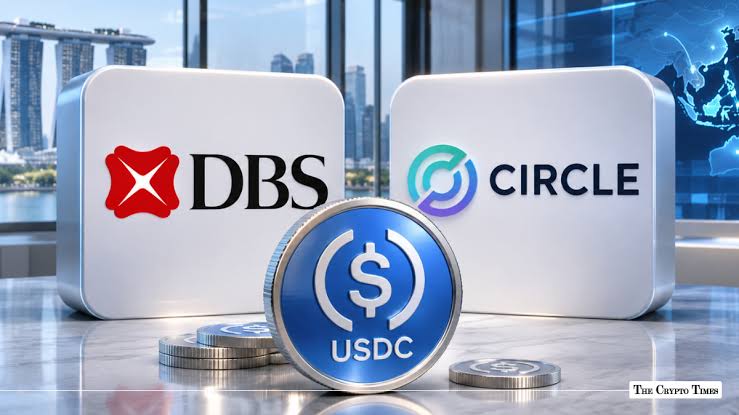
The Singapore bank will allow eligible institutional clients to mint and redeem USDC directly, reducing reliance on secondary markets and supporting round-the-clock dollar-to-stablecoin settlement.
DBS and Circle are expanding institutional access to USDC across Asia through a new partnership that connects traditional banking infrastructure with regulated stablecoin services.
Announced on 18 November 2026, the agreement will allow eligible institutional clients to mint and redeem USDC directly through DBS. It will also support near-instant settlement between US dollars and USDC, 24 hours a day, seven days a week.
The arrangement targets businesses that use stablecoins for treasury operations, settlement, and liquidity management. It also gives institutions another route to obtain and redeem digital dollars without relying entirely on secondary-market liquidity.
The partnership brings together DBS's institutional banking and digital asset capabilities with Circle's regulated stablecoin infrastructure. Both companies expect the arrangement to support growing demand for tokenized money across financial markets.
Importantly, the agreement builds on their participation in Project BLOOM, an initiative led by the Monetary Authority of Singapore (MAS) to develop next-generation settlement infrastructure.
Direct USDC minting and redemption through DBS
The partnership introduces a direct banking channel for eligible institutions seeking access to USDC.
Under the arrangement, clients will be able to mint USDC through DBS when they need digital dollars. They will also be able to redeem their USDC through the bank.
This provides an alternative to relying solely on secondary markets, including cryptocurrency exchanges and other trading venues.
Secondary-market access can expose institutions to differences in liquidity, pricing, and market conditions. Direct issuance and redemption can provide another route for managing their digital dollar positions.
The companies also announced near-instant, 24/7 settlement between US dollars and USDC through DBS.
This is important because traditional banking services often operate within defined business hours and payment cut-off times. However, blockchain-based financial activity can continue throughout the day and night.
The new arrangement aims to reduce this timing gap. Eligible institutions will be able to manage liquidity between fiat and digital asset environments outside conventional banking hours.
DBS says the service will support three main institutional requirements:
- Treasury management: Institutions can manage their USDC positions alongside conventional cash holdings.
- Settlement: Businesses can use digital dollars to support financial transactions and settlement requirements.
- Liquidity management: Clients gain another way to move between US dollars and USDC when managing their liquidity needs.
The announcement does not yet disclose a public launch timetable, detailed eligibility requirements, transaction limits, or fees. It also does not identify the specific markets in which the service will initially be available.
Why direct stablecoin access matters for institutions
Stablecoins are becoming an important part of discussions about cross-border payments and digital financial infrastructure.
USDC is a dollar-linked stablecoin issued by regulated affiliates of Circle. It is designed to maintain a value of one US dollar and is backed by reserves held for the benefit of its holders.
For institutions, stablecoins can provide a way to move dollar-denominated value across blockchain networks. They can also support treasury operations and settlement processes that require access beyond traditional banking hours.
However, institutions need reliable connections between digital assets and the banking system. They must also consider compliance, liquidity, custody, and redemption arrangements.
This is where DBS's role becomes important.
Rather than requiring eligible clients to depend entirely on external exchanges, the partnership provides a direct route through an established banking relationship.
For Circle, the arrangement expands its institutional distribution network in Asia. It also connects USDC with a major regional bank's liquidity and financial services capabilities.
For DBS, supporting USDC adds another digital money option alongside its own work on tokenized financial products.
Corporate demand for tokenized money is increasing.
The partnership comes as large businesses explore new forms of digital money for financial operations.
DBS highlighted findings from its report, The Great Rewiring: Money in a New Order.
The study surveyed 422 business and finance leaders across 11 markets. Their organizations had annual revenues exceeding US$500 million.
According to the research, 88% of businesses were already deploying or piloting tokenized money use cases. More than three in five were also adopting, or planning to adopt, stablecoins.
The findings point to growing corporate interest in digital settlement infrastructure.
Businesses increasingly need flexible ways to manage liquidity across markets and currencies. They also want payment systems that can support international operations without unnecessary delays.
However, adoption still requires trusted infrastructure and clear operating arrangements.
Banks can play an important role by connecting traditional financial services with emerging digital money networks. The DBS-Circle partnership reflects this approach.
Project BLOOM connects stablecoins and tokenized bank money.
The agreement also builds on DBS and Circle's participation in Project BLOOM.
Led by the Monetary Authority of Singapore, BLOOM stands for Borderless, Liquid, Open, Online, and Multi-currency.
The initiative brings together financial institutions, technology companies, and policymakers. Its objective is to advance settlement infrastructure for domestic and cross-border financial transactions.
BLOOM focuses on different forms of digital money, including tokenized commercial bank money and stablecoins that meet regulatory expectations.
Its work includes improving interoperability between digital money arrangements, supporting cross-border settlement, and developing programmable controls.
These controls can include identity verification, sanctions screening, and transaction safeguards.
The initiative also explores wholesale financial applications such as corporate treasury management, trade finance, and agentic payments.
DBS and Circle's participation therefore places their partnership within a wider industry effort. The goal is not simply to connect institutions with USDC. It is also to improve how different forms of digital money interact across financial networks.
For Singapore, this work supports its ambition to strengthen its position as a center for digital asset and financial infrastructure innovation.
DBS and Circle take complementary positions in digital finance.
The partnership reflects the different strengths of both companies.
DBS operates across 19 markets and provides consumer, business, and institutional banking services. It has also invested in digital assets and tokenized financial infrastructure.
Circle operates the USDC stablecoin ecosystem and provides blockchain-based financial infrastructure for businesses, developers, and financial institutions.
Evy Theunis, Head of Digital Assets at DBS's Institutional Banking Group, said institutions increasingly want tokenized money to manage liquidity and support growth across new markets.
She added that the partnership gives institutions greater choice by supporting USDC alongside other trusted forms of tokenized money.
Kash Razzaghi, Chief Commercial Officer at Circle, said financial institutions are looking for trusted ways to access stablecoins and integrate blockchain infrastructure into their operations.
He described the collaboration as an important step in expanding institutional access to USDC across Asia.
The partnership also highlights an important distinction in the digital money market. Stablecoins and tokenized bank deposits can serve different purposes.
USDC represents a dollar-linked digital asset issued by Circle's regulated affiliates. Tokenized bank deposits represent commercial bank money recorded on blockchain infrastructure.
DBS is exploring both models. Supporting USDC does not mean the bank is replacing its own digital money initiatives.
Instead, it reflects a market where institutions may need access to several forms of digital money, depending on their settlement, liquidity, and operational requirements.
What the partnership means for Asia's stablecoin infrastructure
The DBS-Circle agreement adds another institutional banking channel to Asia's developing stablecoin ecosystem.
Its immediate importance lies in direct access to USDC issuance and redemption through a major regional bank. The announced 24/7 settlement capability also addresses a key timing challenge between conventional banking and digital asset markets.
However, the partnership's broader impact will depend on implementation.
Institutions will need clarity on eligible markets, onboarding requirements, fees, transaction limits and operational safeguards. They will also need to understand the applicable custody and redemption arrangements.
Near-instant settlement does not remove every operational or compliance requirement. Nor does it eliminate the risks associated with stablecoin holdings and blockchain transactions.
Nevertheless, the agreement shows how established banks and stablecoin issuers can work together to develop institutional digital money infrastructure.
As Project BLOOM advances, interoperability between stablecoins and tokenized bank money will become increasingly important.
For DBS and Circle, the next step is turning this partnership into a practical institutional service. Its adoption could help shape how businesses access and move digital dollars across Asia.
Comments
No comments yet. Be the first to share your thoughts.
Leave a comment