
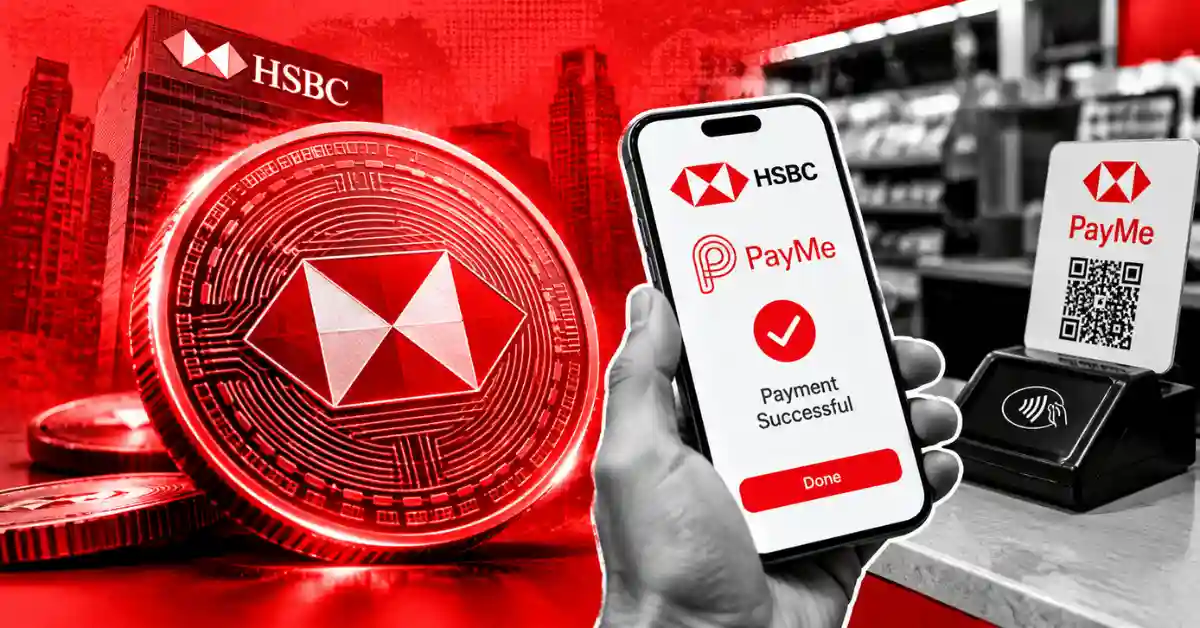
HSBC has named its forthcoming Hong Kong-dollar stablecoin HSBC RedCoin. The bank plans to begin with everyday peer-to-peer and merchant payments before expanding into corporate and institutional use cases later on.
This announcement comes alongside a survey of 1,060 HSBC customers in Hong Kong, in which 74% said they recognized at least one stablecoin use case. Digital asset trading and tokenized investments ranked highest at 57%, followed by person-to-person transfers at 53%, cross-border remittances at 52%, and merchant payments at 52%.
HSBC hasn’t actually issued RedCoin yet. The bank says it plans to launch a Hong Kong dollar-denominated stablecoin in the second half of 2026, under the stablecoin issuer license it was granted in April. At launch, the stablecoin will be available only through PayMe and the HSBC HK Mobile App.
RedCoin starts with everyday payments.
HSBC is taking a phased approach to its stablecoin strategy. The initial focus will be person-to-person, or P2P, and person-to-merchant, or P2M, payments. HSBC plans to expand the use cases later toward wholesale, corporate, and institutional applications.
That approach places RedCoin closer to everyday payments than to a conventional cryptocurrency trading product. The bank said this strategy reflects Hong Kong’s developing digital-asset and currency ecosystem while giving customers a familiar environment through existing HSBC platforms they already use.
PayMe and the HSBC HK Mobile App will serve as the initial distribution channels. HSBC previously said PayMe has more than 3.3 million users, giving the bank an established customer platform for its planned stablecoin rollout.
74% of surveyed customers recognize a stablecoin use case.
HSBC’s customer research points to significant awareness of potential stablecoin applications, though the results also reveal some real gaps in understanding. Among the 1,060 surveyed customers, 74% recognized at least one stablecoin use case.
The most recognized applications were digital asset trading and tokenized investments at 57%, person-to-person transfers at 53%, cross-border remittances at 52%, and merchant payments at 52%.
HSBC conducted the survey online between June 18 and June 28, 2026, among HSBC customers aged 18 to 64. The findings also showed that 60% correctly identified a stablecoin as a fiat-backed digital asset.
However, 26% believed stablecoins were government-issued, while 10% believed they were interest-bearing. HSBC noted that this latter feature isn’t included in Hong Kong’s current regulatory framework at all. That distinction matters for HSBC’s rollout, since customer education is becoming part of the bank’s broader stablecoin strategy.
Security and regulation remain key concerns.
Awareness doesn’t necessarily translate into confidence. HSBC’s survey found that customers remain concerned about security, fraud, and regulatory clarity overall.
When asked what would increase their confidence in stablecoins, respondents highlighted stronger regulatory clarity at 62%, enhanced education at 55%, fraud protection at 53%, seamless conversion to cash at 51%, and reserve transparency at 39%.
These results suggest the bank sees education and trust mechanisms as important parts of the product rollout, not an afterthought. HSBC said it will launch an educational series through its banking apps, website, and social media channels. The program will focus specifically on scam prevention and transparent redemption mechanisms.
RedCoin is not yet issued.
The distinction between this announcement and the eventual launch matters here. HSBC has named RedCoin, but the bank explicitly states it hasn’t yet issued any stablecoins in Hong Kong. The planned launch is targeted for the second half of 2026.
HSBC received its Hong Kong stablecoin issuer license in April 2026. At the time, the bank said its planned HKD stablecoin would be fully backed by high-quality liquid assets held in segregated accounts and would initially support P2P payments, P2M payments, and tokenized investments.
This latest announcement places P2P and P2M payments at the front of the rollout, with broader corporate and institutional applications expected to follow later.
Bringing stablecoins into existing banking apps
One of the most significant aspects of HSBC’s strategy is distribution. Rather than requiring customers to access a separate crypto platform, HSBC plans to make RedCoin available through PayMe and the HSBC HK Mobile App directly.
That gives the bank an existing digital interface customers can use to access the planned stablecoin. It also fits a wider trend in financial services: digital assets are increasingly getting connected to established banking infrastructure, rather than treated as entirely separate products.
HSBC has already been active in Hong Kong’s digital-asset infrastructure more broadly. On September 29, the bank said it supported the Hong Kong government’s roughly HKD 20 billion digital green bond issuance, which HSBC described as the largest digital bond issuance globally to date. HSBC Orion served as the digital-assets platform, and the transaction connected Orion to EnsembleTX for interbank settlement using tokenized deposits.
From retail payments to corporate and institutional use
HSBC’s planned stablecoin strategy extends well beyond retail transactions. The bank says it intends to expand RedCoin toward wholesale corporate and institutional use cases after the initial P2P and P2M phase wraps up.
That could place the stablecoin within a much broader set of financial workflows, including payments and digital-asset applications generally. This phased model also gives HSBC an opportunity to build customer familiarity before expanding the range of transactions the stablecoin supports.
For a large international bank, that approach links stablecoin adoption directly to existing customer relationships, payment platforms, and regulated financial infrastructure already in place.
Hong Kong becomes an important test market.
HSBC’s RedCoin announcement comes as Hong Kong develops a regulated framework for stablecoin issuance. The bank received its issuer license in April under the territory’s new regulatory regime, and HSBC has positioned the planned stablecoin around safety, financial-crime compliance, and regulated digital-asset use.
This market therefore provides an important test of whether a bank-issued stablecoin can move from digital-asset experimentation into genuine everyday payments. The challenge isn’t only technical, either. HSBC’s own survey shows that customers want clearer regulation, education, fraud protection, and confidence around converting digital value back into cash. That makes trust and usability just as important to the rollout as the underlying technology itself.
A shift in bank-issued stablecoins
Naming HSBC RedCoin is more than a simple branding exercise. It puts a major international bank’s stablecoin strategy closer to the consumer payment layer, starting with P2P transfers and merchant payments rather than limiting the technology to institutional experimentation alone.
At the same time, HSBC is openly acknowledging that adoption will depend on customer understanding and confidence. The bank’s survey found strong awareness of stablecoin use cases, but it also identified real misconceptions and concerns around regulation, fraud, and redemption. HSBC now plans to address those issues alongside the product rollout itself.
For HSBC, RedCoin represents a planned bridge between regulated banking infrastructure and digital-asset payments. The next step will be turning that planned infrastructure into a live product for Hong Kong customers later in 2026.
Comments
No comments yet. Be the first to share your thoughts.
Leave a comment