
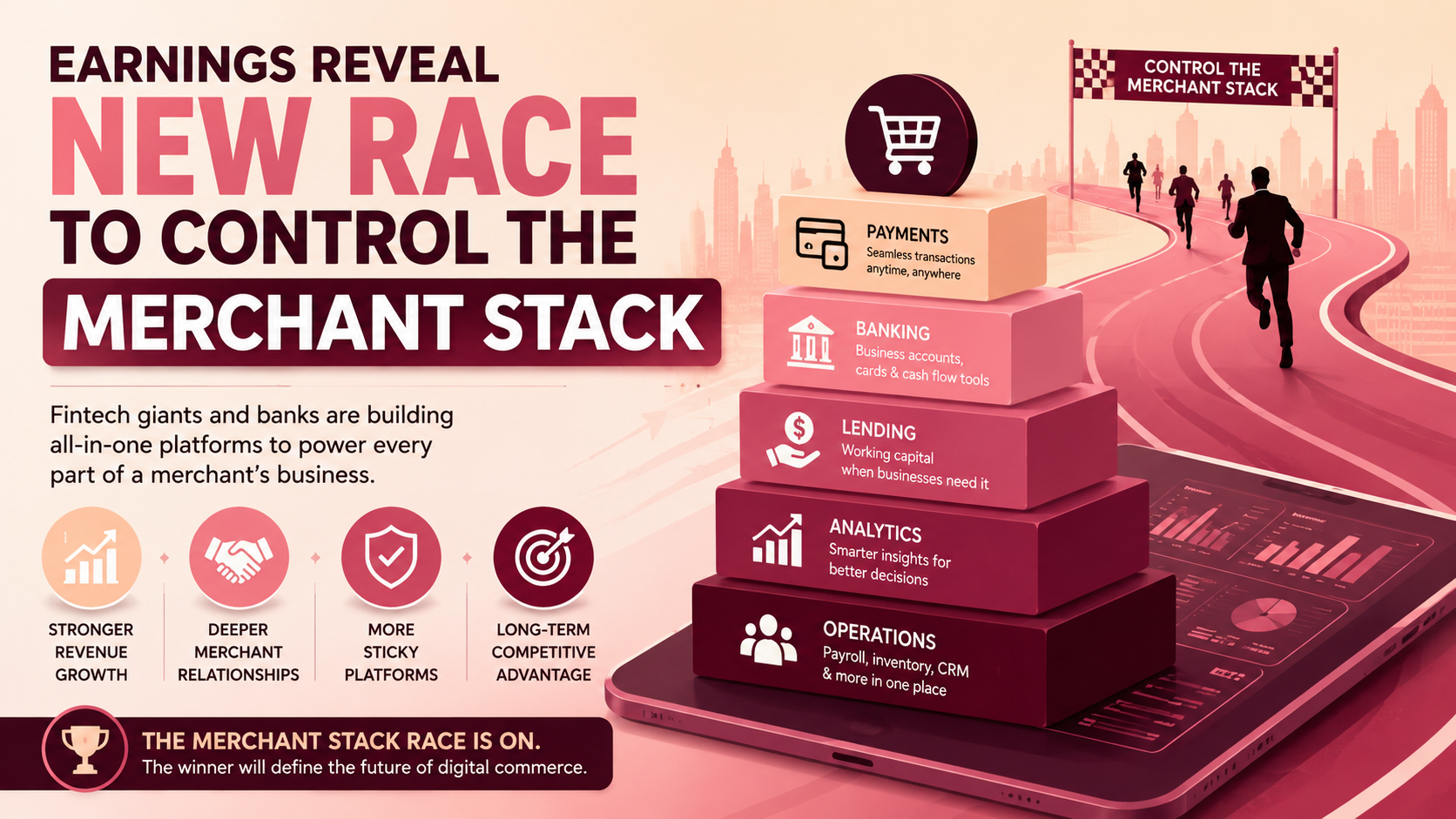
The merchant stack race is accelerating as new fintech earnings reports reveal growing competition among payment companies, banks, and software providers. Moreover, the merchant stack race has become a major focus area as businesses increasingly demand integrated platforms for payments, banking, lending, and analytics.
In particular, companies are no longer focusing only on payment processing. Instead, they are building complete ecosystems that include banking tools, lending, analytics, payroll services, inventory management, and customer engagement solutions. Consequently, the race to control the merchant stack is becoming one of the most important competitive trends in the global fintech industry.
What is the merchant stack?
The merchant stack refers to the collection of digital tools and financial services businesses use to operate efficiently. Traditionally, merchants relied on separate providers for payments, accounting, financing, customer management, and inventory systems.
However, fintech companies now aim to combine these services into unified platforms. As a result, merchants can manage their businesses through a single ecosystem instead of using multiple disconnected tools.
Typically, a modern merchant stack includes:
- Payment processing systems
- Point-of-sale (POS) software
- Business banking solutions
- Payroll and employee management tools
- Lending and credit services
- Inventory and order management
- Customer analytics and loyalty programs
Therefore, controlling the merchant stack allows companies to build deeper relationships with businesses while generating recurring revenue streams.
Merchant stack race in modern fintech
Recent earnings reports across the fintech sector show that companies increasingly prioritise merchant services expansion. Moreover, executives continue to emphasise ecosystem growth during investor calls.
Several major trends explain why the merchant stack has become such a critical focus area.
1. Slowing growth in standalone payment processing
Firstly, payment processing alone has become highly competitive. As margins shrink, companies seek new revenue opportunities through value-added merchant services.
Consequently, firms now bundle software, banking, and analytics into their offerings to improve profitability and customer retention.
2. Rising demand from merchants
Secondly, merchants increasingly prefer integrated platforms that simplify operations. Instead of managing multiple vendors, businesses want centralised systems that reduce complexity and improve efficiency.
As a result, providers that offer complete merchant ecosystems gain a competitive advantage.
3. Expansion of embedded finance
Additionally, embedded finance continues to reshape the industry. Companies now integrate lending, insurance, and banking directly into merchant platforms.
Therefore, businesses can access financial services without leaving their primary operating systems.
Why the merchant stack race is accelerating
Fintech firms are rapidly investing in technologies that strengthen their merchant platforms. Furthermore, many companies are using acquisitions and partnerships to accelerate growth.
Integrated payment solutions
Payment providers now combine transaction processing with invoicing, fraud protection, subscription management, and customer engagement tools.
Consequently, merchants gain a more seamless operational experience.
Business banking services
Many fintech firms now offer merchant bank accounts, debit cards, treasury tools, and cash flow management features.
As a result, providers can deepen relationships with merchants beyond payments alone.
Merchant lending and financing
Another major area of expansion involves lending services. Companies increasingly provide working capital loans and financing products based on merchant transaction data.
Therefore, fintech firms can create new revenue streams while supporting business growth.
AI-driven analytics tools
Artificial intelligence also plays an important role in the merchant stack race. Providers now offer predictive analytics, automated reporting, and customer behaviour insights.
Consequently, merchants can make faster and more informed business decisions.
Impact of the merchant stack race on banks and merchants
The race to control the merchant stack is also intensifying competition between fintech companies and traditional financial institutions.
Historically, banks dominated merchant banking relationships. However, fintech platforms now provide faster onboarding, simpler interfaces, and more flexible tools.
As a result, many small and medium-sized businesses prefer fintech-driven ecosystems over traditional banking services.
Nevertheless, banks are responding aggressively. Many institutions are investing heavily in digital transformation and partnering with fintech providers to remain competitive.
Therefore, the merchant stack battle is likely to reshape financial services over the next several years.
Benefits for merchants
The growing competition around the merchant stack offers several advantages for businesses.
Simplified operations
Firstly, integrated platforms reduce operational complexity by combining multiple tools into one system.
Lower operational costs
Secondly, merchants may reduce software and administrative costs through unified service providers.
Improved financial access
Additionally, embedded financing solutions provide faster access to capital and credit.
Better customer insights
AI-powered analytics help businesses understand customer behaviour, improve retention, and optimise sales strategies.
As a result, merchants gain both operational efficiency and stronger growth opportunities.
Challenges in the merchant stack race
Despite rapid innovation, companies also face significant challenges.
Regulatory complexity
As platforms expand into banking and lending, regulators are increasing oversight of financial compliance and consumer protection.
Data security risks
Moreover, managing large amounts of merchant and payment data increases cybersecurity responsibilities.
Integration difficulties
Many businesses still use legacy systems, making platform integration more difficult.
Intense competition
Finally, the market is becoming increasingly crowded, with fintech firms, banks, software companies, and e-commerce platforms competing aggressively.
Therefore, companies must continue innovating to maintain market leadership.
Future of the merchant stack race
Looking ahead, the merchant stack industry is expected to grow significantly as digital commerce expands globally.
Several trends will likely shape the future:
- Greater adoption of embedded finance
- Increased AI automation for merchants
- Expansion of cross-border commerce tools
- Stronger integration between banking and software platforms
- More personalised merchant services
Consequently, the companies that successfully combine payments, software, and financial services into seamless ecosystems may dominate the next phase of fintech growth.
Conclusion
The latest earnings reports clearly show that the race to control the merchant stack is accelerating across the fintech industry. While payment processing remains important, companies now recognise that merchants want complete operational ecosystems rather than standalone services.
Therefore, fintech firms, banks, and software providers are expanding aggressively into integrated commerce solutions, embedded finance, and AI-driven business tools.
Ultimately, the merchant stack will likely become one of the most valuable battlegrounds in digital finance, shaping how businesses manage payments, operations, and financial services in the years ahead.
Comments
No comments yet. Be the first to share your thoughts.
Leave a comment