
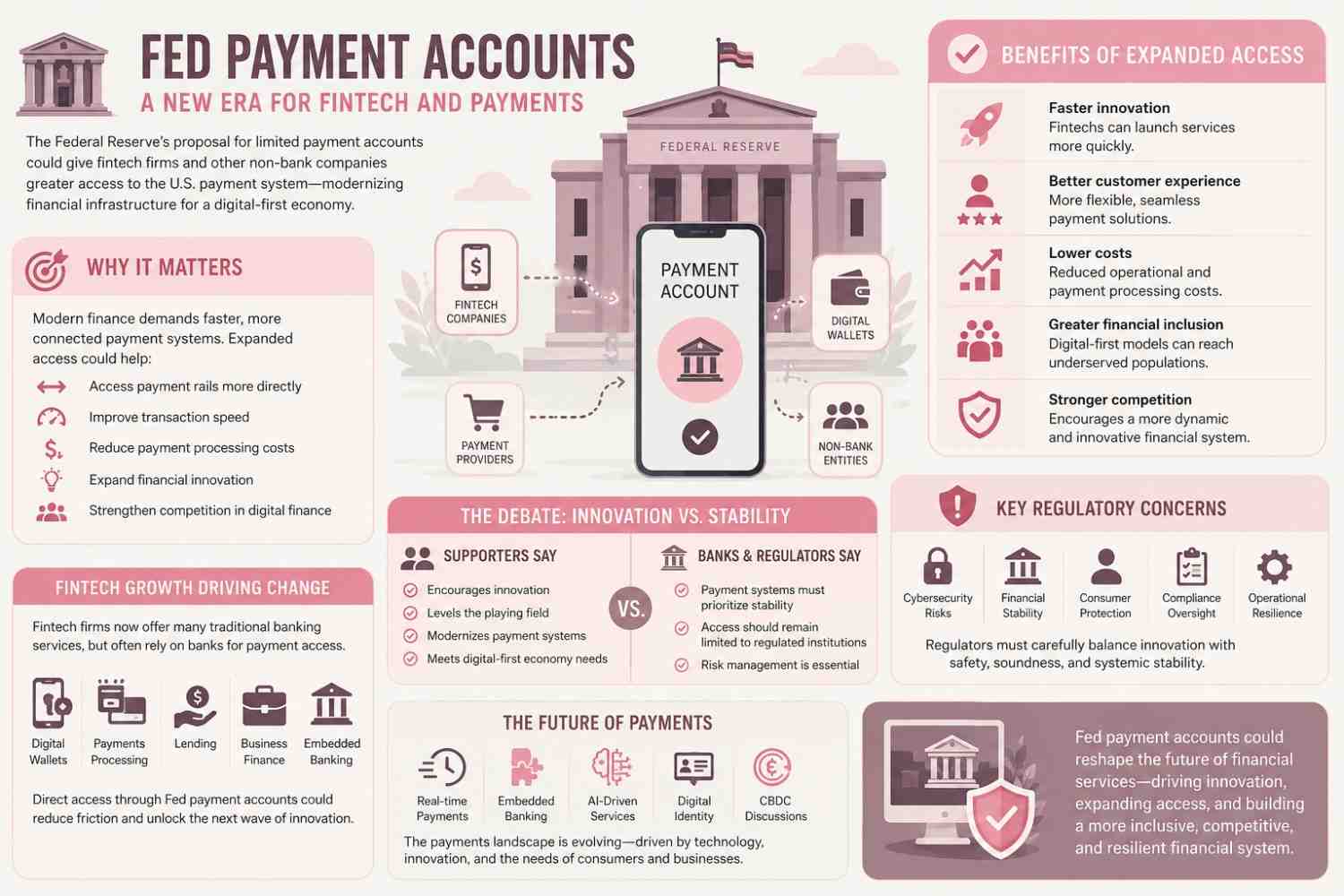
The Federal Reserve System has proposed limited payment accounts that could give fintech firms and other non-bank companies greater access to the US payment system. The proposal surrounding Fed payment accounts highlights the growing push to modernise financial infrastructure as digital finance continues evolving rapidly.
Traditionally, direct access to central bank payment systems has largely remained limited to licensed banks and regulated financial institutions. However, the rise of fintech companies, digital wallets, and embedded finance platforms is increasing pressure for broader access to payment infrastructure.
As a result, policymakers and industry leaders are debating how payment systems should evolve in a digital-first economy. Consequently, the discussion around Fed payment accounts could significantly influence the future of financial competition, innovation, and payment accessibility.
Moreover, the proposal reflects broader changes happening across global financial systems as regulators respond to rapid fintech growth and changing consumer payment behaviour.
Why Fed Payment Accounts Matter
Modern financial services increasingly depend on fast and connected payment infrastructure. Today, consumers and businesses expect real-time transactions, seamless digital banking, and mobile-first financial experiences.
Because of these expectations, fintech firms are seeking greater access to core payment systems traditionally controlled by banks.
The proposed Fed payment accounts could potentially allow eligible fintech companies and non-bank entities to:
- Access payment rails more directly
- Improve transaction speed
- Reduce payment processing costs
- Expand financial innovation
- Strengthen competition in digital finance
As a result, the proposal may reshape how financial services operate within the broader banking ecosystem.
Additionally, supporters argue that expanded payment access could improve efficiency and encourage innovation across the payments industry.
Fed Payment Accounts Could Expand Fintech Access
Fintech companies have grown rapidly over the past decade. Many now provide services traditionally associated with banks, including:
- Digital wallets
- Payments processing
- Consumer lending
- Business finance tools
- Embedded banking services
However, many fintech firms still rely heavily on partnerships with traditional banks to access payment infrastructure.
Because of this dependency, the proposed Fed payment accounts could reduce friction for fintech companies operating within digital finance markets.
Furthermore, broader payment access may help fintech firms:
- Launch services faster
- Improve customer experiences
- Lower operational costs
- Increase payment flexibility
- Expand financial inclusion initiatives
Consequently, many industry participants see the proposal as a potentially important step toward payment system modernisation.
Banking Industry Debate Continues to Grow
The proposal has also sparked debate within the traditional banking sector.
Some banking groups argue that central bank payment access should remain limited to fully regulated institutions because payment systems are critical to financial stability.
At the same time, fintech supporters argue that innovation may slow if payment infrastructure remains restricted to legacy banking models.
The discussion around Fed payment accounts, therefore, reflects broader tensions between:
- Financial innovation
- Regulatory oversight
- Banking competition
- Payment system security
- Market accessibility
Moreover, regulators must balance innovation with risk management as financial ecosystems become more digital and interconnected.
Digital Payments Continue Transforming Finance
The global payments industry continues evolving rapidly as consumers increasingly adopt:
- Mobile banking
- Contactless payments
- Digital wallets
- Real-time payment systems
- Embedded finance platforms
As a result, central banks worldwide are exploring ways to modernise payment infrastructure while maintaining stability and security.
The growing focus on Fed payment accounts reflects these wider industry trends shaping digital finance.
Additionally, fintech companies are becoming increasingly important participants within global payment ecosystems.
Therefore, policymakers are under growing pressure to create regulatory frameworks that support both innovation and financial safety.
Competition in Financial Services Is Increasing
Competition across financial services continues to intensify as fintech platforms expand into traditional banking areas.
Today, consumers can access financial services through:
- Digital banks
- Fintech apps
- E-commerce platforms
- Payment processors
- Technology companies
Because of this shift, many fintech firms are seeking more direct participation within payment networks.
The proposed Fed payment accounts may therefore support greater competition within financial markets.
At the same time, traditional financial institutions continue investing heavily in technology upgrades and digital transformation strategies.
Consequently, the line between banks and fintech companies is becoming increasingly blurred.
Regulatory Challenges Remain Important
Despite potential benefits, regulators still face major questions regarding payment access expansion.
Key concerns include:
- Cybersecurity risks
- Financial stability
- Consumer protection
- Compliance oversight
- Operational resilience
Because payment systems are central to the financial system, regulators must carefully evaluate how expanded access could affect broader market stability.
The debate around Fed payment accounts, therefore, involves both technological innovation and financial risk management.
Furthermore, policymakers may need to develop new supervisory models for fintech firms accessing central bank infrastructure.
Financial Inclusion May Benefit
Supporters of expanded payment access also argue that fintech innovation could improve financial inclusion.
Many fintech platforms already provide services to:
- Underserved consumers
- Small businesses
- Gig economy workers
- Underbanked populations
Because fintech firms often operate through digital-first models, they may reach users underserved by traditional banking systems.
The proposed Fed payment accounts could therefore help accelerate access to affordable digital financial services.
Additionally, faster and lower-cost payment systems may improve access to financial tools for smaller businesses and consumers.
Future Outlook for Fed Payment Accounts
Looking ahead, the future of payment infrastructure will likely continue evolving alongside digital finance innovation.
Several trends may shape the next phase of payment system development, including:
- Real-time payments
- Embedded banking
- AI-driven financial services
- Digital identity systems
- Central bank digital currency discussions
Because of these developments, the role of fintech companies within payment ecosystems is expected to expand further.
The discussion surrounding Fed payment accounts may therefore become increasingly important as financial technology continues to reshape global banking systems.
Final Thoughts
The Federal Reserve’s proposal for limited payment accounts reflects the growing transformation happening across digital finance and banking infrastructure.
As fintech firms expand their role within payments and financial services, access to core payment systems is becoming a major policy issue.
The debate over Fed payment accounts highlights the challenge of balancing innovation, competition, financial stability, and regulatory oversight in a rapidly changing financial landscape.
Ultimately, the future structure of payment infrastructure may significantly influence how consumers and businesses access financial services in the digital economy.
Comments
No comments yet. Be the first to share your thoughts.
Leave a comment