
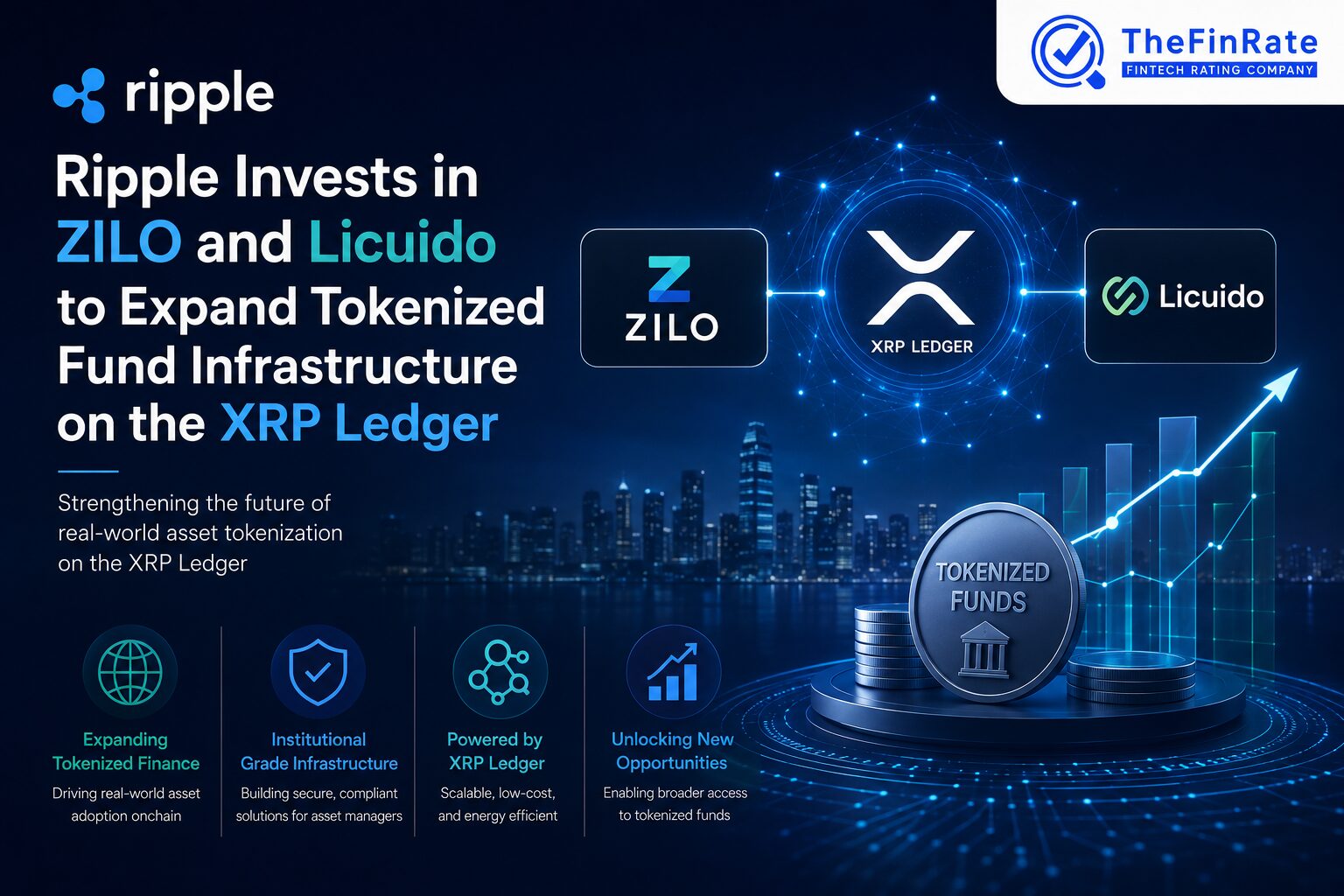
Ripple Invests in ZILO and Licuido to Expand Tokenized Fund Infrastructure on the XRP Ledger
Ripple has announced strategic investments in ZILO and Licuido, two UK-based digital capital markets companies, as it accelerates its push into institutional tokenization infrastructure on the XRP Ledger (XRPL).
The investments will strengthen the XRP Ledger’s capabilities across the full lifecycle of tokenized financial assets. This includes fund issuance, transfer agency services, distribution, settlement, and collateral management.
The announcement marks another important step in Ripple’s strategy to position XRPL as a foundation for regulated institutional capital markets rather than solely as a cross-border payments network.
Ripple expands beyond payments
For years, Ripple was primarily associated with international payments and blockchain-based settlement.
However, the company has increasingly focused on asset tokenization, which many financial institutions view as one of the next major phases of capital markets modernization.
By investing in ZILO and Licuido, Ripple is building infrastructure that supports how tokenized investment funds can be created, administered, transferred, and settled within regulated financial environments.
As a result, the XRP Ledger is evolving into a broader institutional financial infrastructure platform.
What the investments will add
According to Ripple, the partnership will introduce several key capabilities to the XRP Ledger ecosystem.
These include:
- Regulated transfer agency infrastructure
- Tokenized fund issuance capabilities
- Distribution and settlement infrastructure
- Collateral mobility for tokenized assets
- Support for delivery-versus-payment (DvP) transactions using RLUSD as the regulated cash settlement asset
Together, these components create a more complete infrastructure for institutional tokenized fund markets.
Licuido strengthens digital capital markets capabilities
Licuido plays a particularly important role in the new initiative.
The UK-based platform enables institutional clients to issue tokenized fund shares, distribute digital financial assets, trade tokenized securities, and use tokenized assets as digital collateral.
Because these services operate within a regulated framework, they address one of the most important challenges facing institutional tokenization: compliance and operational integration.
Consequently, Ripple’s investment gives the XRP Ledger stronger infrastructure for regulated digital asset markets.
Why tokenized funds matter
Tokenization converts traditional financial assets into blockchain-based digital representations.
For investment funds, tokenization can improve operational efficiency, reduce settlement times, increase transparency, and create new distribution opportunities.
Asset managers and financial institutions increasingly explore tokenized fund structures because they can simplify administration and enable programmable financial transactions.
Moreover, tokenized funds may improve liquidity and collateral efficiency across institutional markets.
Delivery-versus-payment becomes a key feature
One of the most significant aspects of the announcement is the planned support for delivery-versus-payment (DvP) transactions.
DvP ensures that the transfer of an asset and the transfer of cash occur simultaneously.
This reduces settlement risk and remains a core requirement for institutional securities markets.
Ripple plans to use RLUSD, its regulated stablecoin, as the cash settlement leg for these transactions.
Therefore, the company is connecting tokenized assets with regulated digital cash infrastructure on the XRP Ledger.
Ripple’s broader institutional strategy
The ZILO and Licuido investments fit within Ripple’s expanding institutional tokenization strategy.
The company has increasingly focused on infrastructure that supports regulated financial institutions, asset managers, and capital markets participants.
Earlier collaborations with firms such as Aviva Investors highlighted Ripple’s interest in helping financial institutions deploy tokenized investment products on blockchain infrastructure.
This latest announcement extends that strategy into fund administration, transfer agency services, and collateral management.
The UK’s growing role in tokenization
The investments also highlight the United Kingdom’s growing importance in digital capital markets.
London remains a major global financial center, and UK fintech firms have become increasingly active in blockchain-based securities infrastructure, tokenization, and regulated digital asset platforms.
By investing in UK-based companies, Ripple gains access to established financial market expertise and regulated capital markets infrastructure.
This could help accelerate institutional adoption of tokenized fund structures across European and international markets.
Market impact
For Ripple, the investments strengthen the XRP Ledger’s position in the rapidly developing tokenized asset ecosystem.
For ZILO and Licuido, the partnership provides access to Ripple’s global blockchain infrastructure and institutional network.
More broadly, the announcement signals that competition in digital finance is increasingly shifting toward capital markets infrastructure, where tokenized securities, regulated stablecoins, and blockchain-based settlement systems are becoming central to future financial market development.
As financial institutions continue exploring tokenized funds and blockchain-based asset management, infrastructure providers that can combine regulation, settlement efficiency, and institutional-grade operations are likely to play a critical role in the next phase of digital capital markets.
Ripple’s investment in ZILO and Licuido therefore represents more than a venture investment. It is a strategic move to build the infrastructure required for institutional tokenized fund issuance, administration, settlement, and collateral management on the XRP Ledger.
Comments
No comments yet. Be the first to share your thoughts.
Leave a comment