
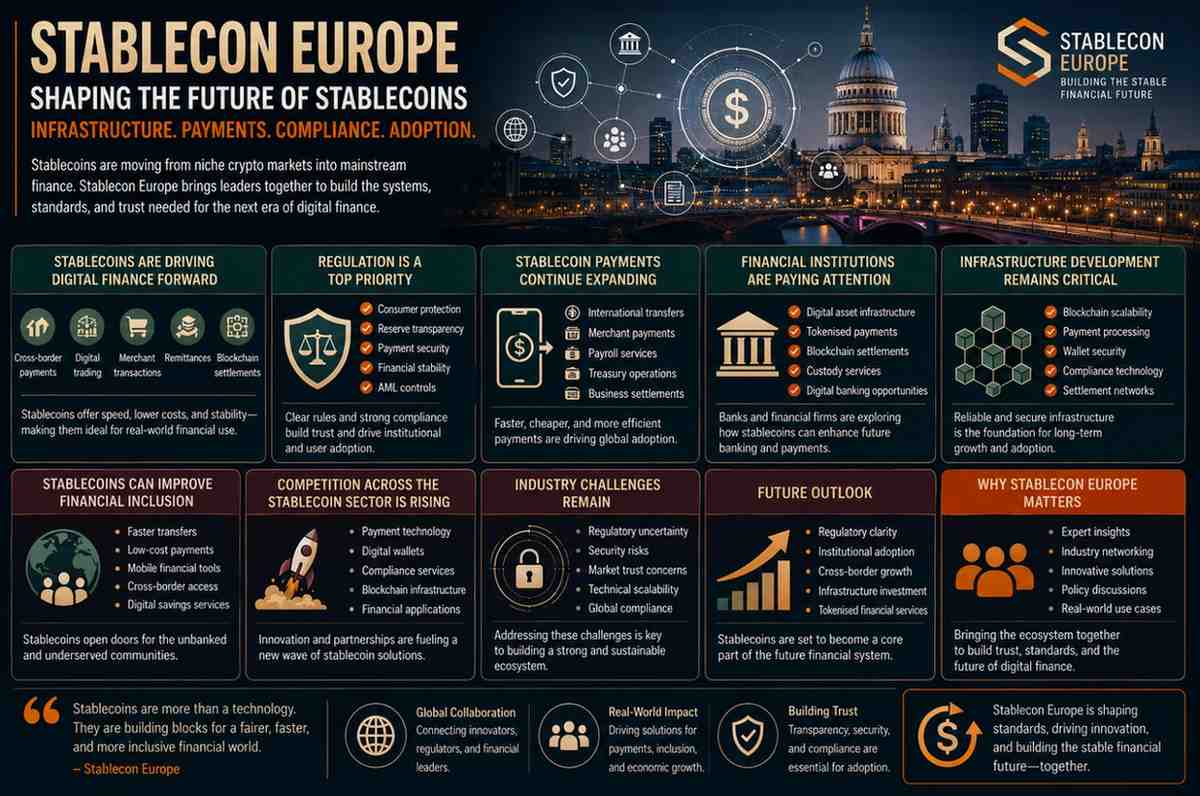
Stablecon Europe is highlighting how the stablecoin sector continues evolving as companies build infrastructure, payment systems, and compliance tools for a rapidly developing digital finance industry.
Over the past few years, stablecoins have moved beyond niche crypto markets and entered broader discussions around payments, banking, and financial infrastructure. As a result, fintech firms, banks, and blockchain startups are increasingly investing in stablecoin-related services.
Consequently, Stablecon Europe reflects growing industry interest in the future of stablecoins and digital asset adoption. Moreover, the event highlights how companies are building products for an industry that is still developing regulatory standards, business models, and market structure. At the same time, financial institutions are paying closer attention to digital asset innovation.
Stablecon Europe Highlights Stablecoin Growth
Stablecoins are becoming an increasingly important part of global digital finance.
Today, stablecoins are used for:
- Cross-border payments
- Digital trading
- Merchant transactions
- Remittances
- Blockchain settlements
Because stablecoins are linked to traditional currencies, many companies view them as a more stable alternative to volatile cryptocurrencies.
The discussions at Stablecon Europe show how the stablecoin market is gradually moving toward mainstream financial adoption.
Additionally, fintech firms are increasingly exploring stablecoin payment infrastructure to improve transaction speed and lower transfer costs.
As a result, stablecoins are attracting attention from both financial institutions and technology companies. Furthermore, payment providers are exploring new ways to integrate stablecoins into everyday financial services.
Regulation Remains a Major Focus at Stablecon Europe
Regulation continues shaping the future of the stablecoin industry.
Financial authorities across Europe are increasingly focused on:
- Consumer protection
- Reserve transparency
- Payment security
- Financial stability
- Anti-money laundering controls
Because stablecoins operate between traditional finance and blockchain technology, regulators are working to create clearer legal frameworks.
The conversations at Stablecon Europe reflect how regulation is becoming one of the most important issues for the sector.
Furthermore, companies believe stronger compliance standards could improve customer trust and institutional adoption.
Meanwhile, businesses are investing more heavily in legal and compliance teams as rules continue evolving. In addition, regulators are seeking ways to balance innovation with financial stability.
Stablecoin Payments Continue Expanding
Stablecoin-based payments are becoming more common across digital finance markets.
Companies are increasingly exploring stablecoins for:
- International transfers
- Merchant payments
- Payroll services
- Treasury operations
- Business settlements
Because traditional cross-border payments can still be slow and expensive, stablecoins offer faster transaction settlement and lower fees.
The growing attention at Stablecon Europe highlights how payment innovation remains one of the strongest drivers of stablecoin adoption.
Additionally, payment providers are developing tools that allow businesses to integrate stablecoins into existing financial systems.
Consequently, stablecoins are gradually becoming part of broader payment infrastructure discussions. At the same time, businesses are searching for faster and more cost-effective payment solutions.
Financial Institutions Are Watching Stablecon Europe Closely
Banks and financial firms are increasingly monitoring stablecoin growth and blockchain payment systems.
Financial institutions are evaluating:
- Digital asset infrastructure
- Tokenised payments
- Blockchain settlements
- Custody services
- Digital banking opportunities
Because digital finance continues evolving rapidly, many traditional firms want to understand how stablecoins could affect future banking systems.
The discussions at Stablecon Europe reflect rising institutional interest in blockchain-based financial services.
Moreover, some banks are already experimenting with tokenised payment solutions and digital asset services.
At the same time, financial firms remain cautious about regulatory uncertainty and operational risks. Nevertheless, many institutions continue investing in blockchain research and digital finance partnerships.
Infrastructure Development Remains Critical
The stablecoin industry still requires stronger infrastructure to support wider adoption.
Companies continue investing in:
- Blockchain scalability
- Payment processing systems
- Wallet security
- Compliance technology
- Settlement networks
Because stablecoin usage is growing, reliable infrastructure is becoming increasingly important for businesses and consumers.
The focus at Stablecon Europe highlights how industry participants are building long-term systems for digital finance growth.
Furthermore, infrastructure providers are working to improve transaction speed, security, and interoperability across blockchain networks.
As a result, competition among fintech infrastructure firms continues to increase. Meanwhile, developers are improving blockchain efficiency and payment reliability.
Stablecoins May Improve Financial Inclusion
Stablecoins may also improve financial access in underserved markets.
Digital asset services can help users access:
- Faster transfers
- Low-cost payments
- Mobile financial tools
- Cross-border transactions
- Digital savings services
Because many regions still face limited banking access, stablecoin-based financial services may help expand digital inclusion.
The conversations at Stablecon Europe reflect growing interest in how blockchain finance could improve global payment accessibility.
Additionally, fintech firms are exploring mobile-first solutions designed for emerging markets and international users.
Consequently, stablecoin services may help support broader digital finance adoption worldwide.
Competition Across the Stablecoin Sector Is Rising
The stablecoin market is becoming increasingly competitive as more companies enter the sector.
Today, firms are competing across:
- Payment technology
- Digital wallets
- Compliance services
- Blockchain infrastructure
- Financial applications
Because stablecoins are gaining mainstream attention, fintech firms and crypto companies are racing to build scalable products and partnerships.
The discussions at Stablecon Europe highlight how the industry is evolving from early experimentation toward broader commercial adoption.
Meanwhile, businesses are increasingly focusing on real-world financial use cases rather than speculative crypto activity. Furthermore, partnerships between fintech firms and payment providers continue expanding across the market.
Stablecon Europe Discusses Industry Challenges
Despite strong growth, the stablecoin sector still faces several major challenges.
Some key issues include:
- Regulatory uncertainty
- Security risks
- Market trust concerns
- Technical scalability
- Global compliance requirements
Because the industry is still developing, companies must balance innovation with financial safety and operational reliability.
The debates at Stablecon Europe show how industry leaders are working to address long-term market challenges.
Furthermore, firms are prioritising transparency and compliance to improve credibility with regulators and institutional partners.
At the same time, businesses continue improving security systems and operational controls.
Future Outlook for Stablecon Europe
Looking ahead, stablecoins are expected to remain an important part of digital finance discussions.
Several trends may shape the sector’s future, including:
- Regulatory clarity
- Institutional adoption
- Cross-border payment growth
- Blockchain infrastructure investment
- Tokenised financial services
Because digital payments and blockchain technology continue evolving, stablecoin adoption may continue expanding globally.
In addition, collaboration between fintech firms, regulators, and financial institutions may help strengthen the industry’s long-term development.
The growing importance of Stablecon Europe reflects how stablecoins are becoming increasingly connected to mainstream financial innovation. Meanwhile, investment in digital finance infrastructure is expected to keep growing.
Final Thoughts
Stablecon Europe highlights how the stablecoin industry is moving from early development toward broader financial integration.
As firms continue building infrastructure, payment tools, and compliance systems, stablecoins are becoming more important within digital finance markets.
The discussions surrounding Stablecon Europe reflect broader trends shaping the future of blockchain payments, digital assets, and fintech innovation.
Ultimately, companies that successfully combine regulation, scalability, and real-world utility may help define the next phase of stablecoin adoption.
Comments
No comments yet. Be the first to share your thoughts.
Leave a comment