
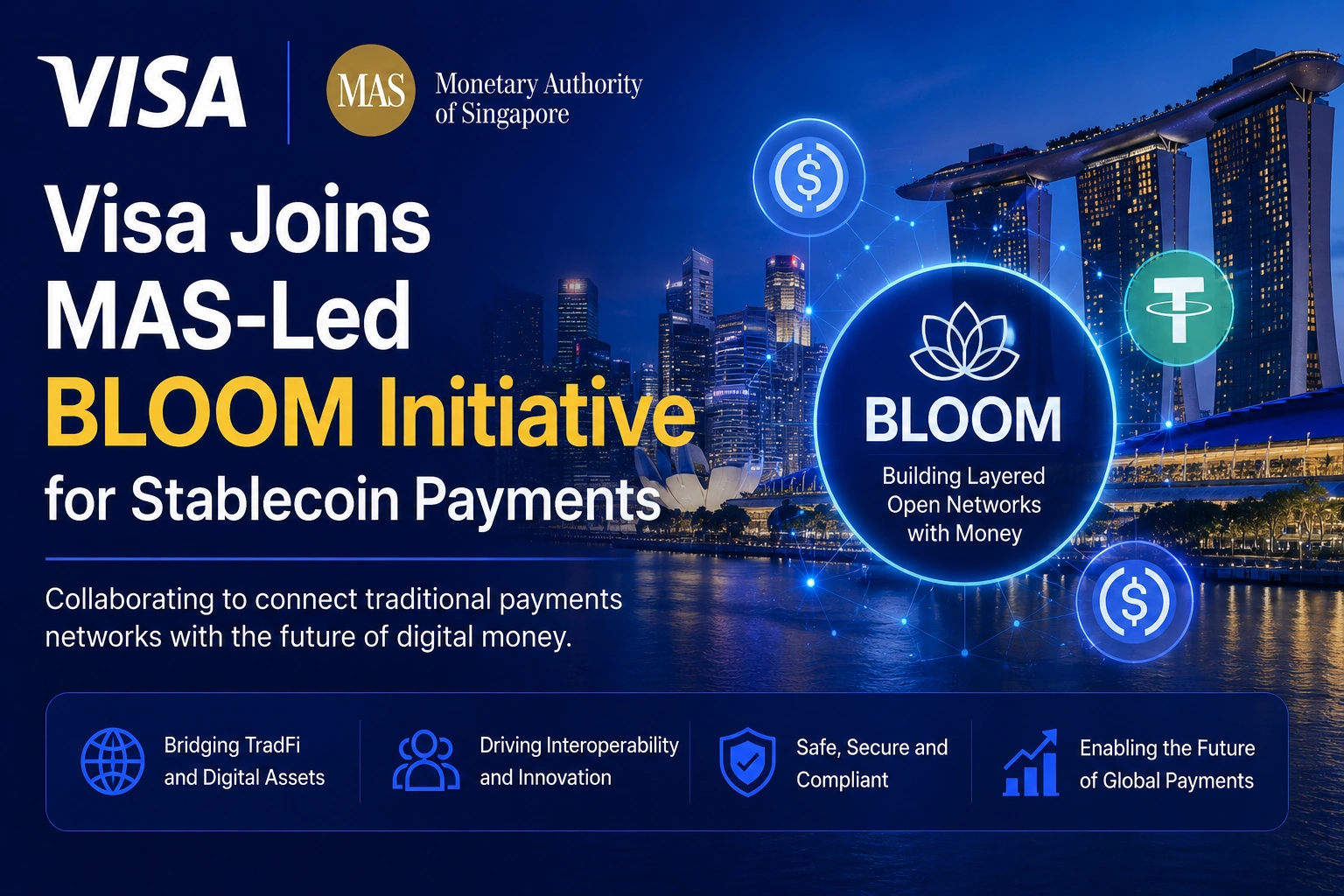
Visa Joins Singapore’s BLOOM Initiative to Connect Traditional Payments With Stablecoins
Visa has joined the Monetary Authority of Singapore’s BLOOM initiative as the payments company explores how stablecoins can work alongside traditional payment networks to make cross-border settlement faster, more flexible and available around the clock.
The announcement, made on August 25, 2026, brings Visa and Nium into a pilot under BLOOM, a MAS-led initiative focused on improving settlement capabilities for financial institutions. BLOOM is designed to explore interoperability between traditional payment systems and stablecoin-based payment rails.
The pilot will examine whether regulated stablecoins can allow financial institutions to settle payments seven days a week, including weekends and public holidays. That could help address one of the long-standing limitations of traditional cross-border settlement.
For Visa, the project is another step in its wider push to connect established payment infrastructure with blockchain-based financial technology.
Visa and Nium Will Test Stablecoin Settlement
Under the BLOOM initiative, Nium has become Visa’s first partner to pilot stablecoin settlement.
Nium is a Singapore-based global payments infrastructure company. Its services support cross-border money transfers and other financial payment operations.
The two companies will explore how stablecoins can be used to settle payment obligations while continuing to rely on Visa’s existing payment network, security controls and compliance infrastructure.
The focus is not on replacing traditional payment networks.
Instead, Visa and Nium are testing whether stablecoins can operate as an additional settlement layer behind existing payment experiences.
That distinction could be important for the financial industry.
Consumers and businesses may continue to use familiar cards, accounts and payment applications. At the settlement level, however, financial institutions could potentially use stablecoins to move value more quickly between participating parties.
The pilot will support regulated stablecoins backed by major currencies, including US dollar and euro-denominated stablecoins.
Why Seven-Day Settlement Matters
One of the most significant aspects of the pilot is its focus on seven-day settlement.
Traditional financial settlement often follows banking and business-day schedules. This can create delays when transactions are initiated late in the week or during public holidays.
For cross-border payments, the problem can become more complicated.
A transaction may involve institutions in different countries, multiple currencies and separate settlement windows. Even when the payment itself is initiated digitally, the underlying movement of funds may still depend on traditional financial infrastructure.
Stablecoins operate differently.
Because they are issued on blockchain networks, they can potentially support transactions outside traditional banking hours.
Visa and Nium are testing whether that feature can be applied to institutional settlement in a regulated environment.
If successful, participating financial institutions could potentially access settled funds on Saturdays, Sundays and public holidays instead of waiting for the next business day.
The companies say this could reduce delays, improve efficiency and provide financial institutions with faster access to funds.
What Is the BLOOM Initiative?
BLOOM stands for Borderless, Liquid, Open, Online and Multi-currency.
The initiative is led by the Monetary Authority of Singapore and is focused on extending settlement capabilities available to financial institutions.
MAS launched BLOOM as part of its broader work on digital financial infrastructure and tokenisation.
The initiative is designed to explore how different forms of digital money and settlement assets can work together across domestic and international transactions.
That includes tokenised bank liabilities and regulated stablecoins.
The broader goal is to develop a more connected financial system where different payment and settlement technologies can interact without forcing financial institutions to abandon existing infrastructure.
Singapore has increasingly positioned itself as a testing ground for regulated financial innovation.
BLOOM fits into that strategy by bringing established financial institutions, payment companies and digital-asset infrastructure providers into a common framework.
Visa’s participation gives the initiative another connection to the global payments ecosystem.
The Importance of Interoperability
Interoperability is at the heart of the Visa-BLOOM partnership.
The payments industry already operates across a large number of networks, currencies and financial institutions.
Adding stablecoins creates another layer that needs to work with the existing system.
If these networks remain isolated, businesses could end up managing separate systems for traditional money and digital assets.
That would reduce much of the potential efficiency.
Visa and Nium are instead exploring a model in which traditional payment networks and stablecoin rails can work together.
Visa has emphasized that interoperability between different forms of money and payment networks will be important as digital payments develop.
The company’s approach is to use stablecoins where they provide an advantage while maintaining the security, resilience and compliance standards associated with established payment infrastructure.
For financial institutions, that could be more practical than replacing existing systems entirely.
Stablecoins Move From Experiment Toward Infrastructure
The Visa-Nium pilot also shows how the role of stablecoins is changing.
For years, stablecoins were primarily discussed as a bridge between traditional currencies and cryptocurrency markets.
That role is expanding.
Financial companies are increasingly looking at stablecoins as potential infrastructure for moving and settling money.
The attraction is relatively simple.
A stablecoin designed to maintain a stable value against a major currency can potentially combine digital transfer capabilities with the stability of a traditional currency.
That makes regulated stablecoins potentially useful for financial applications that require predictable settlement values.
Visa has already been exploring this area.
In 2026, the company said it was expanding stablecoin settlement capabilities across regions, currencies and blockchain networks. Visa also reported that stablecoin settlement through its network had reached a significant scale.
The BLOOM pilot adds another layer to that strategy.
Instead of focusing only on stablecoin transactions, Visa is exploring how stablecoins can connect with broader institutional settlement infrastructure.
Nium Brings Cross-Border Payments Experience
Nium is a natural partner for this experiment because much of its business is built around international money movement.
The company provides infrastructure that allows banks, fintech companies and businesses to collect, convert and distribute funds across borders.
Nium has also been expanding its work around stablecoin payments and card infrastructure.
Its involvement in BLOOM therefore connects two areas of financial infrastructure that are developing quickly: cross-border payments and stablecoin settlement.
The companies can use the pilot to explore how blockchain-based settlement can work with the established payment network rather than operating separately from it.
For Nium, that could eventually help create faster settlement options for businesses moving money internationally.
For Visa, it provides another opportunity to test how stablecoins can support its global payment ecosystem.
What Could This Mean for Businesses?
Businesses may ultimately benefit from the changes even if they never directly use stablecoins.
Consider a company that receives payments from customers in several countries.
The business may need to manage multiple currencies, banking relationships and settlement schedules.
Delays in receiving funds can affect working capital and liquidity.
If financial institutions can settle transactions continuously, companies could potentially gain access to their funds sooner.
That could improve cash-flow management.
It could also reduce the operational friction associated with international payments.
However, the benefits will depend on how widely the settlement model is adopted.
A seven-day settlement system only provides significant value if the relevant financial institutions and payment partners can connect to it.
The current Visa-Nium initiative is therefore an important test rather than a finished product.
Consumers May Not Notice the Underlying Technology
One interesting aspect of stablecoin settlement is that consumers may not need to interact with the technology directly.
A customer could continue paying through a card or another familiar payment method.
Behind the scenes, participating financial institutions could potentially use stablecoins to settle the transaction.
That means the blockchain component could remain largely invisible.
This is similar to how other financial infrastructure works today.
Consumers generally do not think about the systems that move funds between banks after they make a payment.
If stablecoin settlement becomes widely adopted, it could work in much the same way.
The important change would happen underneath the payment experience.
For businesses, however, the impact could be more visible through faster settlement, improved liquidity and potentially lower operational friction.
Singapore Strengthens Its Role in Digital Finance
The announcement also reinforces Singapore’s growing role in digital financial infrastructure.
MAS has spent years working with financial institutions and technology companies on tokenisation, digital money and cross-border payments.
BLOOM is part of that broader effort.
The initiative is designed to bring public-sector oversight together with private-sector experimentation.
That model is particularly relevant for stablecoins.
The technology can potentially make payments faster and more programmable. However, financial institutions also need strong controls around reserves, compliance, risk management and customer protection.
MAS’s involvement gives the project a regulated environment in which those issues can be addressed.
Visa’s Broader Stablecoin Strategy
BLOOM is not an isolated move for Visa.
The company has been building several pieces of infrastructure around digital assets and tokenised money.
Visa has explored stablecoin settlement, stablecoin-backed cards and tokenised assets while continuing to operate its traditional payment network.
The company has also been expanding its work around programmable payments and digital commerce.
The common thread is infrastructure.
Visa is not simply experimenting with individual digital-asset products.
It is trying to make its existing network compatible with new forms of money and new ways of conducting transactions.
BLOOM fits directly into that approach.
The Challenge Will Be Regulation and Trust
Despite the potential benefits, stablecoin settlement is not without challenges.
Financial institutions need confidence that the assets being used for settlement maintain their value and can be redeemed reliably.
They also need clear rules around compliance, transaction monitoring, risk management and operational resilience.
That is why the word “regulated” is important in the Visa-Nium announcement.
The pilot will use stablecoins backed by major currencies, including US dollar and euro-denominated stablecoins.
The objective is not to create an alternative financial system outside regulation.
Instead, the companies are exploring how digital settlement can fit within the existing financial system.
That may ultimately be the more important development.
If stablecoins can meet institutional requirements, they could become another piece of mainstream financial infrastructure.
What Comes Next?
The immediate next step is the Visa-Nium pilot under BLOOM.
The companies will need to demonstrate that stablecoin settlement can operate reliably and securely while connecting with traditional payment infrastructure.
The pilot will also help determine whether seven-day settlement can deliver meaningful improvements for financial institutions.
If the model works, other payment companies and financial institutions could eventually adopt similar approaches.
That could accelerate the development of always-on cross-border settlement.
It could also encourage more businesses to think about stablecoins as financial infrastructure rather than simply as digital assets.
Conclusion
Visa’s participation in Singapore’s BLOOM initiative marks an important step in the convergence of traditional payments and stablecoin technology.
The partnership with Nium will test whether regulated stablecoins can support settlement seven days a week, including weekends and public holidays.
The potential benefits are significant.
Financial institutions could gain faster access to funds. Businesses could benefit from improved liquidity and more efficient cross-border money movement. Consumers could eventually experience faster and more seamless payments without having to interact with stablecoins directly.
But the project is still at the pilot stage.
The biggest challenge will be proving that stablecoin settlement can operate at institutional scale while meeting the security, compliance and risk standards expected from the global financial system.
For Singapore, BLOOM strengthens its position as a hub for regulated digital finance experimentation.
For Visa, the initiative is another step toward building a payment network that can work with multiple forms of digital money.
For the broader financial industry, the project points toward a future where traditional payment networks and stablecoin rails may no longer exist as separate systems.
Instead, they could become connected parts of a faster, more programmable and increasingly always-on global payments infrastructure.
Comments
No comments yet. Be the first to share your thoughts.
Leave a comment