
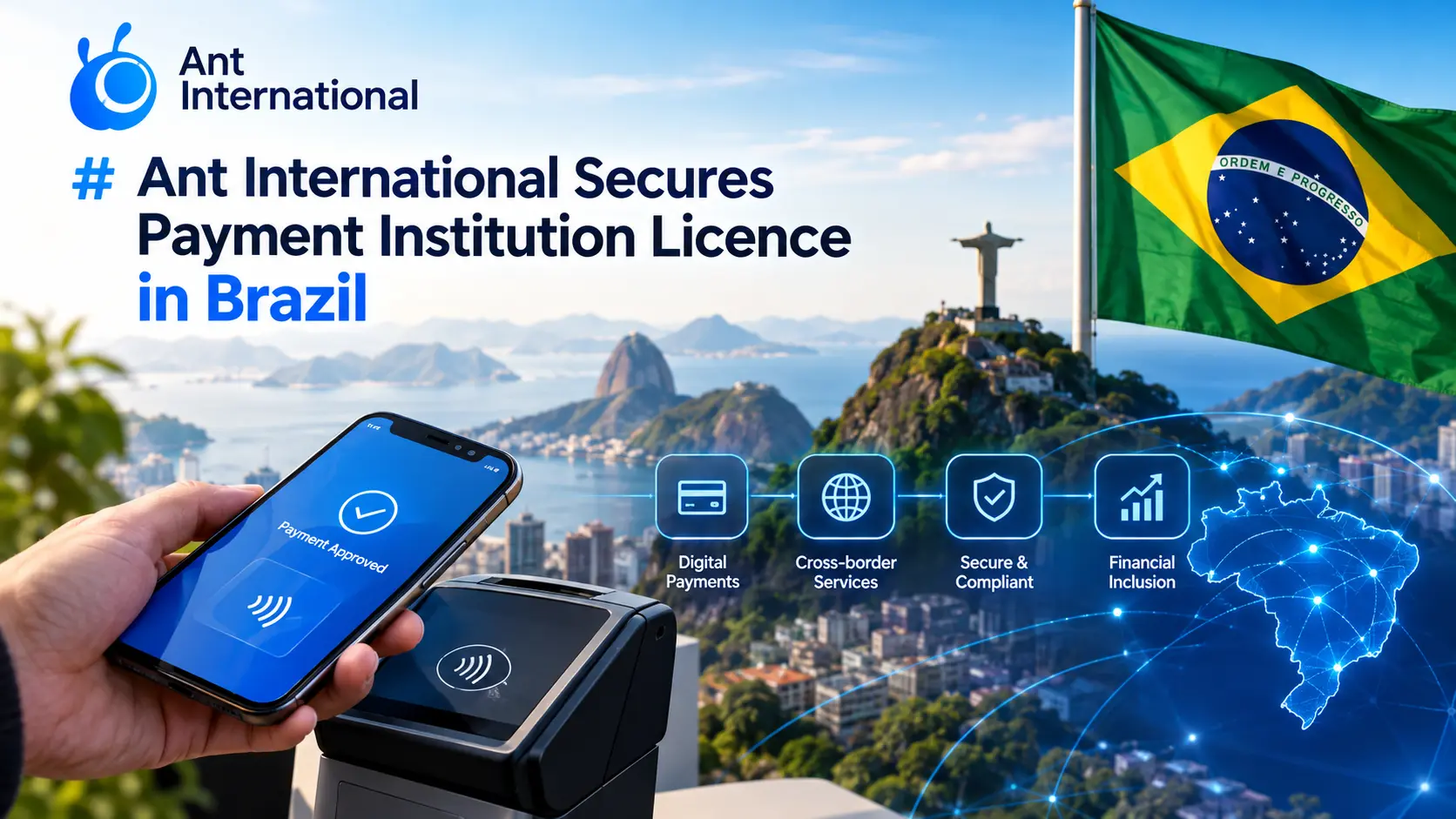
Ant International has secured a Payment Institution (PI) license from the Central Bank of Brazil, strengthening its ability to provide local and cross-border payment services as it expands its financial technology operations in Latin America.
Ant International said on September 4 that it had received the license from Banco Central do Brasil. The authorization gives the company a stronger regulated position in Brazil and is expected to support broader payment and account services for enterprises, platforms, and small and medium-sized businesses.
The move also expands the role of Ant International’s existing merchant payments business, Antom, in one of Latin America’s most advanced digital payments markets.
Ant International Deepens Its Brazil Payments Strategy
The new Brazil payment license builds on Ant International’s existing operations through Antom, its merchant payment and digitalization platform.
Antom enables merchants to accept Pix, credit cards and a range of alternative payment methods. The company said the new licence will strengthen both its local and cross-border payment capabilities in Brazil.
For Ant International, the licence provides a foundation for deeper engagement with Brazil’s payments ecosystem. It also comes as global payment providers increasingly look to connect domestic payment infrastructure with international commerce.
FinTech Futures reported that Antom has expanded its reach across Latin America, where it supports Pix-based solutions, cards and other payment methods.
Licence Expands Services for Businesses and SMEs
Ant International said the new authorization will help it provide more comprehensive payment and account services to enterprises, platforms, and SMEs.
Rodrigo Reif, General Manager of Ant International Brazil, said the company plans to work more closely with Brazil’s payments ecosystem and financial services industry.
The focus extends beyond payment acceptance. Ant International provides cross-border payments and account services, embedded credit and treasury services, as well as financial AI and blockchain solutions across its international operations.
That combination could become increasingly important for companies operating across borders. Businesses selling internationally often need payment acceptance, currency management, settlement and treasury capabilities to work together rather than through separate providers.
Why Brazil Matters to Global Payments
Brazil has become a key market for digital payments, helped by the rapid adoption of Pix and the country’s highly developed financial infrastructure.
For international payment companies, connecting into that ecosystem can provide a route to both domestic merchant activity and cross-border commerce.
Ant International’s existing Antom platform already supports Pix alongside cards and alternative payment methods. The new regulatory approval gives the company an opportunity to build a broader local payments operation around those capabilities.
The development is therefore about more than simply adding another market licence. It strengthens the connection between Ant International’s global payment network and Brazil’s domestic financial infrastructure.
Ant International Brings FinAI Into the Payments Push
Ant International is also positioning financial artificial intelligence, or FinAI, as part of its broader expansion strategy.
The company provides AI and blockchain-based solutions alongside payments, account services, embedded credit and treasury capabilities. Its Brazil announcement specifically highlights the potential to support local partners with FinAI solutions.
The strategy reflects a wider shift in financial infrastructure. Payment providers are increasingly moving beyond transaction processing toward services that help businesses manage liquidity, risk, foreign exchange and financial operations.
For Brazilian businesses involved in international trade, combining payment connectivity with these additional financial services could become a significant competitive advantage.
Scale Behind the Expansion
Ant International said its digital payment ecosystem processes more than 20 million transactions each day and connects 2 billion consumer accounts with 150 million merchants globally. These figures are company-reported.
The company has also been investing heavily in its international expansion.
In July, Ant International announced a $1.2 billion Series A funding round, with the company saying the capital would support areas including merchant payments, account management and cross-border financial services. PYMNTS also linked the Brazil licence to Ant International’s broader expansion in cross-border payments and financial services.
The Brazil licence consequently arrives at an important point in the company’s international growth strategy.
What the Licence Could Mean for Cross-Border Payments
The biggest opportunity may lie in connecting Brazil’s domestic payment infrastructure with Ant International’s global network.
Cross-border commerce continues to create demand for faster payment processing, easier merchant acceptance and more integrated financial management. A locally regulated payment operation can help international providers develop those services with greater alignment to domestic market requirements.
For merchants, the value proposition could increasingly extend beyond accepting payments. Access to account services, treasury tools, embedded financial products and AI-driven financial insights could create a broader business-finance platform.
That is where Ant International’s Brazil strategy could become more significant over time.
A Strategic Step for Ant International
The Central Bank of Brazil’s PI licence marks a meaningful regulatory milestone for Ant International.
The company already had a presence in Brazil through Antom. The new licence strengthens its ability to develop local and cross-border payment capabilities while supporting its wider push into account services, FinAI and financial infrastructure.
Brazil’s sophisticated digital payments ecosystem makes it an important market for global fintech companies. For Ant International, deeper regulatory integration could help turn its existing merchant payment presence into a broader financial-services operation.
The next stage will be whether the company can translate that regulatory access into wider adoption among Brazilian businesses, platforms and SMEs.
For the global payments industry, the development is another sign that international fintech expansion is increasingly being built around local regulatory licences combined with global payment connectivity.
Comments
No comments yet. Be the first to share your thoughts.
Leave a comment