
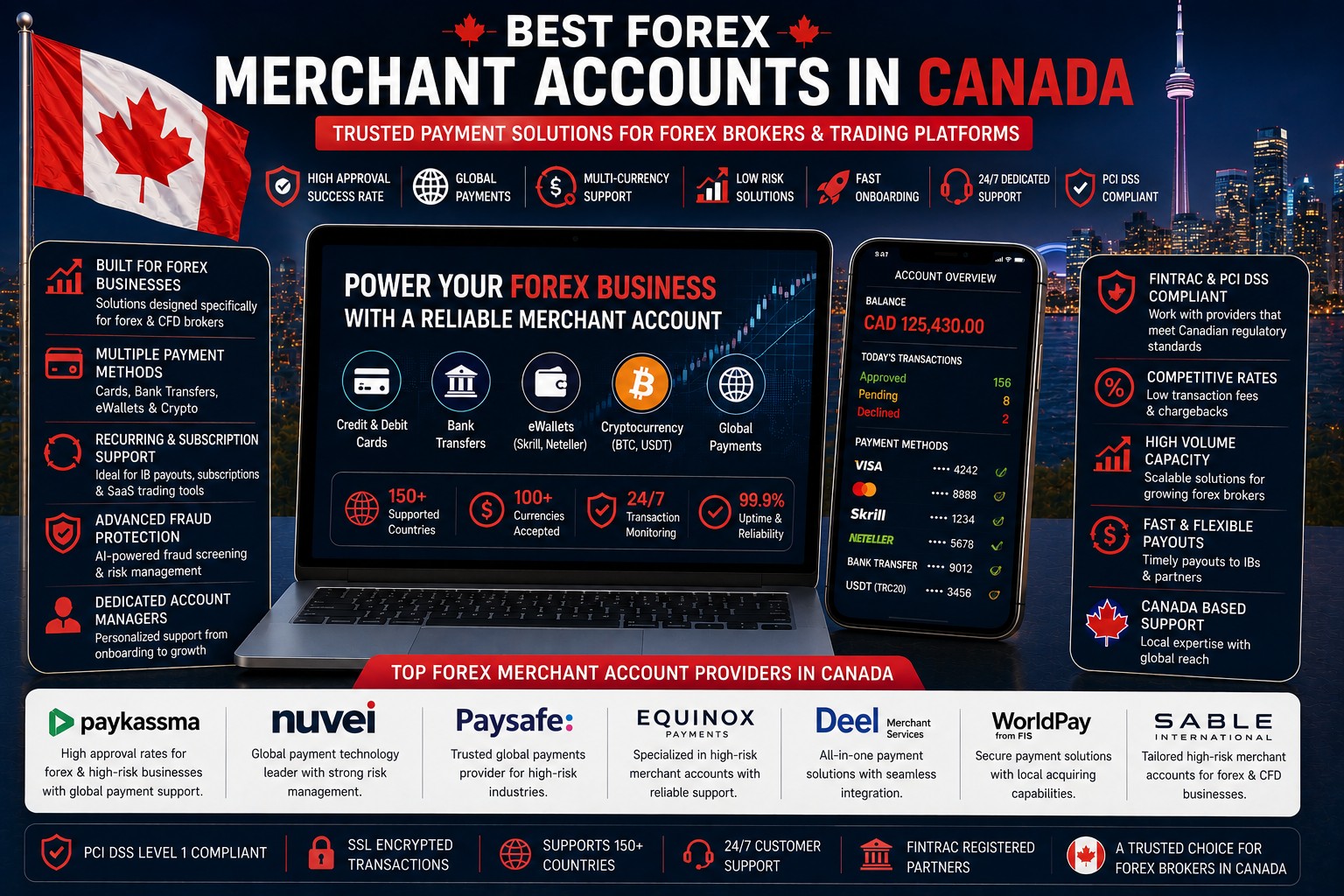
Canada has a large and growing base of retail forex and CFD traders, but Canadian forex brokers and trading platforms face many of the same payment processing hurdles as their US and UK counterparts: mainstream processors routinely decline forex applications outright, and even approved accounts can face fund holds during risk reviews. Add in Canada-specific regulatory layers — the Code of Conduct for the Payment Card Industry in Canada, provincial securities regulation for brokers, and PIPEDA data protection requirements — and finding the right payment partner becomes a genuinely specialized task.
This guide compares the 10 best forex merchant account providers serving Canadian forex brokers, prop-trading platforms, and forex education businesses in 2026, along with what Canadian acquirers look for and how to avoid the account freezes that are common in this industry.
Why Forex Merchant Accounts Are High-Risk in Canada
- Provincial and national securities oversight. Canadian forex and CFD activity intersects with provincial securities regulators and, in some cases, the Canadian Investment Regulatory Organization (CIRO), adding a layer of regulatory complexity that acquiring banks factor into underwriting.
- Elevated chargeback exposure. As with every market, traders who lose money sometimes dispute the original deposit, and Canadian acquirers monitor dispute ratios closely as part of ongoing account risk reviews.
- Cross-border client bases. Canadian-facing brokers frequently serve US, European, and international clients simultaneously, increasing both fraud-screening complexity and settlement risk.
- High average transaction values. Forex deposits and withdrawals tend to run well above typical Canadian retail transaction sizes, raising the stakes of any single dispute or fraud event for the acquiring bank.
- PIPEDA compliance requirements. Canada’s federal privacy law adds documentation and data-handling obligations that payment providers factor into onboarding for financial services merchants.
What Canadian Forex Merchants Should Look for in a Provider
- Genuine forex or high-risk financial services experience rather than a generic high-risk label bolted onto a standard e-commerce processor.
- CAD settlement alongside USD and other major currencies, since most Canadian brokers still need to serve US and international clients.
- Transparent reserve terms. Rolling reserves are standard for forex; get the exact percentage and release schedule in writing.
- Documented approval timelines. Canadian high-risk approvals commonly take a few business days to a few weeks depending on documentation completeness and business risk profile.
- Chargeback and fraud tooling built for forex-style dispute patterns rather than generic retail fraud prevention.
- A track record of processing stability, since sudden account termination — not the headline rate — is the biggest real-world cost in this space.
With that framework in mind, here are the 10 forex merchant account providers worth evaluating for Canadian businesses in 2026.
- WebPays
WebPays is a high-risk payment specialist whose forex-focused content spans multiple English-speaking markets, including North America. The company markets multi-currency support across 100+ currencies and 35+ alternative payment methods, along with chargeback alert tooling — both directly relevant to Canadian brokers managing cross-border deposits from US and international clients.
Why it’s on this list: WebPays’ published underwriting guidance around dispute ratio thresholds gives Canadian forex merchants a useful benchmark before they apply, rather than discovering acceptable ratios after the fact.
Best for: Canadian forex platforms that also serve US clients and need broad currency and payment method coverage.
- PayCly
PayCly is a global high-risk payment gateway and merchant account provider that explicitly supports both regulated and unregulated forex merchants, with coverage across 150+ countries and 100+ currencies. For Canadian brokers operating under provincial licensing or those serving clients in jurisdictions with lighter regulatory regimes, PayCly’s willingness to underwrite unregulated forex activity (where legally permissible) broadens the pool of eligible merchants beyond top-tier-licensed brokers only.
Why it’s on this list: PayCly’s PCI DSS Level 1 compliance and dedicated merchant dashboard give Canadian forex businesses enterprise-grade infrastructure without needing to build it in-house.
Best for: Canadian brokers who need a processor comfortable with a broader risk spectrum, from regulated to newly established operations.
- Amald
Amald supports forex, gaming, casino, and IPTV merchants with both 3DS and non-3DS transaction routing plus ACH/eCheck alternatives — useful for Canadian forex platforms that want funding options beyond card-based deposits, especially given how card-network restrictions on forex trading vary by jurisdiction across North America.
Why it’s on this list: Amald frames its “higher risk appetite” as a way to reduce sudden account terminations, a pain point Canadian forex merchants report just as often as their US and UK counterparts.
Best for: Canadian forex education businesses and platforms wanting ACH/eCheck alongside card processing.
- eLotPay
eLotPay provides offshore and cross-border payment infrastructure, including dedicated IBANs and virtual accounts, for forex, gaming, and eCommerce merchants. Canadian brokers managing multi-currency settlement — CAD, USD, EUR, and beyond — can use eLotPay’s virtual account structure to consolidate collections without opening a separate banking relationship in every market served.
Why it’s on this list: The dedicated IBAN offering is a differentiator for Canadian brokers with meaningful European client volume who need to settle in EUR without excessive conversion costs.
Best for: Canadian forex brokers with a significant international, particularly European, client base.
- InQuid
InQuid explicitly lists Canada among the markets it serves alongside the UK, USA, and Europe, and publishes country-specific forex merchant account content — a meaningful differentiator in a space where most processors offer only generic global pages. InQuid emphasizes smart transaction routing, elevated chargeback thresholds, and real human underwriting support rather than pure automation.
Why it’s on this list: InQuid’s stated 3–7 business day underwriting timeline and settlement support across USD, EUR, GBP, AED, SGD, and 150+ additional currencies make it a strong fit for Canadian brokers with genuinely global client bases.
Best for: Canadian forex brokers who also operate in the UK, US, or Europe and want one processing relationship across regions.
- BoxCharge
BoxCharge offers a dedicated forex trading merchant account with multi-currency processing for both deposits and withdrawals, plus PCI-DSS compliance. Its acquiring relationships are concentrated in Southeast Asia, which is a useful complement for Canadian brokers with an Asia-Pacific-facing client segment alongside their North American book.
Why it’s on this list: BoxCharge’s virtual named accounts support multi-currency collection, relevant for Canadian platforms taking deposits from clients across several regions simultaneously.
Best for: Canadian forex brokers with meaningful Asia-Pacific trading volume.
- Corepay
Corepay offers regional acquiring across the US, EU, UK, and Australia, with forex merchant account services built for both fully licensed trading platforms and forex education businesses (software, newsletters, courses, seminars). While Corepay’s regional acquiring list doesn’t include Canada specifically among its named regions, its multi-region infrastructure and forex-specific compliance content are useful reference points for Canadian brokers with meaningful US-facing volume.
Why it’s on this list: Corepay’s transparency about card-network restrictions on retail forex funding, and its structured alternative of debit/ACH/multi-currency options, reflects the kind of forex-specific expertise that translates well across North American markets.
Best for: Canadian forex education businesses with significant cross-border US volume.
- QuadraPay
QuadraPay is a Canada-focused high-risk payment specialist offering fast PSP setup for gaming, forex, and travel merchant accounts. QuadraPay markets itself directly to Canadian businesses struggling with strict underwriting policies at mainstream acquirers, positioning its forex merchant account offering alongside gaming and travel as part of a broader high-risk portfolio.
Why it’s on this list: As a provider marketing specifically to the Canadian high-risk segment, QuadraPay’s underwriting process is built around Canadian documentation norms and acquiring relationships from the outset.
Best for: Canadian-domiciled forex businesses that want a processor whose primary market focus is Canada itself.
- CARDZ3N Canada
CARDZ3N is a Canada-specific high-risk merchant account provider covering sectors including adult entertainment, CBD, travel, and forex, with a stated focus on cutting disputes, lowering fees, and supporting cross-border growth for Canadian businesses. CARDZ3N emphasizes fraud prevention, multi-currency support, and real-time reporting as core features of its high-risk merchant services.
Why it’s on this list: CARDZ3N’s dedicated Canadian market presence (en-ca domain and Canada-specific content) signals familiarity with Canadian banking norms and documentation expectations that generic global processors may lack.
Best for: Canadian forex-adjacent businesses that want a provider built specifically around the Canadian high-risk landscape.
- SecureGlobalPay
SecureGlobalPay is a payment services provider supporting high-risk and hard-to-place merchants across the US, Canada, the EU, and the UK, with explicit content addressing Canadian regulatory considerations including the Code of Conduct for the Payment Card Industry in Canada and PIPEDA compliance. SecureGlobalPay offers card payments, ACH, eCheck, and alternative payment methods for Canadian high-risk merchants.
Why it’s on this list: SecureGlobalPay’s direct acknowledgment of Canada-specific regulatory frameworks — rather than treating Canada as an extension of US underwriting — is a meaningful signal of market-specific expertise.
Best for: Canadian businesses that want a provider with documented awareness of Canadian payment card industry and privacy regulations.
Comparison at a Glance
| Provider | Regional Focus | Notable Strength | Best For |
| WebPays | Global/North America | Multi-currency, chargeback alerts | Cross-border CAD/USD brokers |
| PayCly | Global | Regulated & unregulated forex support | Broader risk-spectrum merchants |
| Amald | Global | ACH/eCheck + card routing flexibility | Forex education businesses |
| eLotPay | Cross-border | Virtual IBANs, dedicated accounts | European client settlement |
| InQuid | Canada/UK/US/EU | Multi-region, published Canada coverage | Multi-country brokers |
| BoxCharge | Southeast Asia | Deposit/withdrawal tools | APAC-facing Canadian brokers |
| Corepay | US/EU/UK/AU | Forex education + trading platforms | US-facing Canadian volume |
| QuadraPay | Canada-native | Canadian-market underwriting | Canada-domiciled forex businesses |
| CARDZ3N | Canada-native | Fraud prevention, real-time reporting | Canadian high-risk merchants |
| SecureGlobalPay | US/Canada/EU/UK | Canada-specific regulatory awareness | PIPEDA/Code of Conduct compliance |
Canadian Regulatory Considerations for Forex Payment Processing
Payment processing for Canadian forex businesses sits on top of a distinct regulatory framework worth understanding before you apply.
- Code of Conduct for the Payment Card Industry in Canada. This voluntary code, overseen by the Financial Consumer Agency of Canada, governs how payment card networks and acquirers must treat merchants, including disclosure requirements around fees and contract terms — relevant when comparing pricing across the providers above.
- PIPEDA (Personal Information Protection and Electronic Documents Act). Canada’s federal privacy law imposes data-handling obligations on any business collecting client financial and personal information, including forex brokers processing deposits and KYC documentation. Payment providers factor PIPEDA compliance into their own onboarding and data-security requirements.
- Provincial securities regulation. Forex and CFD trading activity can fall under provincial securities regulators depending on how a platform is structured, and increasingly under the Canadian Investment Regulatory Organization (CIRO) framework — payment providers will typically ask about this regulatory status during underwriting.
- No uniform national forex-specific rule equivalent to the US CFTC’s credit-card funding ban, but Canadian acquirers still apply their own risk-based restrictions on funding methods, which is why alternative payment rails (ACH, eCheck, wire) remain common in this space.
None of this constitutes legal advice — Canadian forex businesses should confirm their specific regulatory obligations with a securities or financial services lawyer — but understanding this landscape clarifies why Canadian forex merchant accounts require specialist underwriting rather than a standard e-commerce application.
Managing Chargebacks on a Canadian Forex Merchant Account
Chargeback management deserves particular attention because dispute ratios, not initial approval, are the most common reason forex accounts get reviewed or terminated after go-live.
- Document trader consent clearly at deposit. Terms covering leverage, margin calls, and withdrawal timelines should be presented and acknowledged before funds move — tools from providers like Amald and BoxCharge can help capture this consent trail for later dispute evidence.
- Respond to disputes within the card network’s window. A missed or late response is typically treated the same as accepting the chargeback, which is why providers offering dedicated account management, such as QuadraPay and CARDZ3N, tend to produce better representment outcomes than purely self-service platforms.
- Track your dispute ratio as a trend, not a single number. Canadian acquirers, like their US and UK counterparts, monitor chargeback-to-transaction ratios over time, so catching an upward trend early lets you intervene before it triggers a formal review.
- Use fraud-screening tools appropriate to cross-border volume. AVS, velocity checks, and 3D Secure where supported all reduce fraud-related disputes, particularly relevant for Canadian brokers processing deposits from US and international clients simultaneously.
- Understand your reserve release schedule. Because reserves exist specifically to buffer chargeback exposure, knowing exactly when funds release avoids cash-flow surprises during a growth quarter.
How to Apply for a Forex Merchant Account in Canada
- Assemble your documentation early. Business registration, financial statements, identification, processing history, and any provincial regulatory registration should be ready before you apply.
- Disclose your business model clearly. Whether you’re a regulated broker, a forex education platform, or a cross-border operation serving US and international clients, transparency speeds up underwriting significantly.
- Expect a rolling reserve. As with every major market, Canadian forex accounts typically carry a reserve — confirm the exact percentage and release schedule in writing before signing.
- Plan your currency mix from day one. If you’ll settle in CAD but accept USD, EUR, or other currencies, confirm which currencies each provider settles natively versus converts.
- Consider a backup processing relationship. Given how frequently high-risk accounts face reviews or holds, many established Canadian forex businesses maintain a second provider relationship as a contingency.
Frequently Asked Questions
Is forex trading payment processing legal in Canada? Yes, forex trading itself is legal in Canada, though the businesses offering it may fall under provincial securities regulation or CIRO oversight depending on structure — payment providers assess this regulatory status as part of underwriting.
How long does it take to get a forex merchant account approved in Canada? Most specialist providers quote a range from a few business days (for straightforward, well-documented applications) to a few weeks for more complex or higher-risk structures.
Can a Canadian forex business get a merchant account that also serves US clients? Yes — several providers on this list, including WebPays, InQuid, and Corepay, offer multi-region acquiring that supports both CAD and USD settlement for brokers serving cross-border clients.
What documentation does PIPEDA compliance require for payment processing? While PIPEDA itself is a privacy law rather than a payment regulation, Canadian forex businesses need clear data-handling and consent policies for any personal or financial information collected during onboarding and KYC — payment providers typically request evidence of these policies during underwriting.
Are reserve terms different in Canada compared to the US or UK? Reserve terms vary primarily by provider and business risk profile rather than country, though Canadian-focused providers like QuadraPay and CARDZ3N structure their terms around Canadian banking norms specifically — always request written terms rather than assuming parity with US or UK accounts.
Do Canadian forex merchant accounts support cryptocurrency settlement? Some providers in this space, including offshore-focused processors, offer crypto payment rails alongside traditional card and ACH processing, though this varies significantly by provider — confirm directly if crypto settlement matters for your business model.
What’s the difference between a Canadian and a US-domiciled processor for a Canada-based broker? A Canada-native provider like QuadraPay or CARDZ3N typically has more direct familiarity with Canadian banking documentation and the Code of Conduct for the Payment Card Industry in Canada, while a US-domiciled processor serving Canada, such as SecureGlobalPay, may offer broader acquiring bank relationships across multiple countries at once — the right choice depends on whether your priority is local expertise or cross-border reach.
Should a Canadian forex broker maintain accounts with more than one provider? Many established Canadian forex businesses do, specifically to avoid a single point of failure — if one processing relationship faces a hold or review, a backup account keeps revenue flowing while the issue resolves.
Final Thoughts
Canadian forex brokers and trading platforms face the same core payment processing challenge as their US and UK counterparts — mainstream processors decline the vertical outright, leaving specialist high-risk providers as the practical path forward. Providers like WebPays, PayCly, InQuid, Amald, eLotPay, and BoxCharge bring global high-risk expertise with real forex specialization, while Canada-native providers like QuadraPay, CARDZ3N, and SecureGlobalPay bring direct familiarity with Canadian regulatory frameworks and banking norms. Corepay rounds out the list with useful cross-border infrastructure for Canadian businesses with significant US-facing volume. As always, compare written reserve terms, confirm native CAD/USD settlement, and verify each provider’s actual experience with Canadian documentation requirements before signing.
Disclosure: This article is for informational purposes only and does not constitute financial, legal, or regulatory advice. Fees, approval criteria, and supported currencies change frequently — always confirm current terms directly with each provider before signing a processing agreement.
Comments
No comments yet. Be the first to share your thoughts.
Leave a comment