
TL;DR:
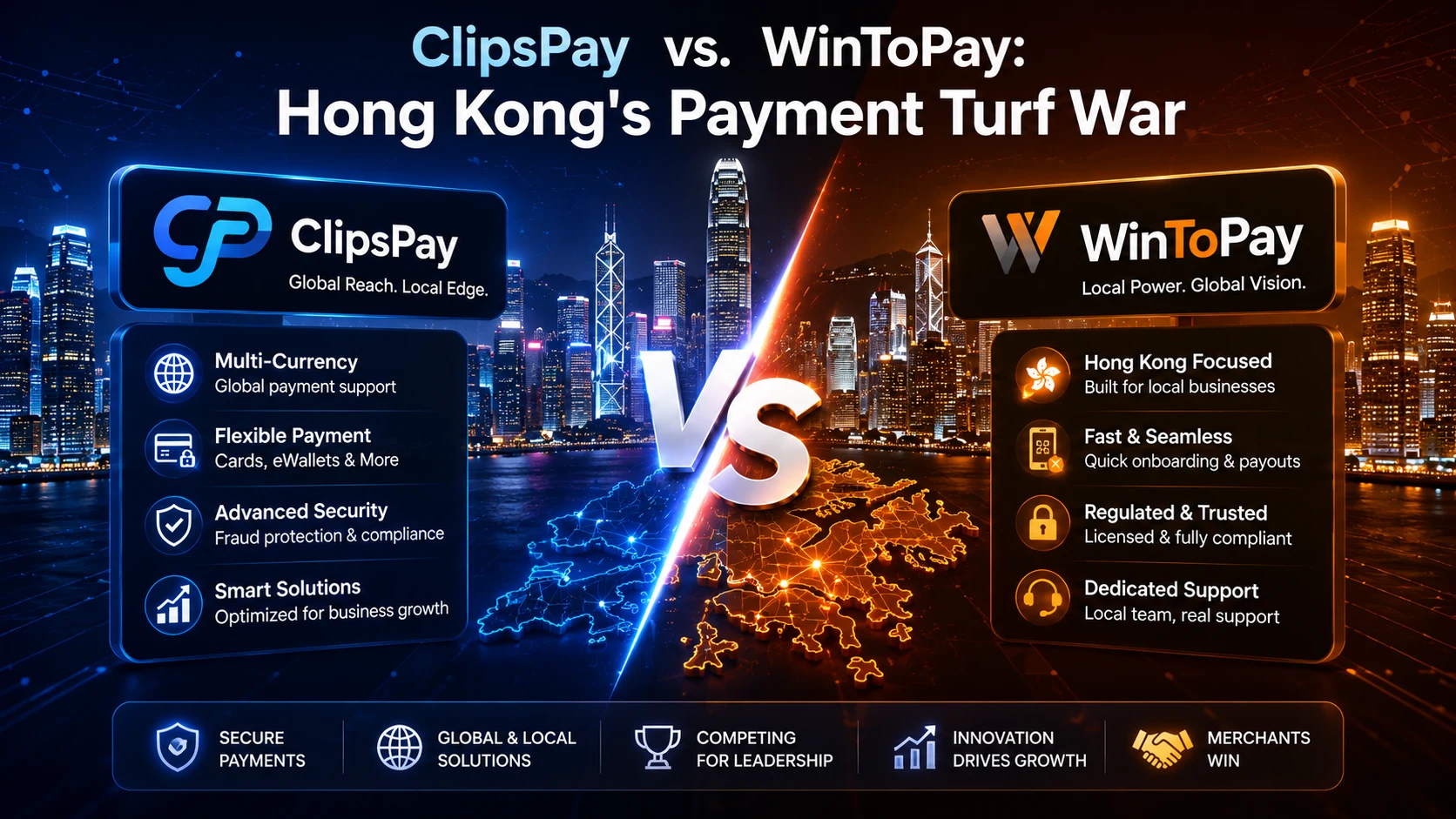
Hong Kong’s real payment-gateway landscape is dominated by names like Stripe, PayPal, Adyen, AsiaPay, and PayDollar, none of which is ClipsPay or WinToPay. Of this pair, WinToPay discloses a Hong Kong MSO license and US MSB registration and has a documented multi-year track record serving Chinese cross-border sellers. ClipsPay has almost no independent footprint beyond its own site and a directory listing built from template marketing copy. If this is a “turf war,” it’s a lopsided one, and neither company is actually contesting the territory that matters most in Hong Kong’s payments market.
Search “best payment gateway Hong Kong” and you’ll get the same handful of names over and over: Stripe, PayPal, Adyen, AsiaPay, PayDollar, PayMe, eftPay. Search “ClipsPay” or “WinToPay” specifically, and you’ll find both companies describing themselves as serious contenders in exactly that market, cross-border processing, secure transactions, global reach, the works. That gap between self-description and independent visibility is the real tension behind any “turf war” framing here. Before asking who’s winning, it’s worth asking a more basic question: are these two companies actually fighting over the same territory at all, or is one of them barely in the fight?
What WinToPay Actually Is
WinToPay, also marketed under the name “Ying Payment,” describes itself as established in Shanghai in 2013, holding a Hong Kong Money Service Operator (MSO) license and US Money Services Business (MSB) registration, with PCI DSS certification for payment security. Its stated focus is narrow and specific: cross-border card acquiring for Chinese e-commerce sellers, supporting Visa, Mastercard, American Express, JCB, Diners Club, and Discover, with the company claiming authorized service-provider status with Visa and Mastercard directly. WinToPay states it has served more than 6,000 cross-border e-commerce sellers since launch, with branches across Shanghai, Shenzhen, and Europe.
A few things worth noting about WinToPay’s public profile, stated plainly:
- Its licensing claims are of a verifiable type, Hong Kong MSO and US MSB are real, checkable registries, even though confirming WinToPay’s specific current status requires checking those registries directly rather than taking the company’s word for it.
- Third-party review coverage is genuinely mixed: some reviews describe high transaction volume and solid country coverage positively, while at least one Trustpilot review raises a brand-impersonation concern, warning that scam operators have built copycat sites using reputable payment companies’ names, WinToPay potentially among them. That reads as a warning about third-party impersonation risk rather than a claim against WinToPay’s own conduct, though the distinction is easy to lose in a single-star review and worth stating explicitly rather than assuming.
What ClipsPay Actually Is
ClipsPay’s public footprint is considerably thinner. The company’s own site lists a Hong Kong address (Kwun Tong, Kowloon) and describes itself as providing cross-border e-commerce payment solutions through partnerships with banks and payment institutions in multiple countries, supporting electronic wallets, cash receipts, and online bank transfers for overseas users. It claims to meet “the highest security” and “strictest” financial data security standards, though without specifying which certification (PCI DSS, ISO 27001, or otherwise) backs that claim.
Beyond ClipsPay’s own site, the available evidence is sparse:
- Its listing on a payment-industry directory uses language that’s nearly identical, word for word in structure, to listings for other, unrelated companies on the same platform, “your premier partner for seamless and secure payment processing solutions,” empowering businesses “from small startups to large enterprises.” That’s a strong signal of templated marketing copy rather than company-specific detail.
- No independent review platform coverage was found for ClipsPay, no Trustpilot presence, no meaningful third-party commentary, positive or negative.
- ClipsPay does not appear in any of the well-established “best payment gateway Hong Kong” comparison guides published by independent research sites, guides that do cover WinToPay’s actual competitors (Stripe, AsiaPay, PayDollar, eftPay, mPay, JETCO Pay) in detail.
- No specific licensing body, registration number, or regulatory disclosure was identified for ClipsPay in any source reviewed.
None of this proves ClipsPay isn’t a legitimate, functioning business, plenty of small B2B payment facilitators operate without a large public footprint, particularly ones serving a narrow client base through direct sales rather than public marketing. But it does mean any claim about ClipsPay’s market position, security standards, or scale currently rests almost entirely on the company’s own unverified self-description.
The Core Argument: This Isn’t Really a Turf War
1. One company has a disclosed license type; the other has none
The clearest, most consequential difference between these two isn’t reputation, it’s disclosure. WinToPay names specific license types (Hong Kong MSO, US MSB) that a merchant can go verify. ClipsPay names no license, certification body, or regulator at all, relying instead on general claims like “highest security” without specifying against which standard. For any merchant evaluating a payment provider for real transaction volume, that’s the first and most important due-diligence gap to close, and right now, it’s only closed for one of these two companies.
2. Independent visibility correlates with actual market presence
Hong Kong’s real payment-gateway competitive landscape, as reflected in independent 2026 buyer’s guides, is dominated by internationally recognized names and well-established local players like AsiaPay and PayDollar. Neither ClipsPay nor WinToPay appears in those comparison guides, meaning that whatever “turf” the headline implies, it isn’t the mainstream Hong Kong merchant accounts and payment gateways market that dominates search results and buyer research. Both companies are, at best, niche specialists rather than contenders for the territory most merchants are actually researching when they search “Hong Kong payment gateway.”
3. Their actual customer bases don’t even overlap much
WinToPay’s stated focus, Chinese sellers running cross-border e-commerce into international, largely card-holding markets, is a specific, well-defined niche. ClipsPay’s stated focus, per its own site, is broadly similar on paper (cross-border e-commerce, overseas payment methods), but without independent verification of scale, client base, or track record, it’s impossible to confirm whether the two are genuinely competing for the same merchants or simply using similar marketing language to describe very different actual businesses. A “turf war” implies active competition for the same customers, and that requires evidence neither company’s current public profile actually provides.
4. The real user-facing problem: how do you evaluate a company you can barely verify?
For merchants actually trying to choose between providers like these, the practical pain point isn’t “which one is better”, it’s “how do I evaluate a company that provides almost nothing to verify.” The solution isn’t complicated, even if it’s more work than reading a directory listing: request the specific license or registration number directly, check it against the relevant regulator’s public registry (Hong Kong’s Customs and Excise Department maintains the MSO license registry, for instance), ask for named client references in your specific vertical, and treat any provider that can’t or won’t provide these as a materially higher-risk choice for high-risk payment gateway or casino payments-adjacent processing, where the cost of picking the wrong partner is highest.
Why Hong Kong Specifically Makes This Worth Watching
Hong Kong’s position as a regional financial hub means it hosts a genuinely wide spread of payment providers, from globally recognized names to small, narrowly-focused facilitators serving specific trade corridors. That range is generally healthy for the market, it gives merchants options at every scale. But it also means Hong Kong-based merchant services research is unusually prone to exactly the kind of visibility mismatch this comparison surfaces: a licensed, multi-year operator like WinToPay sitting in the same search results as a thinly-documented one like ClipsPay, both using near-identical language to describe cross-border capability. For merchants specifically sourcing crypto payment or casino payments-adjacent processing, categories where mainstream Hong Kong gateways like AsiaPay or PayDollar are less likely to onboard, that visibility gap matters even more, since the search results merchants rely on to find a willing provider are exactly the ones most likely to include under-verified listings.
The Counterpoint
The steelman case for taking ClipsPay more seriously despite its thin public footprint: plenty of legitimate B2B payment facilitators, especially ones serving a specific regional niche through direct outreach rather than public marketing, simply don’t need a large public review presence to run a real business. A company processing meaningful volume for a handful of enterprise clients has little reason to court Trustpilot reviews or comparison-guide inclusion, and the absence of public visibility isn’t, by itself, evidence of illegitimacy.
That’s a fair point, and it’s worth taking seriously rather than assuming the worst by default. But it doesn’t close the actual gap that matters for due diligence: even a low-public-visibility B2B provider should be able to produce specific licensing information, named references, or verifiable operational history on direct request. The absence of public reviews is explainable; the absence of any disclosed regulatory status at all is a different, more significant gap, one that a legitimate niche provider could resolve easily in a direct conversation, and one that merchants evaluating either company should specifically ask about before assuming it away.
Comparison Table
| Dimension | WinToPay | ClipsPay |
|---|---|---|
| Core offering | Cross-border card acquiring for Chinese e-commerce | Cross-border e-commerce payment solutions |
| Founded/established | 2013 (Shanghai) | Not independently confirmed |
| Disclosed licensing | Hong Kong MSO, US MSB (self-reported, verifiable type) | None disclosed |
| Independent review presence | Mixed Trustpilot coverage, including an impersonation-risk flag | None found |
| Appears in independent HK gateway guides | No | No |
| Stated client base | 6,000+ cross-border e-commerce sellers | Not specified |
| Marketing copy originality | Company-specific detail present | Closely mirrors templated directory language |
Practical Takeaway
If you’re evaluating either company for real payment processing volume, don’t rely on either company’s self-description or a directory listing alone. For WinToPay, verify the Hong Kong MSO license and US MSB registration directly against the relevant registries, and confirm you’re transacting through the legitimate WinToPay domain given the impersonation risk flagged in reviews. For ClipsPay, start further back, request specific licensing or registration information directly, since none is currently disclosed publicly, and treat the absence of independent reviews or comparison-guide coverage as a reason for more due diligence, not less.
Open question for fintech watchers: in a market as crowded and well-documented as Hong Kong’s payment-gateway landscape, what does it actually take for a niche, low-visibility provider to build a durable business, and how much of that durability depends on staying below the radar of the comparison guides and review platforms that shape most merchants’ first impression of who’s actually competing for their business?
Comments
No comments yet. Be the first to share your thoughts.
Leave a comment