
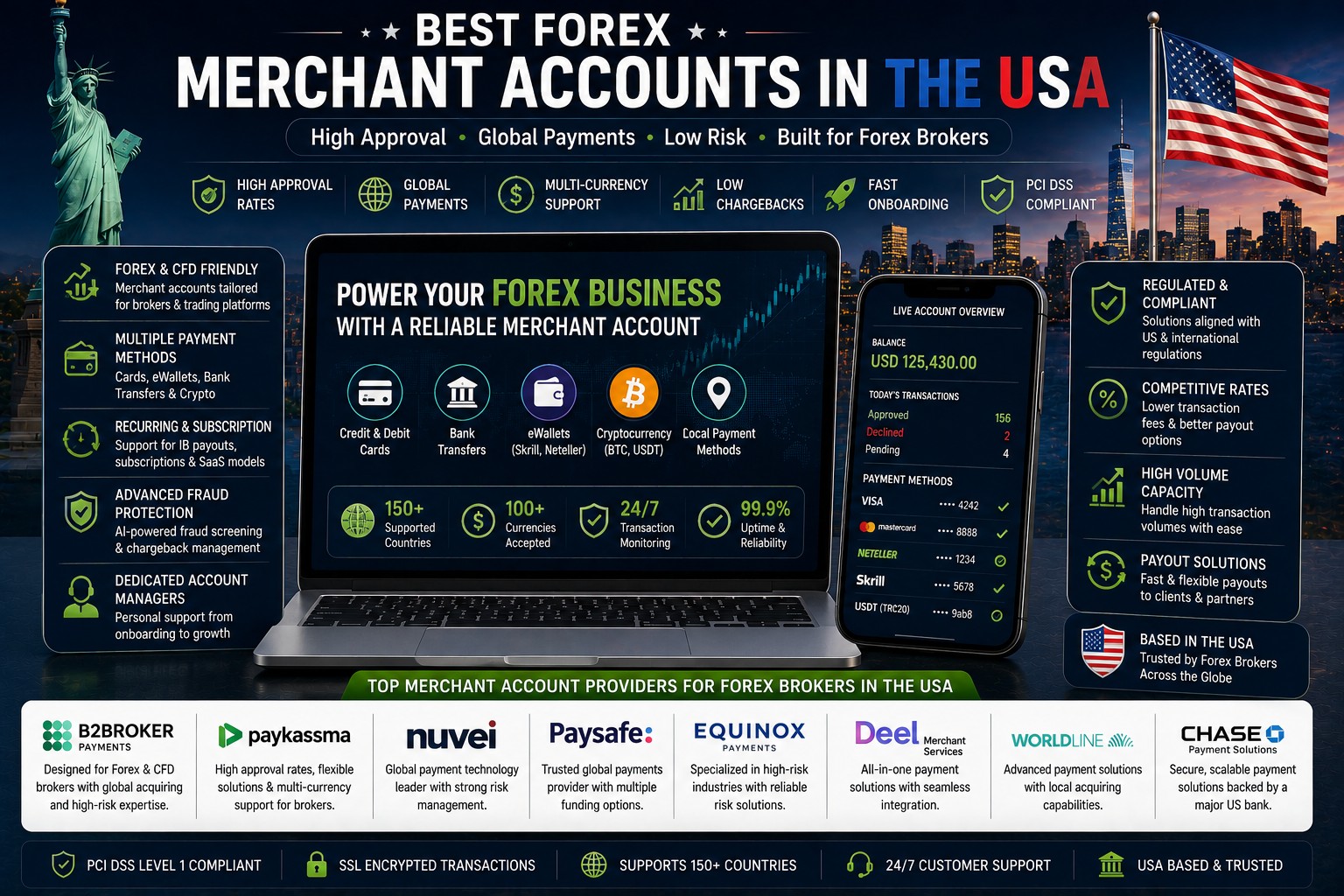
The United States is home to the largest pool of retail and institutional forex traders in the world, yet it remains one of the toughest markets in which to get a forex merchant account. Between CFTC restrictions on credit-card funding of retail forex accounts, tight card-network rules on trading-related MCCs, and a banking sector that is generally allergic to anything labeled “high risk,” most US-facing forex brokers, prop-trading platforms, signal services, and forex education businesses find themselves rejected by mainstream processors like Stripe, PayPal, or Square before they ever get started.
That’s where specialist high-risk payment providers come in. A forex merchant account is a dedicated payment processing relationship — built with an acquiring bank that actually understands the forex vertical — that lets a broker or trading platform accept client deposits, process withdrawals, and manage chargebacks without the account being frozen or shut down the moment volume spikes.
In this guide, we break down the 10 best forex merchant account providers serving US-based and US-facing forex businesses in 2026, what to look for before you sign a processing agreement, and how to avoid the account terminations that plague this industry.
Why Forex Merchant Accounts Are Classified as High-Risk
Before comparing providers, it helps to understand why forex sits in the same underwriting bucket as gaming, adult content, and nutraceuticals.
- Regulatory ambiguity: Forex brokerage is legal, but the line between a regulated broker, an unregulated broker, and an outright scam is not always obvious to an acquiring bank’s compliance team. Underwriters have to dig into your licensing, your jurisdiction, and your marketing claims.
- Card network restrictions: In the US, the CFTC’s 2015 rule banning credit-card funding of retail off-exchange forex accounts pushed much of the industry toward debit cards, ACH, wire transfers, and alternative payment methods — all of which require more sophisticated payment infrastructure than a plug-and-play Stripe integration.
- Chargeback exposure: Traders who lose money sometimes dispute the original deposit rather than accept the loss, which drives chargeback ratios above what standard processors will tolerate.
- Cross-border volume: Forex brokers typically serve clients in dozens of countries and currencies simultaneously, which increases fraud screening complexity and settlement risk for the acquiring bank.
- High average transaction values: Deposits and withdrawals in forex are often large relative to typical e-commerce tickets, which raises the stakes of any single fraudulent transaction.
Because of this, forex brokers, funded-trading-account providers, forex signal sellers, and trading education companies all need a payment partner that has already built underwriting relationships specifically around this vertical — rather than trying to fit a forex business into a generic “high-risk e-commerce” bucket.
What to Look for in a US Forex Merchant Account Provider
- Genuine forex underwriting experience — not just a generic high-risk label, but demonstrated relationships with acquiring banks that actively approve forex MCCs.
- Multi-currency and multi-acquirer routing — the ability to settle in USD while still accepting EUR, GBP, and other major currencies from an international client base.
- Chargeback and fraud tooling — 3D Secure, AVS, velocity checks, and a dedicated representment process, since forex chargeback ratios run higher than standard retail.
- Transparent reserve terms — rolling reserves are standard in this space, but you want a provider that discloses the percentage and release schedule up front rather than surprising you after go-live.
- Fast, realistic approval timelines — most legitimate forex accounts take between 3 and 10 business days to underwrite properly; anyone promising same-day approval for a full forex brokerage should be treated with caution.
- Support for regulated and offshore-licensed brokers — some providers only work with brokers holding top-tier licenses (FCA, ASIC, CySEC), while others also support offshore-regulated or newly licensed operations.
- Stable long-term processing — the real cost of a bad forex merchant account isn’t the rate, it’s the sudden termination mid-quarter. Ask every provider about their average account lifespan and de-risking policy.
With those criteria in mind, here are the 10 providers worth evaluating for a US forex merchant account in 2026.
- WebPays
WebPays is a high-risk payment specialist that has built a large part of its business specifically around forex, casino, gaming, IPTV, and adult verticals. Its forex-focused pages walk merchants through the full onboarding process — application, underwriting, and approval — and the company markets itself heavily on multi-currency support, claiming coverage for 100+ currencies and 35+ alternative payment methods, which matters for a forex brokerage with an international client base even if its processing entity is US-registered.
Why it’s on this list: WebPays leans into forex as a named specialty rather than treating it as an afterthought, and it publishes forex-specific onboarding content for both the US and European markets, including add-on services like chargeback alert notifications for merchants who need an early warning system on disputes.
Best for: Forex brokers and trading platforms that want a processor whose entire content and sales funnel is built around high-risk verticals including forex.
- PayCly
PayCly is a Singapore-headquartered payment gateway and merchant account provider with a strong specialization in high-risk and unregulated-industry processing, forex included. PayCly’s marketing is explicit that it supports both regulated and unregulated forex merchants, which is a meaningful differentiator for newer or offshore-licensed brokers who get turned away by processors that only work with top-tier-regulated entities.
Why it’s on this list: PayCly advertises coverage across 150+ countries and 100+ currencies, PCI DSS Level 1 compliance, and a dedicated merchant dashboard — all relevant for a US-based forex platform that also serves an international client base. It has published dedicated forex merchant account pages for the US and UK markets specifically.
Best for: US forex brokers who also serve unregulated or emerging markets and need a processor comfortable with that risk profile.
- Amald
Amald is a merchant services provider that has grown a substantial content and service footprint around high-risk categories, including forex trading, casino, gaming, and IPTV merchant accounts. Amald positions itself as having a “higher risk appetite” than typical processors, which it frames as reducing the chance of sudden account termination — a common pain point for forex merchants who get approved and then shut down a few months later.
Why it’s on this list: Amald offers both 3DS and non-3DS payment options along with eCheck/ACH processing, which is useful for forex businesses that need alternatives to card-based funding given US card-network restrictions on forex deposits.
Best for: Forex education platforms and trading businesses that want ACH/eCheck options alongside card processing.
- eLotPay
eLotPay specializes in offshore, high-risk, and cross-border payment solutions, explicitly listing forex among its target industries alongside gaming and eCommerce. The company’s offering centers on multi-currency processing, dedicated IBANs, virtual accounts, and fraud prevention tools designed for businesses that standard processors won’t touch.
Why it’s on this list: eLotPay’s emphasis on dedicated IBANs and virtual accounts is particularly relevant for forex brokers who need to segregate client funds or manage multiple settlement currencies without maintaining a separate banking relationship in every jurisdiction.
Best for: Forex brokers that need virtual IBANs and cross-border settlement infrastructure in addition to a card-processing merchant account.
- InQuid
InQuid is a global high-risk payment processor with a specific forex merchant account page for the US, UK, Canadian, and European markets. InQuid markets itself around approval flexibility — explicitly stating that it manages risk rather than avoiding it — and highlights smart transaction routing, fraud prevention, and human support as differentiators from processors that lean entirely on automated underwriting.
Why it’s on this list: InQuid publishes country-specific forex merchant account pages (a rarity among high-risk processors), which signals a level of localization relevant to brokers targeting more than one jurisdiction from a single US entity. It also lists forex explicitly alongside gaming, crypto, and eCommerce as a core vertical, with acquiring bank relationships built for elevated chargeback thresholds.
Best for: Forex brokers operating across multiple countries who want a single processor with region-specific onboarding support.
- BoxCharge
BoxCharge is a full-stack payment gateway provider with a dedicated forex trading merchant account product. BoxCharge highlights PCI-DSS compliance, multi-currency processing for deposits and withdrawals, and fraud/chargeback management tailored to the “high-volume, fast-paced nature of forex transactions.”
Why it’s on this list: BoxCharge’s regulatory framework is anchored in Southeast Asia, particularly Singapore, which can be an advantage for US forex platforms that also route volume through Asian markets. The company also promotes 150+ payment options and virtual named accounts for multi-currency collection.
Best for: Forex platforms that need a single gateway to manage deposits, withdrawals, and commission payouts in one dashboard.
- Corepay
Corepay is a US-facing high-risk merchant services provider with a dedicated forex merchant accounts page and a strong focus on regulated trading platforms and forex education businesses (software, newsletters, courses, and seminars). Corepay is transparent that the CFTC has banned credit-card funding of retail forex trading accounts in the US, and structures its offering around debit card, ACH, and multi-currency alternatives accordingly.
Why it’s on this list: Corepay’s website candidly documents the US regulatory landscape for forex processing rather than glossing over it, and the company offers local acquiring in the US, EU (PSD2/SCA compliant), UK (FCA-regulated), and Australia — useful for forex platforms with cross-border ambitions from a US base.
Best for: US-regulated forex education and trading-adjacent businesses that want a compliance-forward processor with regional acquiring in multiple markets.
- PaymentCloud
PaymentCloud is one of the most established names in US high-risk payment processing, regularly cited by independent review sites as a top pick for high-risk merchant accounts across CBD, firearms, nutraceuticals, adult, travel, and forex. PaymentCloud is known for assigning a dedicated account manager to every merchant and for working with multiple acquiring banks simultaneously, which improves approval odds for forex businesses that have been declined elsewhere.
Why it’s on this list: PaymentCloud publishes a reported approval rate above 98% and offers case-by-case consideration for merchants who have previously landed on the MATCH list — a common obstacle for forex-adjacent businesses with a prior processing history.
Best for: US forex education and forex-adjacent businesses that want a processor with a long track record and hands-on underwriting support.
- Instabill
Instabill has operated in the offshore and high-risk merchant account space for well over a decade and maintains a dedicated forex merchant account page built specifically around offshore acquiring bank relationships. Instabill is explicit about the CFTC’s 2015 credit-card funding ban and positions its offshore banking partnerships as a way for forex merchants to access multi-currency processing despite US card-network restrictions.
Why it’s on this list: Instabill also offers stock brokerage merchant accounts alongside forex, which can be useful for platforms that straddle both categories, and it supports settlement in a wide range of currencies through its acquiring bank network.
Best for: US forex brokers that specifically need an offshore acquiring relationship to work around domestic card-network restrictions.
- HighRiskPay.com
HighRiskPay.com is a US-based processor that explicitly lists forex trading among its core supported industries, alongside CBD, adult content, vape, and tobacco retail. The company positions its underwriting around evaluating the whole business — processing history, compliance measures, and industry experience — rather than relying purely on credit scores or blanket industry rejections.
Why it’s on this list: HighRiskPay.com is frequently included in independent comparisons of US high-risk processors and advertises multi-currency processing capability and real-time fraud monitoring, both relevant to forex merchants managing cross-border deposit flows.
Best for: US-based forex businesses that want a domestic processor with straightforward, industry-aware underwriting.
Comparison at a Glance
| Provider | Headquarters Focus | Notable Strength | Best For |
| WebPays | High-risk specialist | Multi-currency, chargeback alerts | Forex + multi-vertical high-risk merchants |
| PayCly | Singapore | Regulated & unregulated forex support | Offshore-licensed brokers |
| Amald | High-risk specialist | ACH/eCheck + card options | Forex education platforms |
| eLotPay | Offshore/cross-border | Virtual IBANs, dedicated accounts | Multi-currency settlement needs |
| InQuid | UK/global | Country-specific forex pages | Multi-jurisdiction brokers |
| BoxCharge | Southeast Asia | Deposit/withdrawal/commission tools | Full-stack gateway needs |
| Corepay | USA | Regional acquiring (US/EU/UK/AU) | US-regulated forex education |
| PaymentCloud | USA | 98%+ approval, dedicated manager | Established forex-adjacent businesses |
| Instabill | USA/offshore | Offshore acquiring network | Working around card-network limits |
| HighRiskPay.com | USA | Whole-business underwriting | Domestic forex processing |
The US Regulatory Landscape Forex Merchants Need to Know
Payment processing for forex businesses in the US doesn’t happen in a vacuum — it sits on top of a regulatory framework that shapes what any provider on this list is willing (and legally able) to do.
- CFTC oversight of retail forex: The Commodity Futures Trading Commission regulates off-exchange retail forex trading in the US, and its 2015 rule prohibiting credit-card funding of these accounts is the single biggest reason forex payment processing looks different from standard e-commerce. Providers that understand this distinction — like Corepay and Instabill, both of which reference the rule directly in their forex materials — tend to structure onboarding around debit, ACH, and wire funding rather than trying to force credit-card volume through and risking a rapid shutdown.
- NFA membership for domestic brokers: US-based retail forex brokers are generally required to register with the National Futures Association and meet minimum capital requirements. A merchant account provider will typically want to see this registration as part of underwriting for a domestic brokerage.
- State money-transmitter rules: Depending on how a forex platform structures deposits, withdrawals, and any wallet-style balance holding, state-level money transmitter licensing can come into play, which is part of why providers ask detailed questions about your business model before quoting rates.
- Offshore and unregulated brokers serving US-adjacent markets: Some forex businesses operate offshore but still process through US-facing payment infrastructure. Providers like PayCly and eLotPay are more explicit about supporting both regulated and unregulated forex operations, which matters if your entity is licensed outside the US but you still need dollar-denominated settlement.
None of this is legal advice — every forex business should confirm its specific obligations with a securities or commodities attorney — but understanding the landscape helps explain why forex payment processing looks so different from, say, an online clothing store, and why the providers above spend so much of their content explaining compliance rather than just advertising low rates.
Managing Chargebacks on a Forex Merchant Account
Chargeback management deserves its own section because it’s the single biggest reason forex merchant accounts get terminated mid-relationship, not the initial approval.
- Set clear expectations at the point of deposit. Traders who understand your terms — leverage, margin calls, withdrawal timelines — are statistically less likely to dispute a transaction later. Several providers on this list, including BoxCharge and Amald, offer merchant-facing tools to document this consent trail.
- Respond to disputes quickly. Most card networks give merchants a limited window to submit compelling evidence. A slow response is treated the same as no response, which is why providers like PaymentCloud emphasize dedicated account management rather than a purely self-service dashboard.
- Watch your ratio, not just the raw count. Visa and Mastercard both use chargeback-to-transaction ratios to flag merchants for their chargeback monitoring programs. A high volume forex broker can absorb more disputes in absolute terms than a smaller platform before triggering a review.
- Use 3D Secure where your client base supports it. It shifts liability for certain fraud-related disputes away from the merchant and is standard practice among the providers profiled above, including InQuid and WebPays.
- Keep a reserve buffer in mind when forecasting cash flow. Because rolling reserves exist specifically to cover chargeback exposure, understanding your provider’s release schedule up front avoids unpleasant cash-flow surprises during a growth quarter.
How to Apply for a Forex Merchant Account in the USA
- Prepare your documentation. Expect to provide a business license, bank statements, prior processing history (if any), identification documents, and — critically for forex — details of your regulatory status or licensing.
- Be upfront about your business model. Whether you’re a regulated broker, an offshore-licensed broker, or a forex education business, disclose it early. Underwriters move faster when they aren’t uncovering surprises mid-review.
- Expect a rolling reserve. Most forex merchant accounts carry a reserve of roughly 5–10% of volume, held for a period before release. Ask each provider for their exact terms in writing.
- Plan for multi-currency settlement from day one. If you’ll be accepting deposits in EUR, GBP, or other currencies, confirm which currencies each provider actually settles natively versus converts.
- Diversify where possible. Many established forex brokers eventually run two processing relationships in parallel, so a single account freeze doesn’t halt operations entirely.
Frequently Asked Questions
Is it legal to accept forex trading payments by credit card in the USA? Retail forex accounts generally cannot be funded by credit card in the US due to a 2015 CFTC rule; debit cards, ACH, and wire transfers remain common funding methods, which is why forex merchant accounts are built around a broader mix of payment rails than standard e-commerce processing.
How long does approval take for a forex merchant account? Most specialist providers quote 3–10 business days for full underwriting, though this varies based on the completeness of your documentation and whether you hold formal regulatory licensing.
Do I need to be a licensed broker to get a forex merchant account? Not necessarily — several providers on this list, including PayCly and Corepay, explicitly support both regulated brokers and forex education businesses, though licensed operations generally see faster approvals and better long-term account stability.
What’s a realistic processing rate for a forex merchant account? High-risk processing rates in this space typically run higher than standard retail, often in the 2%–4.5% range depending on chargeback history, volume, and jurisdiction — always request a written quote rather than relying on advertised “starting at” rates.
Can a forex merchant account support multiple currencies at once? Yes — most providers on this list, including eLotPay, BoxCharge, and PayCly, advertise support for well over 100 currencies. The distinction that matters is whether a currency is settled natively or converted, since native settlement typically avoids extra conversion fees for both the merchant and the trader.
Why do forex merchant accounts get terminated even after approval? The most common causes are chargeback ratios climbing above network thresholds, undisclosed changes to the business model (such as adding new trading products without informing the processor), and regulatory status changes. This is why ongoing communication with your account manager matters as much as the initial application.
Should a new forex brokerage start with an offshore or domestic processor? It depends on where your client base and banking relationships sit. A US-incorporated broker serving mostly domestic clients often does better starting with a domestic specialist like PaymentCloud or HighRiskPay.com, while brokers with a significant international client base may find offshore-friendly providers like Instabill or eLotPay better suited to their settlement needs.
Final Thoughts
Choosing a forex merchant account provider in the USA is less about finding the lowest advertised rate and more about finding a partner that won’t disappear the moment your volume grows or a chargeback spike hits. Providers like WebPays, PayCly, Amald, eLotPay, InQuid, and BoxCharge have built their businesses specifically around high-risk verticals including forex, while established US names like Corepay, PaymentCloud, Instabill, and HighRiskPay.com bring longer track records and deeper acquiring bank networks. The right choice ultimately depends on your regulatory status, your client base’s geography, and how much weight you put on domestic versus offshore acquiring relationships — so it’s worth requesting quotes and reserve terms from at least two or three providers before you commit.
Disclosure: This article is for informational purposes only and does not constitute financial, legal, or regulatory advice. Fees, approval criteria, and supported currencies change frequently — always confirm current terms directly with each provider before signing a processing agreement.
Comments
No comments yet. Be the first to share your thoughts.
Leave a comment