
TL;DR
- A payment gateway routes and encrypts transaction data. A merchant account holds and settles the funds. You need both to accept online payments, they are not substitutes for each other.
- Around 61% of merchants initially conflate the two when setting up payment processing, which leads to underwriting mismatches, surprise fees, and avoidable account instability.
- PayFac platforms like those offered by aggregators bundle both into one product, which is convenient but removes individual underwriting and account stability protections.
- High-risk merchants face the starkest version of this distinction: a specialist high-risk payment gateway handles transaction-level fraud and routing, while a dedicated high-risk merchant account handles the settlement, reserve, and compliance layer that standard providers won’t underwrite.
- In 2026, Visa VAMP and Mastercard CE3.0 compliance obligations sit at the merchant account layer, not the gateway layer, which makes understanding the difference commercially critical, not just conceptually interesting.
The Core Distinction, Plainly Stated
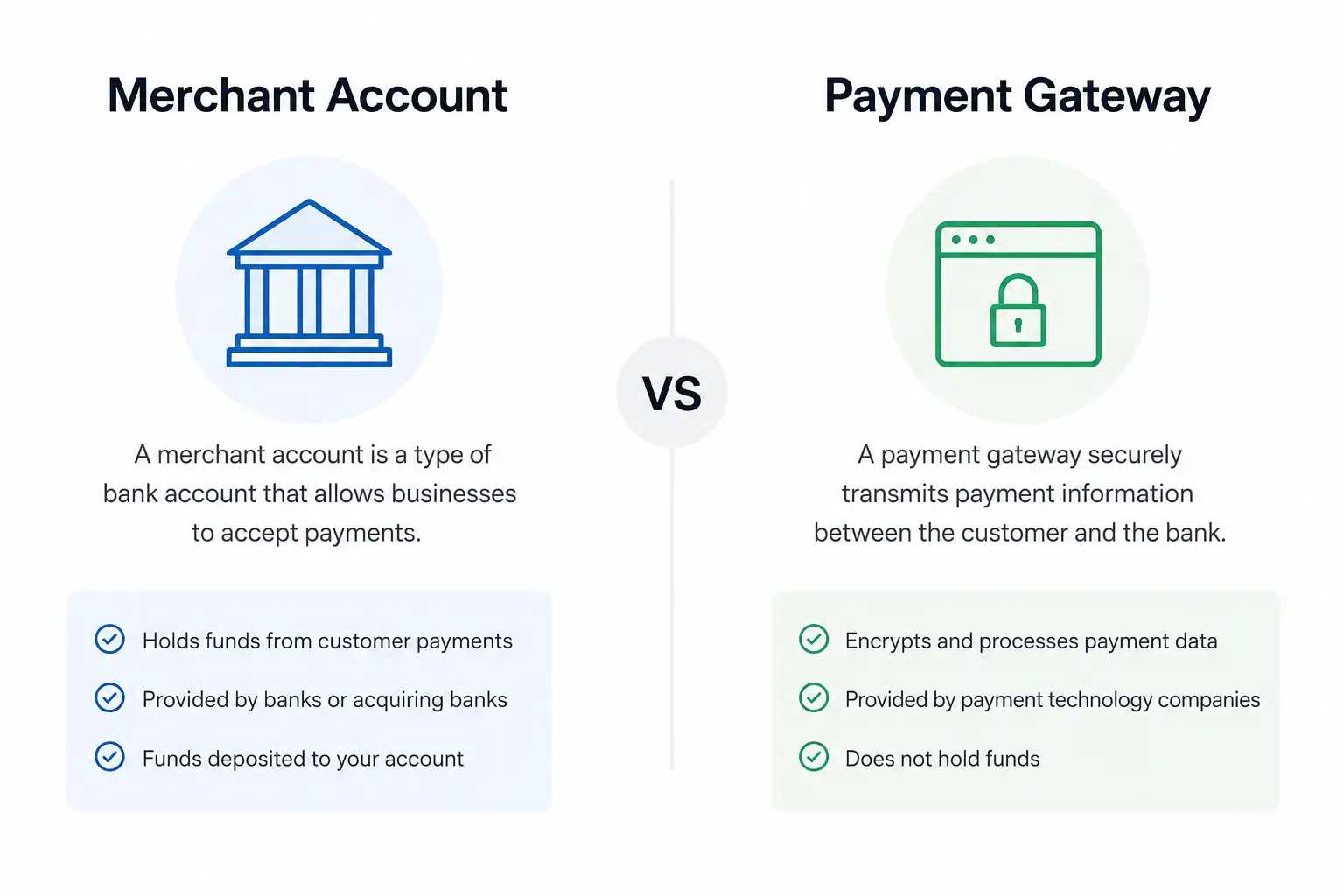
A payment gateway is a technology. A merchant account is a bank account. They sit at different points in the payment processing chain and perform entirely different functions, even though both are necessary for a merchant to accept digital payments.
Think of it this way: the gateway is the pipe, the merchant account is the tank. The pipe moves transaction data from a customer’s bank to your acquiring bank quickly and securely. The tank holds the funds while the acquiring bank runs its checks, then releases them to your business bank account on a set schedule. One handles information flow. The other handles money.
The confusion arises because the industry’s language is inconsistent. Many payment providers market a single product that bundles gateway technology with a pooled settlement arrangement, calling the whole thing a “payment account” or “payments platform.” That bundle is real and useful for many merchants. But understanding what each component does independently is what separates a merchant who manages their payment stack confidently from one who gets surprised by a reserve hold, a compliance flag, or an account termination they didn’t see coming.
What a Payment Gateway Actually Does
A payment gateway handles the data layer of a transaction. When a customer submits card details or uses a payment wallet at checkout, the gateway takes over immediately.
Its core functions are:
- Encrypting card or wallet data so it travels securely between checkout and the acquiring bank
- Tokenizing card numbers to remove sensitive data from the merchant’s environment, reducing PCI DSS compliance scope
- Routing the authorization request through the card network to the customer’s issuing bank
- Receiving the approval or decline response and surfacing it at the checkout in real time
- In more advanced configurations, running fraud scoring, managing 3DS2 authentication, and applying intelligent routing across multiple acquiring relationships
The gateway is entirely focused on the transaction itself, what happens in the 1-3 seconds of the authorization process. It doesn’t hold funds. It doesn’t determine settlement timing. It has no underwriting relationship with your business. A gateway can be set up in 1-3 days for most merchants because there is no financial risk assessment involved, it’s a data pipe, not a financial institution.
Gateway costs sit on the technology side of the fee structure: a monthly platform fee of $0-$25 for most standard gateways, a per-transaction fee of $0.10-$0.30, and a one-time setup fee ranging from nothing to a few hundred dollars depending on the provider.
What a Merchant Account Actually Does
A merchant account is an account issued by an acquiring bank that holds funds after a card transaction is authorized, before they’re transferred to your standard business bank account. It’s the financial layer of payment processing, the piece that involves real underwriting, contractual terms, and a formal banking relationship.
Its core functions are:
- Holding settled transaction funds during the clearing and settlement window (typically 1-14 days depending on account type and risk tier)
- Absorbing and managing chargeback liability on the acquirer’s behalf, with terms and reserves set accordingly
- Setting the processing rate, rolling reserve, and settlement timeline based on the merchant’s underwriting outcome
- Maintaining the ongoing compliance relationship under card network programs including Visa VAMP and Mastercard CE3.0 in 2026
A merchant account is where the financial relationship between your business and the acquiring bank lives. Underwriting takes 3-7 days for standard merchant accounts and 7-21 days for high-risk accounts because the acquirer is assessing your industry, chargeback history, processing volume, and financial health before taking on liability for your transactions.
The costs at the merchant account level are the substantive ones: the processing rate (0.5%-1.8% for standard merchants on interchange-plus, 1.5%-3.5% for high-risk), the monthly account fee ($0-$99), chargeback fees ($15-$100 per dispute depending on risk tier), and, for high-risk accounts, the rolling reserve of 5-10% of gross volume held for 90-180 days.
How They Work Together in the Transaction Lifecycle
These two components operate in sequence, not parallel. Understanding the handoff between them clarifies why both are necessary.
When a customer submits payment, the gateway handles the authorization stage, encrypting data, routing it to the card network and issuing bank, receiving the approval or decline, and surfacing the result at checkout. This happens in roughly 1-3 seconds.
Once a transaction is authorized, the gateway’s job is essentially done. The merchant account takes over at the clearing and settlement stage, receiving the batched transaction data at end of day, coordinating the fund transfer through the card network, and holding the settled funds before releasing them to the merchant’s bank account.
Chargebacks and disputes enter through the merchant account, not the gateway. This is why VAMP and CE3.0 compliance obligations in 2026 sit at the acquirer/merchant account level. A gateway can provide pre-chargeback alert integration and dispute management tooling, but the formal compliance exposure under both programs is a merchant account relationship, not a gateway relationship.
When They’re Bundled – And Why That Matters
Most small-to-mid merchant experience with online payments comes through PayFac or aggregator platforms that bundle a payment gateway and a settlement arrangement into one product. These platforms make sense for early-stage and standard-risk merchants: onboarding is fast, pricing is flat and transparent, and integration is well-documented.
But there are three situations where the bundle breaks down and merchants need to understand the two components separately:
1. High-risk industries: Standard PayFac platforms don’t underwrite elevated-risk MCCs. A merchant in iGaming, nutraceuticals, forex, adult content, or subscription billing who signs up with a standard aggregated platform will eventually have their account terminated, not because the gateway fails to work, but because the settlement/underwriting layer of the bundled product can’t accommodate their chargeback exposure. These merchants need a specialist high-risk merchant account and a compatible high-risk payment gateway, two separate relationships with different providers in some cases.
2. Volume growth: Once a merchant passes roughly $150,000 in monthly volume, the economics of a bundled flat-rate product deteriorate compared to interchange-plus pricing on a dedicated merchant account. Separating gateway costs from processing costs makes the pricing negotiable and transparent in a way that bundled products aren’t.
3. Account stability: Bundled platforms terminate sub-merchant accounts algorithmically when fraud or chargeback patterns shift. A dedicated merchant account with a direct acquirer relationship comes with contractual termination protections, material breach, notice periods, dispute processes, that sub-merchant arrangements simply don’t provide.
High-Risk Merchants: The Distinction Matters Most
For standard e-commerce businesses, the gateway vs merchant account distinction is conceptually useful but practically manageable, most bundled platforms handle both adequately. For high-risk merchants, the distinction is operationally critical.
A high-risk payment gateway does more than route transactions. In 2026, it needs to provide 3DS2 dynamic exemption routing, real-time fraud scoring tuned to the merchant’s specific vertical, pre-chargeback alert integration (Ethoca, Verifi), and compliance monitoring against VAMP’s 0.5% chargeback threshold and CE3.0’s three-tier penalty structure.
A high-risk merchant account provides the underwriting relationship that absorbs elevated chargeback exposure at contractually agreed terms, including rolling reserve structures that protect both the acquirer and the merchant’s long-term account stability. Without a dedicated high-risk merchant account, even the best gateway tooling can’t prevent account termination, because the termination decision sits with the acquirer, not the gateway.
This is also why high-risk merchants should never let a gateway vendor conflate the two. A gateway that claims to “include” a merchant account in a high-risk context is usually offering a sub-merchant arrangement, which carries none of the underwriting stability of a dedicated account.
Pros and Cons: Dedicated vs Bundled
Bundled gateway + merchant account (PayFac model):
- Fast onboarding, often same-day
- Transparent flat-rate pricing with no negotiation required
- Single integration, single support relationship
- No formal underwriting, sub-merchant stability is algorithmically managed, not contractual
- High-risk MCCs typically excluded
Separate dedicated gateway + merchant account:
- Longer onboarding (gateway: 1-3 days; merchant account: 3-21 days)
- More documentation required, more relationships to manage
- Interchange-plus pricing negotiable at volume; typically saves 0.3-0.7% above $150K/month
- Contractual termination protections on the merchant account
- Essential for high-risk, cross-border, and high-volume merchants
Frequently Asked Questions
Do I need both a merchant account and a payment gateway?
Yes, to accept online payments you need both. A gateway routes and encrypts the transaction; a merchant account holds and settles the funds. If you use a PayFac platform, both are bundled into a single product, but both components are still there under the surface.
What happens if I only have a payment gateway and no merchant account?
You can’t settle funds without a merchant account. A gateway alone can authorize transactions but has nowhere to send the settled proceeds.
What is a high-risk payment gateway?
A high-risk payment gateway is a specialist gateway built for merchants in elevated-risk industries, iGaming, adult content, forex, nutraceuticals, and similar categories. It includes more advanced fraud screening, higher chargeback tolerance, 3DS2 dynamic exemption routing, and compliance tooling for programs like Visa VAMP and Mastercard CE3.0.
Can a payment gateway affect my merchant account approval?
Indirectly, yes. If a merchant’s gateway lacks 3DS2 support or fraud screening, the resulting chargeback ratio may push the merchant’s account into VAMP or CE3.0 monitoring territory, which then affects the acquirer’s willingness to maintain the merchant account relationship.
Why do some payment providers only mention “accounts” and not gateways?
Many providers bundle both into a single product and market it under a single name. This is fine for standard-risk merchants at moderate volume, but merchants should confirm what’s included, specifically whether they receive a dedicated merchant account with individual underwriting or a sub-merchant arrangement under a master account.
Do cross-border payments change how merchant accounts and gateways interact?
Yes. For cross-border payment flows, local acquiring relationships at the merchant account level materially improve authorization rates, especially in emerging markets. The gateway handles routing logic, but whether a transaction is classified as local or cross-border is determined by the acquiring bank relationship, not the gateway.
Comments
No comments yet. Be the first to share your thoughts.
Leave a comment