
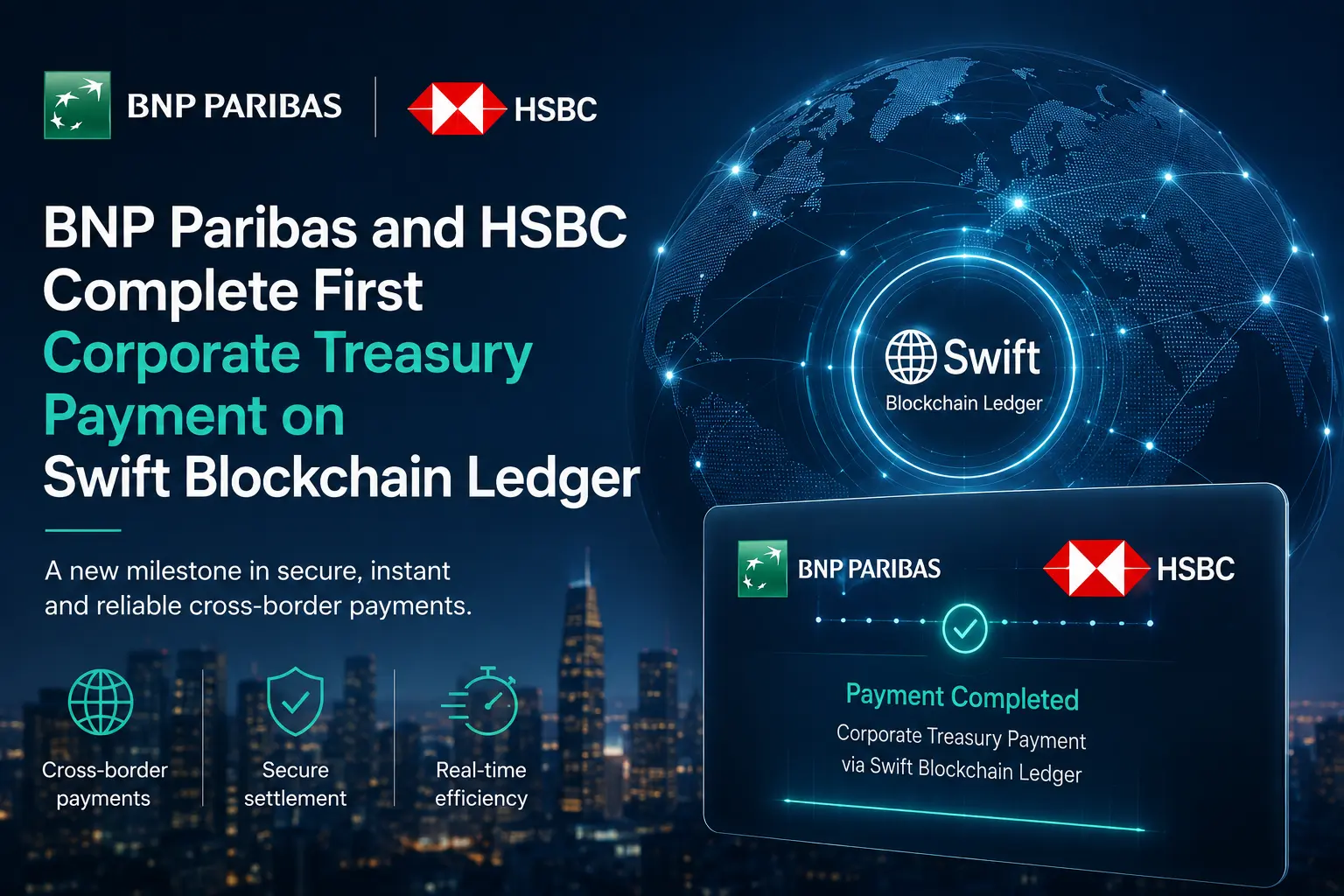
BNP Paribas and HSBC have completed the first corporate treasury payment using Swift’s blockchain-based ledger, marking a major step toward blockchain-enabled cross-border payments for large businesses.
Global banks BNP Paribas and HSBC have completed a live corporate treasury transaction using Swift’s blockchain-based shared ledger for industrial group Siemens.
The pilot transaction moved funds from Siemens’ euro account with BNP Paribas in France to its sterling account with HSBC in the UK, testing whether Swift’s shared ledger could connect banking systems across borders while maintaining commercial bank money for corporate payments.
The transaction represents an important development in the integration of blockchain technology with traditional banking infrastructure.
Swift Tests Blockchain for Corporate Treasury Payments
Swift launched its blockchain-based shared ledger in 2025 as part of its efforts to modernise cross-border payments infrastructure.
The ledger uses blockchain technology and tokenised deposits to enable interbank payments while maintaining interoperability across financial institutions.
The BNP Paribas and HSBC transaction focused specifically on corporate treasury activity, an area where businesses require reliable movement of liquidity across currencies, accounts and banking relationships.
For multinational companies such as Siemens, improving the speed and efficiency of cross-border treasury operations can help reduce friction in managing global liquidity.
Why the Siemens Transaction Matters
One of the most significant aspects of the pilot is that it tested blockchain-based payment infrastructure within the existing commercial banking ecosystem.
Rather than replacing banks or traditional money, the transaction explored how tokenized deposits and shared-ledger technology can work across established financial institutions.
The transaction also demonstrated the potential for cross-currency settlement, moving euros through BNP Paribas in France into a sterling account at HSBC in the UK.
This could have broader implications for corporate treasury teams managing international liquidity.
Blockchain Moves Closer to Mainstream Payments
Blockchain has spent years being associated primarily with cryptocurrencies and digital assets.
That picture is changing.
Banks and financial market infrastructures are increasingly exploring blockchain and distributed ledger technology for areas such as:
- Cross-border payments
- Tokenized deposits
- Securities settlement
- Corporate treasury
- Interbank liquidity
- Digital currencies
- 24/7 settlement
Swift’s approach is particularly significant because of its role in the global banking network.
The ability to connect blockchain-based payment infrastructure with existing financial institutions could help reduce one of the biggest barriers to institutional blockchain adoption: interoperability.
Tokenised Deposits Could Transform Treasury Management
Tokenized deposits are becoming an increasingly important area of financial innovation.
Unlike cryptocurrencies, tokenised deposits represent commercial bank money in a digital form. This creates the possibility of combining some of the efficiency benefits of blockchain infrastructure with the established banking relationships used by corporations.
For treasury teams, potential benefits could include faster movement of liquidity, improved visibility and more flexible settlement across markets.
The BNP Paribas, HSBC and Siemens pilot provides an early example of how these concepts could work in a real corporate environment.
What Comes Next for Swift’s Blockchain Ledger?
Swift has indicated that 24/7 payments are only one potential use case for its shared ledger.
The broader objective is to develop an interoperable infrastructure that can support tokenised transactions across the global financial ecosystem.
The successful Siemens transaction therefore represents more than a technology demonstration. It shows that blockchain-based settlement is increasingly being tested inside the infrastructure of traditional finance.
However, widespread adoption will depend on factors including regulatory frameworks, interoperability, liquidity management, operational resilience and participation from financial institutions and corporates.
The key question is whether blockchain-based shared ledgers can move from successful pilots to the everyday infrastructure powering global corporate treasury and cross-border payments.
BNP Paribas and HSBC complete first corporate treasury transaction on Swift’s blockchain ledger
Comments
No comments yet. Be the first to share your thoughts.
Leave a comment