
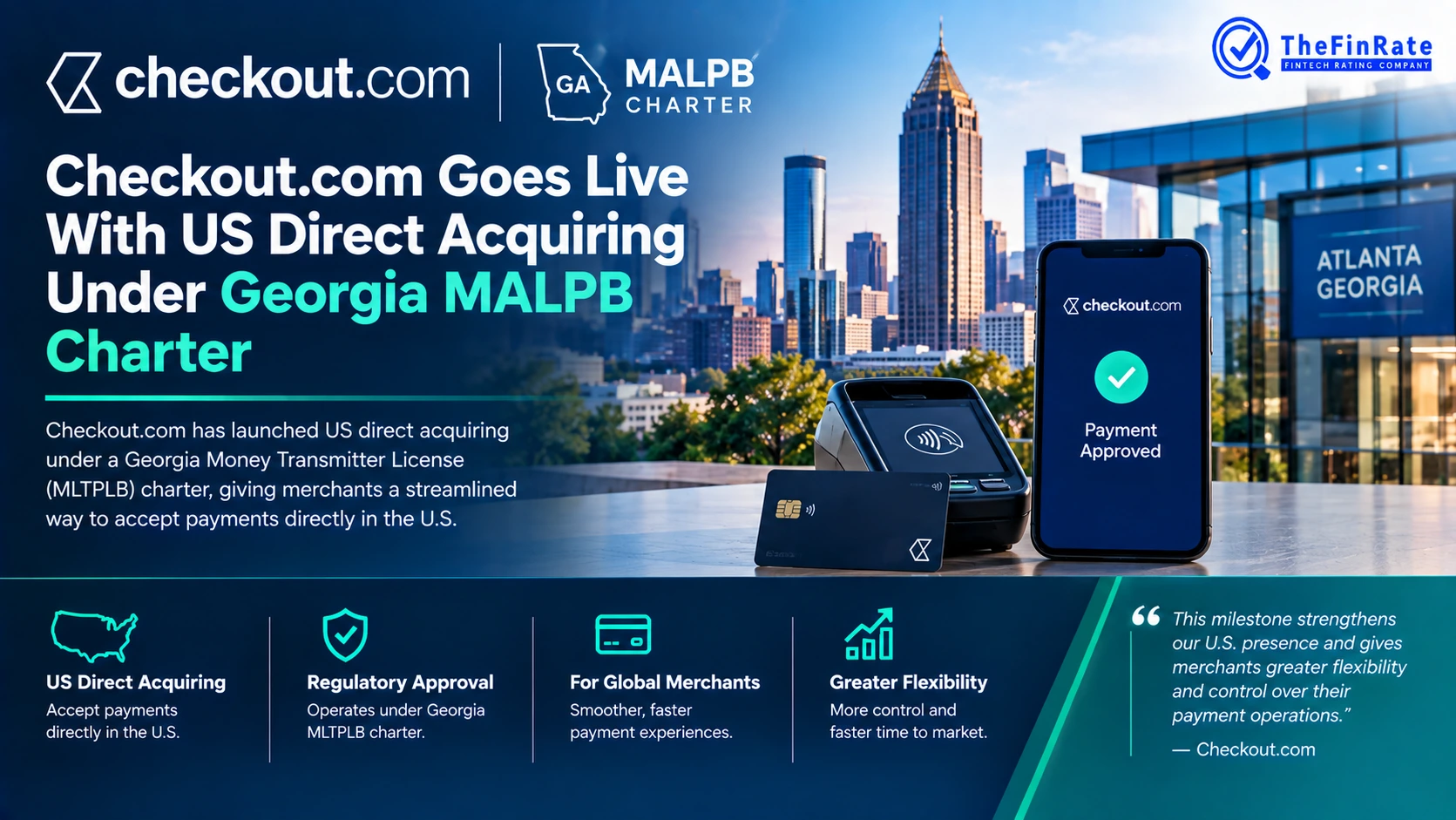
Checkout.com has begun direct acquiring in the United States after bringing its Georgia Merchant Acquirer Limited Purpose Bank (MALPB) charter into operation, giving the payments company a more direct connection to card networks and greater control over the US payment lifecycle.
The milestone marks the third stage of Checkout.com’s MALPB journey, following the acceptance of its application and the subsequent approval of the charter. The company can now begin processing US volume through the new acquiring structure.
For Checkout.com, this is more than a licensing milestone. It is an infrastructure move that could change how the company manages payment routing, product development and merchant performance in one of the world’s largest digital payments markets.
Checkout.com moves from charter approval to active acquiring
Checkout.com received approval for its Georgia MALPB charter in January 2026. At the time, the company said the structure would allow it to move toward operating as its own US acquirer and establish direct card-network integration.
The charter is now live and operational.
That takes Checkout.com from regulatory preparation into actual processing activity, giving the company a more direct position within the US acquiring ecosystem.
Checkout.com says the MALPB structure reduces its reliance on third-party intermediaries and gives it greater control across the payment lifecycle.
What is a MALPB?
A Merchant Acquirer Limited Purpose Bank is a specialized Georgia bank charter designed for merchant acquiring.
Georgia created the MALPB framework to give merchant acquirers a route to direct access to payment card networks without relying exclusively on a third-party bank sponsor. The state describes the framework as a regulated structure for merchant acquiring businesses.
The model has already been used by other payments companies. Fiserv’s MALPB, for example, became the first chartered MALPB to process card transactions in the US in April 2025.
Checkout.com’s move therefore places the company within an increasingly important part of the US payments infrastructure.
Direct card-network access changes the economics of acquiring
The most significant benefit is control.
When a payments company relies on third-party acquiring banks, parts of the payment lifecycle sit outside its direct operational control.
A direct acquiring structure can give the provider greater influence over routing, authorization performance, processing operations, network connectivity and product development.
Checkout.com says this will help it pursue higher performance, faster operational execution and continued product innovation for US merchants.
The company’s US acquiring product page now lists the US among its direct acquiring markets, while noting that domestic US processing also involves two sponsor banks.
That nuance matters: the MALPB does not mean every aspect of Checkout.com’s US payments operation suddenly becomes independent of banking partners.
Instead, it adds a direct acquiring capability to a broader US payments infrastructure.
A major investment in the US market
Checkout.com has been steadily expanding its US footprint.
The company says US volumes grew by almost 70% in 2025, while total ecommerce payment volume exceeded $300 billion globally that year.
It has also established a strategic hub in Atlanta alongside existing operations in New York and San Francisco.
That geographic investment is important because the MALPB framework is closely associated with Georgia’s payments ecosystem.
Georgia’s Department of Banking and Finance has described the state as a major payments hub, noting that companies operating in Georgia handle roughly 70% of US payment transactions.
For Checkout.com, the charter therefore combines regulatory infrastructure with a growing local operational presence.
Enterprise merchants are the target
Checkout.com’s strategy is heavily focused on enterprise merchants.
The company says the direct acquiring infrastructure is intended to support merchants with better payment performance, resilience and flexibility.
That is increasingly important as large businesses operate across multiple markets and payment methods.
Checkout.com’s global acquiring platform supports more than 150 processing currencies and 57 domestic processing countries, while its US direct acquiring capability now sits alongside direct acquiring licenses across other major regions.
The objective is not simply to process more transactions.
It is to give enterprise merchants a more consistent infrastructure for optimizing acceptance, controlling costs and managing payment performance across markets.
Greater control could support better payment performance
Payment acceptance is one of the most commercially important parts of digital commerce.
A transaction that fails at authorization can mean a lost sale, even when the customer has sufficient funds and the merchant’s product is available.
Checkout.com already uses its Intelligent Acceptance technology to optimize payment authorization and reduce false declines. The company says the system is trained on 20 billion network data points.
Direct acquiring could strengthen the company’s ability to connect that type of optimization with the underlying processing infrastructure.
The potential benefit is a shorter feedback loop between transaction data, payment routing and product development.
For large merchants, even small improvements in acceptance can have meaningful revenue implications.
Checkout.com is building more than an acquiring business
The MALPB launch also fits into a broader strategy.
Checkout.com has been expanding its product footprint across acquiring, stablecoin payments, AI-powered payment optimization, agentic commerce and financial infrastructure.
The company has said its 2026 roadmap includes building a connective layer for agentic commerce across emerging protocols, schemes and AI platforms. It has also been developing a US platforms service for marketplaces and independent software vendors.
That makes the US acquiring charter strategically important beyond traditional card processing.
Owning more of the underlying payment infrastructure can give Checkout.com a stronger foundation for new payment products as commerce becomes increasingly automated.
The US payments market is becoming more infrastructure-driven
Checkout.com’s move reflects a broader trend among large payment technology companies.
The competitive question is increasingly shifting from who can provide a payment gateway to who controls the infrastructure underneath the transaction.
Direct acquiring can influence economics, routing, data visibility, operational resilience and speed of product development.
That is why specialized acquiring bank structures such as MALPBs have attracted attention from major payments companies.
The model allows fintechs and payment providers to build more direct relationships with card networks while remaining within a regulated banking framework.
What the launch means for merchants
For US merchants, the immediate impact is likely to be less visible than the strategic implications.
Customers will not necessarily see a new checkout screen simply because Checkout.com is operating through its MALPB.
The potential benefits are behind the scenes: payment routing, authorization performance, operational resilience and the speed at which Checkout.com can introduce new capabilities.
Checkout.com says the charter will allow it to tailor its payments infrastructure more closely to the needs of US enterprise merchants.
That becomes increasingly valuable as merchants demand more control over payment performance rather than treating payments as a commodity infrastructure layer.
The next phase of Checkout.com’s US expansion
The company says the MALPB will serve as the foundation for its next phase of North American growth.
Checkout.com plans to continue investing in hiring, product development and enterprise payments infrastructure across the region.
The timing is also notable.
Checkout.com is expanding direct acquiring while simultaneously pursuing new areas such as AI-powered payments, agentic commerce and stablecoin settlement.
The combination suggests that the company sees ownership of payment infrastructure as an important competitive advantage across several emerging payment models.
The bottom line
Checkout.com’s US direct acquiring launch turns a regulatory milestone into operating infrastructure.
The Georgia MALPB gives the company a more direct connection to card networks and greater control over the payment lifecycle, while reducing its reliance on third-party acquiring intermediaries.
For merchants, the real test will be whether that additional control translates into better acceptance, resilience, cost efficiency and faster product innovation.
For Checkout.com, however, the strategic direction is already clear: build deeper into the payments stack rather than simply sitting on top of it.
Comments
No comments yet. Be the first to share your thoughts.
Leave a comment