
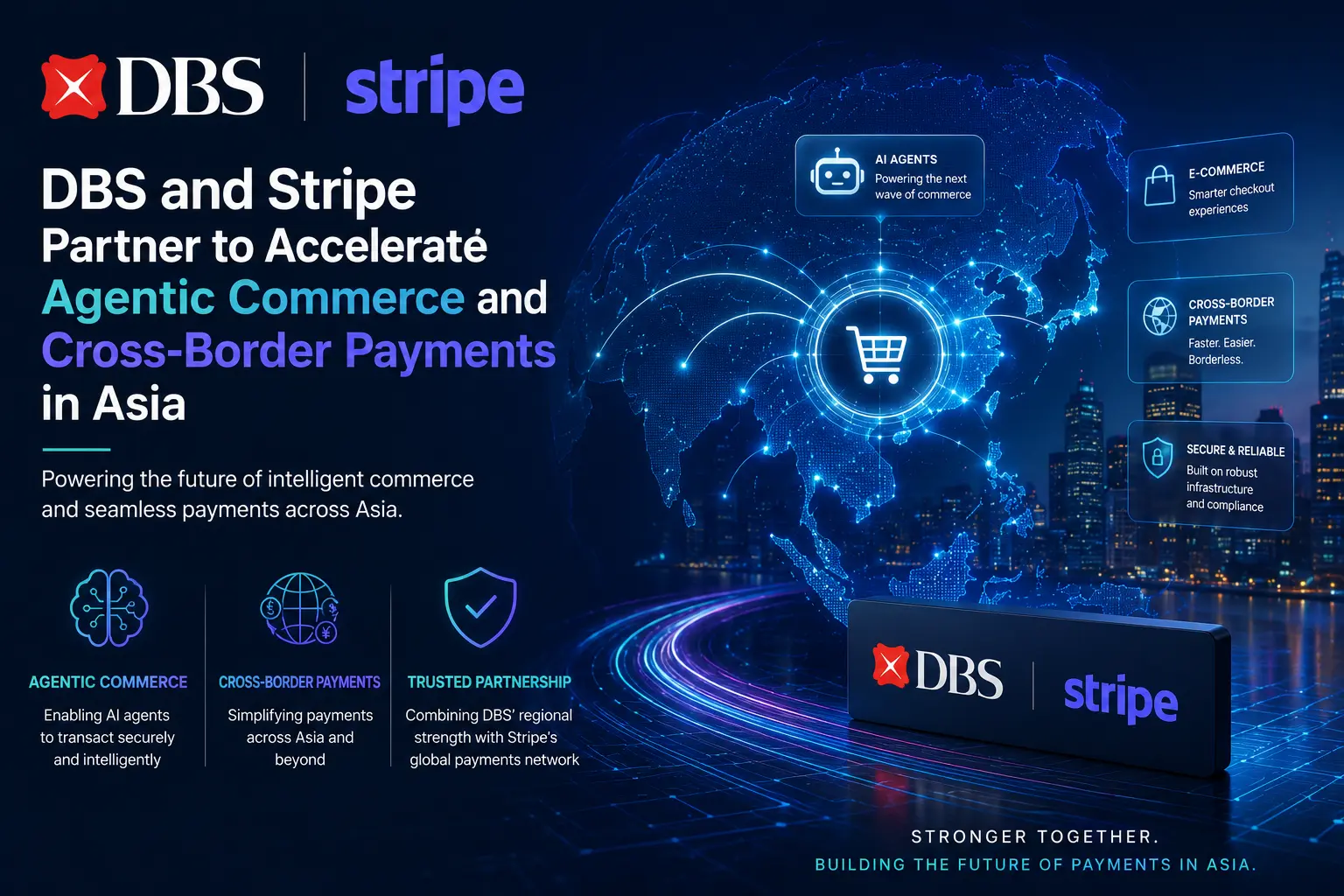
DBS and Stripe Partner to Accelerate Agentic Commerce and Cross-Border Payments in Asia
The DBS Stripe partnership is bringing together two increasingly important pieces of Asia’s digital economy: cross-border financial infrastructure and artificial intelligence-powered commerce.
DBS and Stripe have announced a strategic partnership aimed at helping businesses collect, move and manage money across markets while exploring new agentic AI capabilities for DBS customers.
The partnership combines DBS’s banking capabilities and pan-Asian connectivity with Stripe’s programmable financial infrastructure.
It comes as businesses increasingly sell across borders and AI agents begin to play a larger role in product discovery, purchasing and financial transactions.
For both companies, the opportunity extends beyond faster payments. The bigger goal is to build financial infrastructure that can support a more automated, global and increasingly AI-driven economy.
DBS Stripe Partnership Brings Banking and Programmable Finance Together
Under the agreement, Stripe will leverage DBS’s digital banking, money movement and cash management capabilities.
The arrangement is designed to give merchants on Stripe’s platform enhanced cross-border payment capabilities. DBS’s infrastructure can help Stripe merchants collect payments while also supporting liquidity and cash-position management across Stripe’s corporate entities.
That makes the partnership particularly relevant for businesses operating across multiple Asian markets.
Cross-border commerce creates a familiar set of challenges: businesses need to accept different currencies, manage liquidity, move funds between markets and navigate local financial infrastructure.
Combining Stripe’s global technology platform with DBS’s regional banking network could help address some of those complexities.
At the same time, DBS plans to explore Stripe’s global platform and embedded finance capabilities to expand its own cross-border network.
The bank’s institutional clients could potentially use that expanded network to connect with customers in more international markets.
In other words, the partnership works in both directions.
Stripe gains access to deeper Asian banking infrastructure, while DBS gets an opportunity to extend its institutional reach through Stripe’s global financial technology platform.
Agentic Commerce Moves Into the Payment Infrastructure Layer
The most forward-looking part of the DBS Stripe partnership is its focus on agentic commerce.
AI agents are moving beyond simple recommendations. Increasingly, they can discover products, compare options and participate in purchasing workflows.
Stripe has already been building infrastructure for this shift.
Its Agentic Commerce Suite is designed to allow businesses to make products discoverable through AI interfaces and support checkout and payments within those environments. Stripe has also been developing infrastructure for machine-to-machine payments and agent-initiated transactions.
DBS and Stripe now want to explore how similar capabilities could develop within banking.
The two institutions will explore jointly developing agentic AI capabilities for DBS customers, with the goal of enabling customers to transact more efficiently and securely.
That distinction matters.
The partnership does not announce a fully launched autonomous banking agent. Instead, it establishes a framework for exploring how AI agents could interact with financial services.
That leaves important questions around customer permissions, authentication, fraud prevention, liability and transaction controls.
Those questions will become increasingly important as AI agents move from recommending actions to actually taking them.
Why Cross-Border Payments Are Central to the Deal
Agentic commerce only becomes truly useful when an AI agent can complete a transaction.
That requires more than an AI model.
Behind every successful transaction sits a network of payment acceptance, settlement, foreign exchange, liquidity and compliance infrastructure.
This is where the DBS Stripe partnership becomes particularly interesting.
Stripe brings global payment technology and programmable financial services, while DBS brings banking infrastructure and deep connectivity across Asia.
Together, the companies can potentially address both sides of the equation: helping businesses sell internationally and giving them the financial infrastructure needed to manage the resulting money flows.
The opportunity is significant.
DBS and Stripe cited research from Money20/20 and FXC Intelligence projecting Asia’s outbound cross-border payments to reach $24 trillion by 2033, representing 36% of global outbound flows.
That would be almost twice the projected 2025 volume of $13.5 trillion.
As Asian businesses expand internationally, the need for reliable payment and currency corridors will grow alongside them.
Stripe’s Asian Expansion Gets Another Infrastructure Layer
The partnership also fits into Stripe’s broader expansion across Asia.
Stripe said more than half of its users in the region are already selling cross-border.
That means international payment infrastructure is becoming a core requirement for a significant portion of its Asian customer base.
For these businesses, the challenge is no longer simply accepting online payments.
They increasingly need to manage revenue across currencies, move funds between corporate entities and maintain efficient liquidity positions.
DBS’s regional banking network could therefore complement Stripe’s technology layer.
Rather than building every piece of banking infrastructure itself, Stripe can use established financial infrastructure where it provides an advantage.
That model reflects a broader evolution in fintech.
Payment companies are increasingly becoming financial infrastructure platforms, while banks are looking for ways to make their own infrastructure more accessible through technology platforms.
DBS Wants to Extend Its Cross-Border Network
The strategic value also runs in the opposite direction.
DBS will explore using Stripe’s global platform and embedded finance solutions to expand its cross-border network.
For an Asian bank, this could create new routes to international customers for institutional clients.
The model is particularly relevant for companies that are already digital-first.
A business can now launch globally without building a traditional physical presence in every market. Financial infrastructure therefore has to keep pace.
Stripe’s platform provides one potential technology layer for that expansion, while DBS contributes banking relationships, liquidity and regional market knowledge.
The partnership effectively connects those two worlds.
AI Could Change How Businesses Interact With Payments
The rise of agentic commerce could ultimately change the role of payments in the digital economy.
Today, a human typically selects a product, enters payment information, confirms the transaction and monitors the result.
An AI agent could eventually perform much of that workflow on behalf of a customer or business.
For example, an agent might identify a supplier, negotiate a price within predefined limits, place an order and initiate payment.
For businesses, another agent could monitor incoming payments, identify liquidity requirements and recommend or execute treasury actions within authorised rules.
But the technology will only work at scale if the underlying financial infrastructure can support those actions safely.
That is why partnerships such as DBS and Stripe matter.
The AI interface may receive most of the attention, but the financial infrastructure underneath it determines whether the transaction can actually happen.
Trust Will Become the Real Test of Agentic Payments
The biggest challenge may not be whether AI agents can transact.
They increasingly can.
The harder question is whether businesses and consumers will trust them with financial decisions.
An agent handling payments needs clear boundaries.
Customers must be able to define what an agent can purchase, how much it can spend and when it requires additional approval.
Financial institutions also need strong authentication, fraud detection, monitoring and dispute mechanisms.
Stripe’s existing agentic-commerce infrastructure already emphasizes controlled agent transactions and fraud protection, while DBS brings the regulatory and banking environment required for financial activity.
The DBS-Stripe partnership therefore arrives at an important point in the development of agentic commerce.
The industry is moving from asking whether AI can understand a transaction to asking whether AI can safely execute one.
What the DBS Stripe Partnership Means for Asia
Asia is becoming an increasingly important test market for the next generation of financial infrastructure.
The region combines large digital economies, rapidly growing cross-border commerce and highly diverse payment systems.
That fragmentation creates complexity, but it also creates opportunity for infrastructure providers that can connect different markets.
DBS has the regional banking footprint.
Stripe has the global technology platform.
The partnership attempts to connect the two.
If successful, the result could help businesses expand internationally while laying groundwork for AI-driven commerce that operates across borders.
However, the partnership remains a strategic collaboration rather than a fully deployed agentic-banking product.
Its long-term impact will depend on what the companies ultimately build, how quickly they deploy it and whether customers trust AI with increasingly important financial decisions.
The Bigger Picture
The next payment revolution may not simply be about making transactions faster.
It could be about changing who initiates them.
AI agents are beginning to act as intermediaries between consumers, businesses and digital marketplaces. As that happens, banks and payment companies will need infrastructure capable of supporting transactions initiated by software rather than people.
The DBS Stripe partnership is an early example of that shift in Asia.
DBS brings the banking rails and regional connectivity.
Stripe brings programmable financial infrastructure and experience building for the agentic economy.
The real opportunity lies where those capabilities meet.
If AI agents become a major channel for commerce, the financial institutions that provide the infrastructure beneath those transactions could become just as important as the AI platforms customers interact with.
For now, DBS and Stripe are laying the groundwork.
The bigger question is whether Asia can become one of the world’s first major regions where cross-border payments and agentic commerce operate together at scale.
DBS and Stripe partner to accelerate the digital and AI-powered economy in Asia
Comments
No comments yet. Be the first to share your thoughts.
Leave a comment