
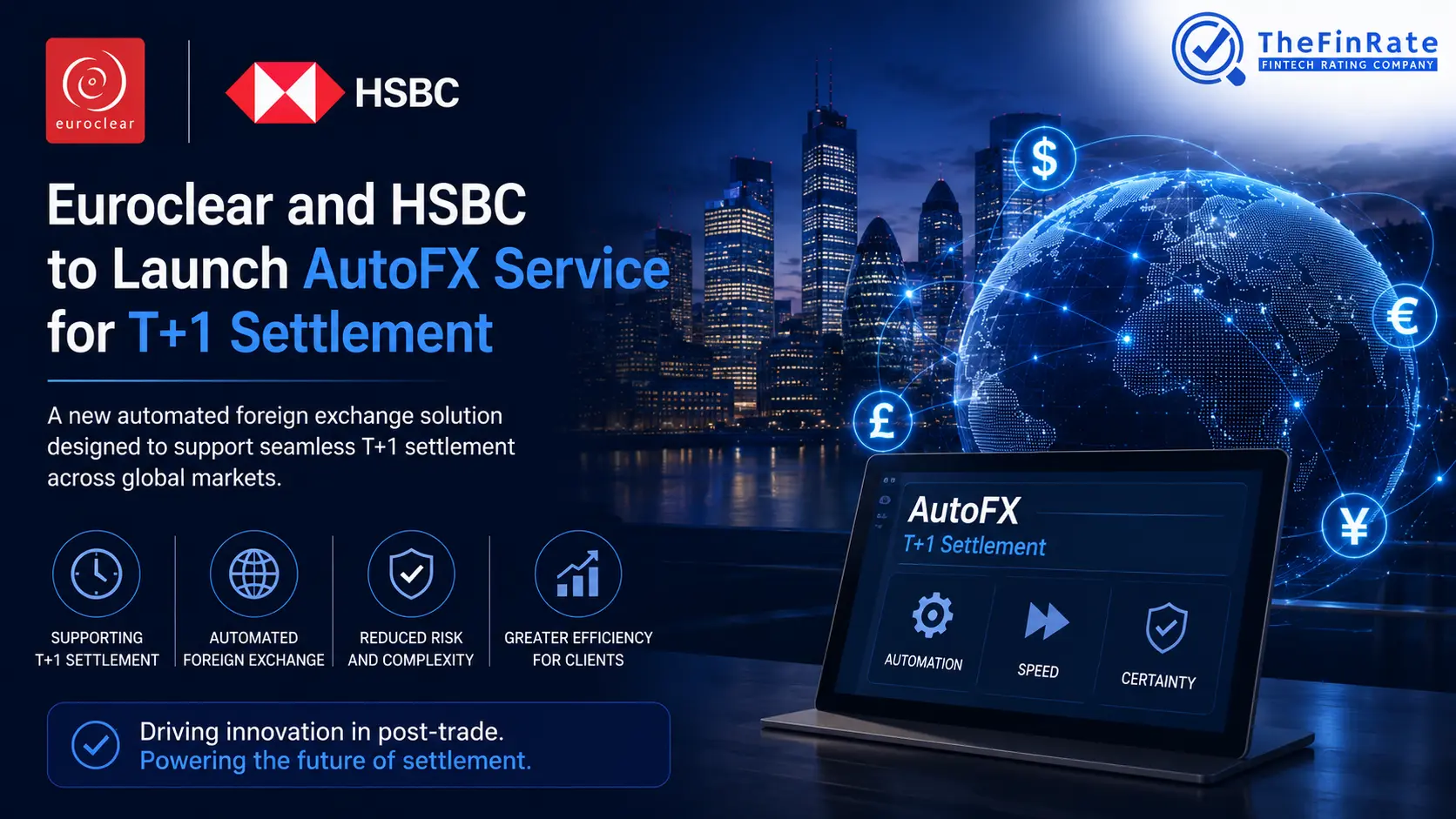
Euroclear and HSBC to Launch AutoFX Service for T+1 Settlement
Euroclear and HSBC are joining forces to launch AutoFX, an automated foreign-exchange service designed to help financial institutions manage currency requirements as European and UK securities markets prepare for the move to T+1 settlement.
The service will embed FX execution directly into the securities settlement process, automatically sourcing the currency required for settlement. The goal is to reduce operational risk, improve settlement certainty and simplify cross-border transactions as market participants face a shorter post-trade window.
Europe and the UK are expected to move to mandatory T+1 securities settlement in October 2027. Under the shorter cycle, trades will settle one business day after execution, reducing the time available for firms to complete funding, liquidity and FX processes.
Euroclear and HSBC Build FX Into Settlement
The planned AutoFX service will connect Euroclear’s settlement infrastructure with HSBC’s FX pricing, currency conversion, and liquidity capabilities.
Initially, AutoFX will support more than 30 currencies. Instead of requiring clients to manage FX activity separately from securities settlement, the service will integrate currency execution into the settlement workflow.
That integration matters because T+1 compresses the time available to identify currency requirements, arrange funding and complete settlement.
Euroclear already provides integrated foreign-exchange services alongside its settlement activity, including automated solutions designed to reduce manual instructions and settlement risk.
With AutoFX, the two institutions are taking that model further by combining automated FX execution with settlement activity.
Why T+1 Makes FX Automation More Important
The shift from T+2 to T+1 is more than a change to the settlement date.
It also changes the operational timetable surrounding every trade.
Investment firms, banks, custodians, and other market participants will have less time to complete a series of post-trade tasks, including trade matching, funding, liquidity management, and currency conversion.
That creates a particular challenge for cross-border securities transactions.
A trade involving a European security, a UK investor and a transaction denominated in another currency can require several funding and FX steps before settlement can occur. Under T+1, delays or manual intervention can create a greater risk of settlement failure.
Euroclear’s own T+1 roadmap highlights FX lifecycle management, FX settlement risk and payment-versus-payment mechanisms among the areas requiring industry attention.
AutoFX is therefore positioned as part of the broader automation push surrounding T+1.
What AutoFX Will Offer
The service is expected to provide several capabilities directly within the settlement workflow.
These include:
- Automated FX execution to source currencies required for settlement
- More than 30 currencies at launch
- Real-time visibility through an FX execution dashboard
- Intraday FX fixing points aligned with settlement schedules and time zones
- Transparent pricing
- Liquidity optimization capabilities
- Reduced excess funding requirements
The combination could help institutions reduce the amount of manual coordination required between securities settlement, treasury, and FX teams.
That is particularly relevant for global firms operating across multiple markets and time zones.
HSBC Adds Global FX and Liquidity Infrastructure
For HSBC, the collaboration extends its role across the FX value chain.
The bank said its Global FX Services business has an on-the-ground presence in more than 20 markets and provides FX solutions spanning front-to-back activities.
By connecting those capabilities with Euroclear’s settlement infrastructure, the partnership aims to make FX activity more closely aligned with the actual settlement requirement.
In practical terms, the model moves FX closer to where the underlying securities transaction is being settled.
That could reduce operational handoffs and give institutions greater visibility into their currency requirements.
A Bigger Change in Post-Trade Infrastructure
The announcement reflects a wider shift taking place across capital markets.
For years, post-trade infrastructure has depended heavily on a combination of automated systems and manual processes operating across separate functions.
T+1 increases the pressure to connect those functions.
Euroclear says the European T+1 transition is moving from planning toward implementation during 2026, with market participants expected to prepare for the October 2027 migration.
As a result, automation is becoming less about incremental efficiency and more about operational readiness.
FX is an important part of that equation.
If a securities transaction settles faster but the required currency is not available at the right time, the benefit of a shorter settlement cycle can be undermined.
That makes automated currency sourcing, liquidity management, and settlement connectivity increasingly important.
Why the Euroclear-HSBC Partnership Matters
The strategic significance of AutoFX goes beyond the service itself.
Euroclear sits at the centre of securities settlement and custody infrastructure, while HSBC brings large-scale FX pricing, conversion and liquidity capabilities.
Combining those capabilities creates a more integrated post-trade model.
For clients, the potential benefit is straightforward: fewer disconnected processes between securities settlement and FX management.
For the broader market, the partnership highlights how the transition to T+1 is likely to accelerate investment in post-trade automation.
The move also fits into Euroclear’s broader effort to improve settlement efficiency and reduce operational risk. The infrastructure provider says its settlement services achieve straight-through-processing rates of up to and above 99% across its operations.
AutoFX Expected in Early 2027
Euroclear and HSBC expect to make AutoFX available in early 2027, ahead of the planned October 2027 T+1 transition for European and UK securities markets.
The timing is significant.
Market participants will need to test processes, update technology and establish new operating models well before the shorter settlement cycle becomes mandatory.
AutoFX gives Euroclear clients another tool for handling one of the more complicated parts of that transition: ensuring the right currency is available when settlement occurs.
The Bigger Picture
T+1 is often described as a settlement-cycle change.
In reality, it is becoming a broader technology and operational transformation across capital markets.
The less time firms have to settle trades, the less room there is for fragmented workflows, manual intervention and delayed funding decisions.
That is why the next generation of post-trade infrastructure is likely to connect settlement, FX, liquidity and funding more tightly.
Euroclear and HSBC’s AutoFX initiative is one example of that shift.
The real test will come when markets move to T+1 and institutions have to execute these processes at scale.
If automated FX can reliably deliver the required currency within the settlement window, it could help financial institutions capture the efficiency benefits of T+1 without adding another layer of operational complexity.
Frequently Asked Questions
What is AutoFX?
AutoFX is a planned automated FX service from Euroclear and HSBC that will integrate FX execution directly into the securities settlement process.
Why is AutoFX being launched?
The service is designed to help Euroclear clients manage FX, funding and liquidity more efficiently as Europe and the UK prepare for T+1 settlement.
How many currencies will AutoFX support?
The service is expected to initially support more than 30 currencies.
When will AutoFX be available?
Euroclear and HSBC expect AutoFX to become available in early 2027.
When will Europe and the UK move to T+1?
The European Union and the UK are preparing for mandatory T+1 securities settlement from October 2027. Euroclear currently identifies 11 October 2027 as the EU transition date.
Why does T+1 increase the need for FX automation?
T+1 gives market participants less time between trade execution and settlement. Firms therefore need to complete funding, liquidity and FX processes faster, making automation more important.
Comments
No comments yet. Be the first to share your thoughts.
Leave a comment