
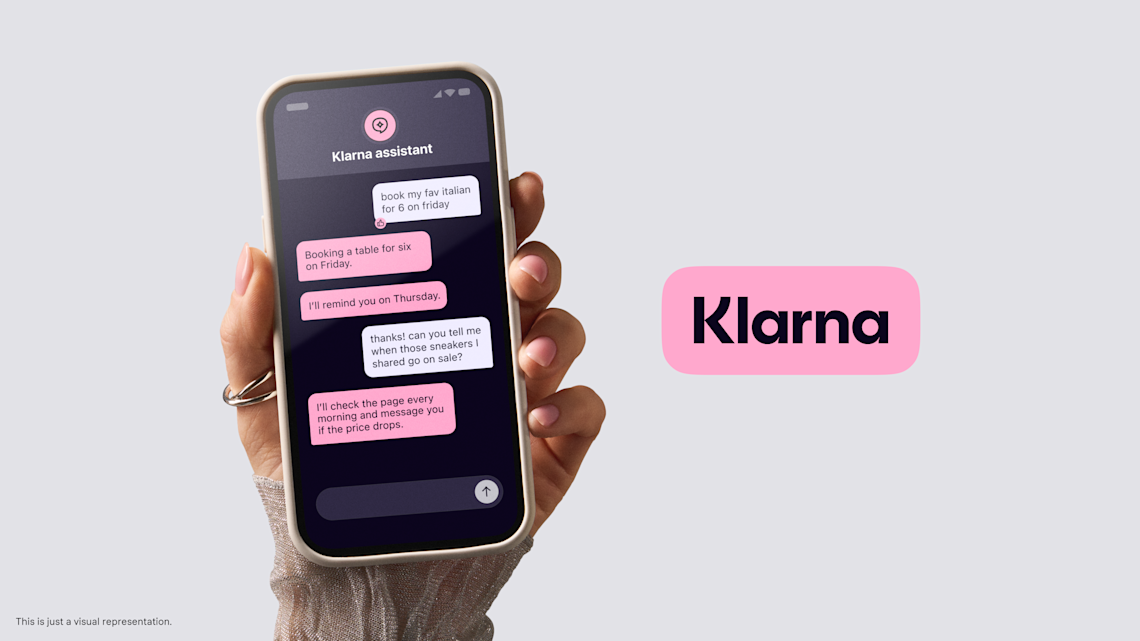
Klarna is expanding its artificial intelligence strategy beyond online shopping with a new personal assistant designed to manage purchases, returns, bookings, and everyday administration. The Swedish fintech says the assistant can find products, compare prices, arrange services, and help users manage routine tasks.
Announced on 17 November 2026, the Klarna AI-assistant is currently available to a small group of early users. The company has opened a waitlist, with invitations being issued gradually.
The assistant extends Klarna's existing shopping experience into a broader personal concierge. It can help users find products, book restaurant tables or babysitters, track deliveries, draft email replies for approval, organize receipts, and suggest gifts for upcoming birthdays.
The announcement signals Klarna's ambition to make AI a more central part of its commerce and financial services ecosystem. Rather than simply helping consumers discover products or complete checkout, the company wants its technology to take on more of the work surrounding everyday purchases.
From Shopping Assistant to Personal AI Concierge
Klarna's new assistant builds on its existing in-app shopping browser, which allows customers to browse and purchase products across different websites.
According to Klarna, customers have spent more than $34 billion through the built-in browser since its launch in 2020. The feature supports shopping across websites, including retailers that do not directly offer Klarna at checkout.
The new assistant expands that experience beyond product discovery.
Users can ask it to find suitable products and compare available options. It can also help arrange services, such as restaurant reservations and babysitting.
Beyond shopping, the assistant can manage several administrative tasks. These include tracking expected deliveries, organizing receipts, and preparing email responses for user approval.
It can also flag upcoming birthdays and suggest potential gifts.
This broader functionality moves Klarna closer to the emerging category of AI agents that perform tasks on behalf of consumers. These systems aim to reduce the number of steps users must complete when shopping or managing everyday activities.
Klarna Brings AI Assistance to WhatsApp and iMessage
The assistant is designed to work through messaging channels, including WhatsApp and Apple's iMessage, as well as Klarna's own app.
This approach allows customers to interact with the assistant through familiar conversations rather than navigating multiple applications and websites.
Klarna says the assistant acts on behalf of customers while keeping them in control. Email replies, for example, are drafted for approval rather than automatically sent.
The company has also emphasized that access remains limited. Only a small group of early users can currently use the service, while other interested customers can join the waitlist.
Klarna has not announced a broad public rollout date or provided a detailed country-by-country availability schedule.
The company says joining the waitlist is free. It plans to invite users gradually as access expands.
Human Approval Remains Important for AI-Initiated Purchases
One of the central questions surrounding agentic commerce is how much authority an AI assistant should have when spending money.
An assistant that can find products and arrange purchases must operate within clear customer permissions. Users also need to understand what they are authorizing and when a payment will take place.
Klarna's announcement promotes a shopping experience in which customers do not pay until an ordered item arrives. However, it does not explain the full payment process, merchant settlement arrangements, or the technical mechanisms behind this promise.
Reporting by Payments Dive, citing a Klarna spokesperson, indicates that a human must authorize purchases rather than allowing the assistant to complete payments entirely autonomously.
That distinction matters. The assistant can take on much of the discovery and administrative work, but payment approval remains a critical customer control.
Klarna will need to demonstrate how these permissions work in practice as the service expands.
A Larger AI Strategy Built Around Commerce
The launch forms part of Klarna's longer-term strategy to integrate AI into shopping, payments, and everyday financial management.
CEO Sebastian Siemiatkowski said the company's vision dates back to 2015, when it imagined technology that could help people save money and manage financial tasks automatically.
He described the new assistant as an important step towards that vision.
Klarna is also using its existing customer and merchant network as a foundation for the expansion.
In its announcement, the company reported more than 122 million global active users, approximately 3.8 million daily transactions, and over 1.3 million retail partners.
These figures give Klarna a substantial existing commerce ecosystem in which to develop AI-powered services.
However, the success of the assistant will depend on more than the size of its network. Its ability to find relevant products, complete useful tasks, protect customer information, and maintain reliable payment controls will shape adoption.
Agentic Commerce Moves Beyond Product Discovery
Klarna's launch reflects a wider shift in digital commerce. AI assistants are moving from answering questions and recommending products towards carrying out multi-step tasks.
For consumers, this could mean delegating product research, delivery tracking, returns, and bookings to a single assistant.
For merchants, it could change how customers discover products and interact with checkout systems. Retailers may increasingly need to make their catalogs, product information, and payment processes accessible to AI-driven shopping experiences.
For payment providers, the development raises questions about authentication, delegated spending authority, fraud prevention, and transaction approval.
Klarna has not yet disclosed the technical protocols or merchant integrations powering the new assistant. These details will become important as the service moves beyond its limited early-access phase.
The FinRate Takeaway: Klarna is positioning AI as more than a shopping recommendation tool. Its new assistant aims to connect product discovery, purchases, bookings, and everyday administration through conversational interfaces. Yet the most important test will be whether it can perform these tasks reliably while keeping customers in control of their money and decisions.
Comments
No comments yet. Be the first to share your thoughts.
Leave a comment