
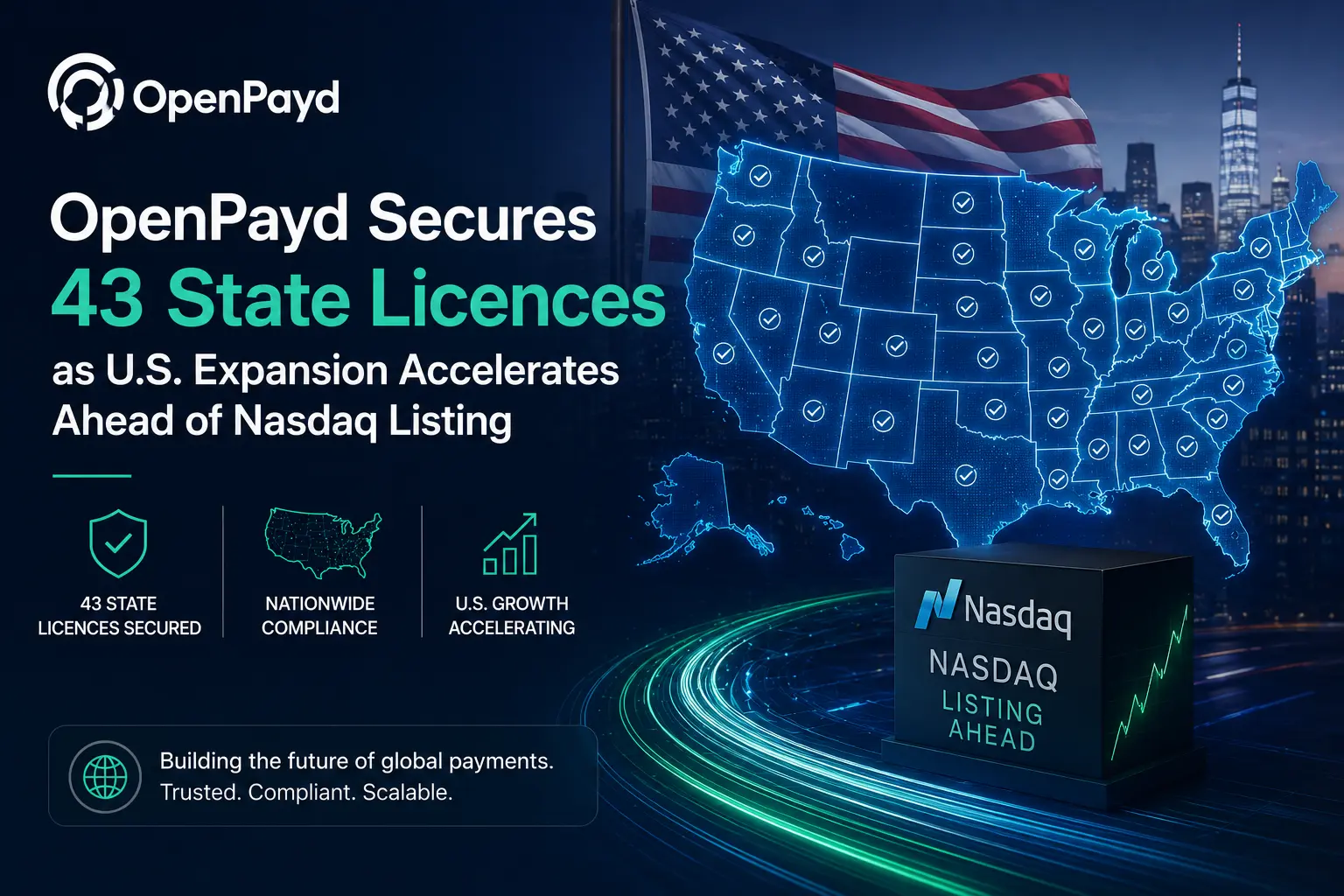
OpenPayd Secures 43 State Licenses as U.S. Expansion Accelerates Ahead of Nasdaq Listing
OpenPayd has strengthened its U.S. market position by integrating MSB USA Inc., bringing 43 state Money Transmitter Licenses under the financial infrastructure provider’s umbrella.
The move gives OpenPayd a substantially broader regulatory foundation in the United States as it expands its global payments and financial infrastructure offering. It also comes at an important moment for the company: OpenPayd is preparing for a proposed Nasdaq listing through its business combination with Titan Acquisition Corp.
The integration of MSB USA has been finalised following regulatory approvals, according to OpenPayd’s latest announcement.
For OpenPayd, the significance goes beyond adding licences. The company is building the regulatory infrastructure needed to serve global businesses that want access to U.S. payment capabilities while maintaining connections to fiat and digital-asset markets.
OpenPayd 43 State Licences Expand U.S. Regulatory Reach
The integration brings 43 state money transmitter licenses into the OpenPayd group.
That matters because the U.S. money transmission market remains highly fragmented at the state level. A broader licensing footprint can reduce one of the major barriers facing financial infrastructure companies seeking to expand their services across the country.
OpenPayd said the additional licences will provide greater geographic reach for global clients already operating in the U.S. or planning to enter the market.
MSB USA will continue operating with its existing leadership team while preparing for deeper integration into OpenPayd’s platform.
The business was founded by OpenPayd founder Dr. Ozan Ozerk and provides money transmission and payment-related infrastructure through third-party financial institutions and payment providers.
Importantly, MSB USA does not operate as a bank, accept deposits, or issue bank accounts. Its services include access to U.S. dollar payment capabilities such as ACH, Fedwire, and SWIFT, subject to applicable regulatory and contractual requirements.
OpenPayd Is Building a Transatlantic Financial Infrastructure Network
The U.S. expansion arrives shortly after OpenPayd received authorization under the European Union’s Markets in Crypto-Assets framework from the Malta Financial Services Authority.
Together, the developments strengthen OpenPayd’s positioning across the U.S., U.K. and Europe.
The company’s broader strategy is to connect traditional financial infrastructure with digital assets through a single technology platform.
OpenPayd offers embedded accounts, foreign exchange, domestic and international payments, Open Banking and stablecoin on- and off-ramps.
That positioning is increasingly relevant as fintechs, digital-asset companies and global businesses look for infrastructure that can operate across multiple payment rails and regulatory environments.
Founder Dr. Ozan Ozerk described the shift as a move toward programmable money, arguing that the next generation of financial infrastructure will need to support money movement across traditional and digital networks.
The U.S. expansion therefore gives OpenPayd an additional piece of that infrastructure puzzle.
OpenPayd Reports $96 Million in ARR and $300 Billion in Annualized Volume
The licensing expansion also comes as OpenPayd reports strong operating momentum.
As of July 31, 2026, the company said its Annual Recurring Revenue had exceeded $96 million, while annualized transaction volume had surpassed $300 billion.
OpenPayd also said it remains profitable and has taken no external capital.
Its client base has grown beyond 1,200 businesses globally, including well-known names such as Kraken, eToro, OKX and B2C2.
The numbers point to a business that has already reached substantial scale before its proposed public-market debut.
However, OpenPayd’s ARR figure comes with an important qualification. The company defines ARR using revenue from its most recently completed calendar month multiplied by 12. That measure includes transaction fees, subscription fees, foreign exchange margins, interest earned on client balances and other operational revenue.
As a result, ARR is a management operating metric rather than an IFRS revenue measure, and it should not be treated as a direct forecast of future revenue.
Nasdaq Listing Adds Another Dimension to the U.S. Strategy
OpenPayd’s regulatory expansion is closely linked to its plans for the U.S. public markets.
In June 2026, OpenPayd and Titan Acquisition Corp. announced a definitive business combination agreement.
If completed, the transaction would result in OpenPayd becoming a publicly listed company on Nasdaq under the proposed ticker OP.
The transaction values OpenPayd at up to $1.145 billion in pro-forma equity value.
The companies currently expect the transaction to close during the fourth quarter of 2026, subject to customary closing conditions, including approval by Titan shareholders.
The proposed transaction remains subject to those conditions. Therefore, OpenPayd should not yet be described as a Nasdaq-listed public company.
The SEC filing also makes clear that the transaction carries risks, including the possibility that required approvals could be delayed or not obtained, shareholder approval could fail, or the expected benefits could differ from management’s expectations.
Why the U.S. Move Matters for OpenPayd
The U.S. expansion could give OpenPayd a stronger proposition when competing for multinational fintech and digital-asset clients.
For businesses operating across borders, payment infrastructure is rarely just about moving money from point A to point B.
They also need local regulatory coverage, banking relationships, payment-rail connectivity, foreign exchange capabilities, and compliance processes.
By bringing 43 state licenses into the group, OpenPayd can potentially address more of those requirements through its own regulatory footprint.
That could become particularly important for clients expanding from Europe into the U.S.
At the same time, OpenPayd’s strategy reflects a wider shift in financial infrastructure.
Fintech companies increasingly want one technology layer that can connect bank accounts, payment rails, cards, FX, instant payments and digital assets.
OpenPayd is attempting to position itself in that infrastructure layer.
From Payments Infrastructure to Programmable Money
The company is also positioning its platform around the convergence of traditional finance and digital assets.
That includes stablecoin on- and off-ramps alongside conventional payment infrastructure.
This creates a potentially important opportunity as stablecoins become more integrated into cross-border payments and treasury operations.
Yet regulation remains central to that opportunity.
A company can build sophisticated payment technology, but its ability to deploy those services at scale depends heavily on licenses, banking relationships, and compliance infrastructure.
That makes OpenPayd’s 43-state licensing expansion strategically significant.
The company is not simply entering another market. It is building the regulatory foundation required to operate more deeply within one of the world’s largest financial markets.
What Comes Next for OpenPayd?
OpenPayd now faces two major execution challenges.
First, it must turn its expanded U.S. regulatory footprint into actual customer growth, payment volume and revenue.
Second, it must complete the proposed combination with Titan if it wants to achieve its planned Nasdaq listing.
The timing creates an interesting intersection between regulatory expansion and public-market preparation.
OpenPayd already reports more than $300 billion in annualized transaction volume and more than $96 million in ARR. The addition of 43 U.S. state licences could give the company another avenue for growth.
But licences alone do not guarantee market share.
The next test will be whether OpenPayd can convert regulatory access into meaningful U.S. business while continuing to scale its existing European and global operations.
The Bigger Picture
OpenPayd’s latest move illustrates how financial infrastructure is becoming increasingly global — but regulation is still local.
For fintech companies, the technology can cross borders in seconds. Licenses cannot.
By integrating MSB USA and adding 43 state licenses to its regulatory footprint, OpenPayd is attempting to close that gap.
And with a potential Nasdaq listing approaching, the U.S. expansion gives investors another factor to watch: whether OpenPayd can turn its growing regulatory network into sustainable commercial growth.
For now, the company has established the infrastructure.
The next question is how much business that infrastructure can unlock.
OpenPayd Strengthens Position in the U.S. Market Through the Acquisition of 43 State Licences
Comments
No comments yet. Be the first to share your thoughts.
Leave a comment