
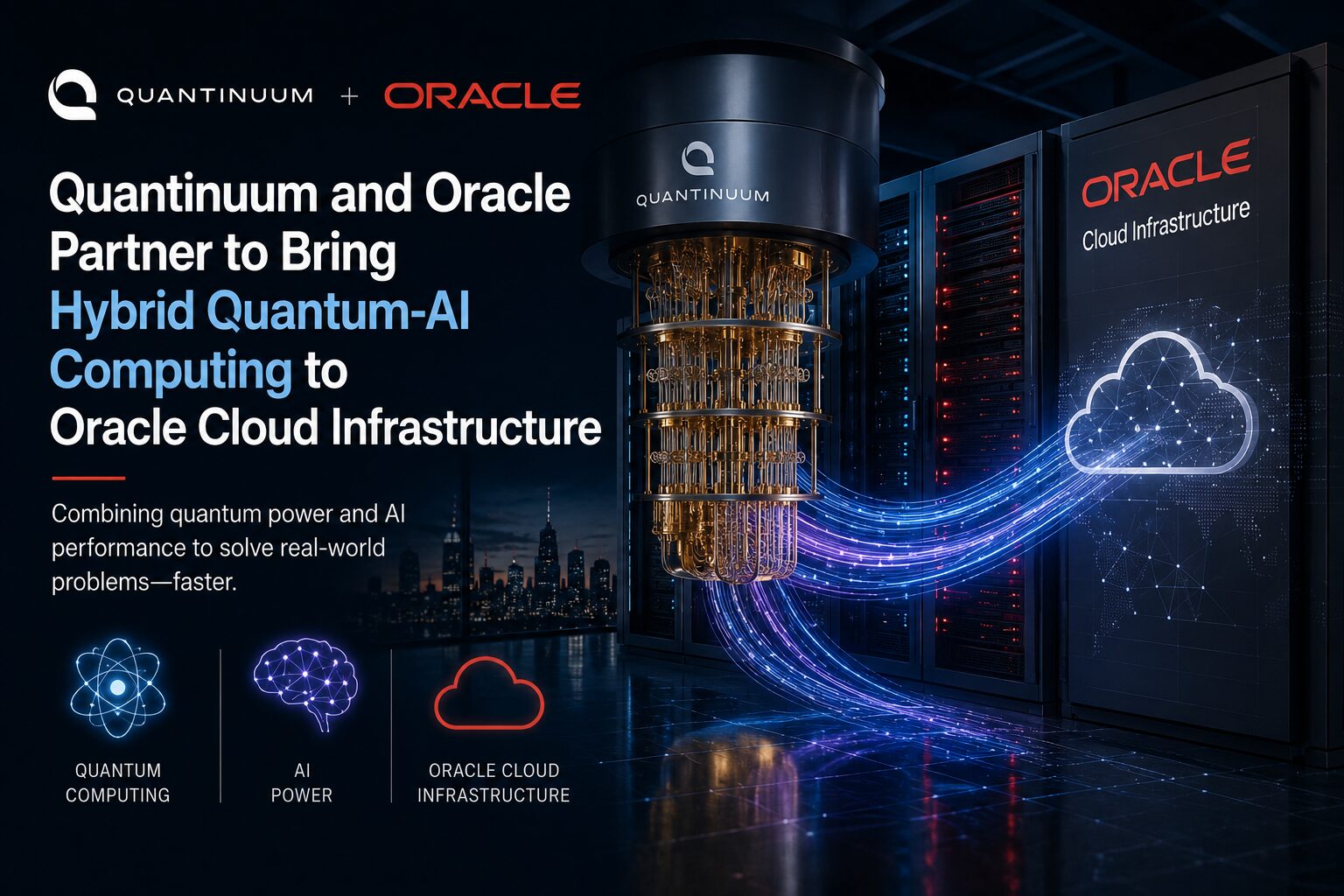
Quantinuum and Oracle Partner to Bring Hybrid Quantum-AI Computing to Oracle Cloud Infrastructure
Quantinuum and Oracle have announced a multi-year strategic partnership to bring enterprise quantum computing to Oracle Cloud Infrastructure (OCI). This marks a significant step toward integrating quantum computing with artificial intelligence and high-performance computing in a cloud environment.
Under the partnership, Quantinuum’s Helios quantum computer will be deployed in an OCI AI data center. As a result, Oracle Cloud customers will be able to access quantum computing directly through OCI’s managed quantum service. The initiative aims to support hybrid quantum-AI workloads across industries including financial services, pharmaceuticals, materials science, logistics, energy, and large-scale optimization.
The announcement reflects a broader industry push to make quantum computing a practical enterprise technology. It also combines quantum computing with existing cloud, AI, and supercomputing infrastructure.
Quantum computing moves into enterprise cloud infrastructure
The partnership gives OCI customers access to Quantinuum’s Helios system. The company describes it as one of the most advanced commercial quantum computers currently available.
Instead of requiring organizations to build specialized quantum facilities, Oracle will provide managed cloud access to quantum computing. In addition, customers will be able to use OCI’s existing GPU and high-performance computing (HPC) infrastructure.
This approach allows enterprises, research institutions, and AI laboratories to develop and run hybrid quantum-classical applications. They can do this within the same cloud environment they already use for advanced computing workloads.
Helios will support hybrid quantum-AI workloads
Helios is Quantinuum’s third-generation trapped-ion quantum computer. The company commercially launched it in late 2025.
The system includes 98 physical qubits. It has also demonstrated 48 logical qubits with a reported average two-qubit gate fidelity of 99.921%.
The companies plan to integrate Helios directly with OCI’s compute, networking, storage, identity, and data services.
As a result, developers will be able to combine quantum processing with AI models and classical HPC systems in a unified workflow.
Potential applications include:
- drug discovery,
- materials research,
- financial modeling,
- portfolio optimization,
- supply-chain optimization,
- and advanced AI workloads.
Oracle expands its quantum cloud ambitions
Oracle said it plans to preview its OCI quantum service in the coming months.
The service is expected to provide developers with a streamlined environment for building, testing, and executing quantum-classical applications.
Oracle also plans to support open-source hybrid quantum programming frameworks. This will allow researchers and enterprises to move from simulation to execution on real quantum hardware more efficiently.
The partnership positions Oracle among the major cloud providers expanding into quantum computing infrastructure. It also aligns with broader investments across the cloud industry in AI and advanced computing platforms.
Energy efficiency becomes part of the quantum case
One notable aspect of the announcement is the emphasis on compute efficiency and energy use.
Quantinuum said a Helios quantum system consumes less than one percent of the power used by leading supercomputers.
While quantum computing will not replace classical computing for most workloads, the companies argue that quantum processors could become an energy-efficient complementary resource for suitable computational problems.
As AI data centers face increasing power demands, energy efficiency has become an increasingly important consideration for future computing infrastructure.
Financial services could become a key use case
The partnership is particularly relevant for financial institutions. These institutions are actively exploring quantum computing for portfolio optimization, derivatives pricing, risk analysis, fraud detection, and complex simulation problems.
Hybrid quantum-AI environments could allow banks, asset managers, and insurers to integrate quantum algorithms with existing AI and analytics workflows.
Because the service will operate within Oracle’s cloud infrastructure, institutions may be able to use existing security, governance, and access-control frameworks. This could be easier than deploying standalone quantum environments.
Lowering the barrier to quantum adoption
A major challenge in enterprise quantum computing has been accessibility.
Specialized hardware, limited integration, and unfamiliar development tools have slowed commercial adoption.
By delivering quantum computing as a managed OCI service, Oracle and Quantinuum aim to reduce those barriers.
Organizations will be able to access quantum hardware through familiar cloud infrastructure and development environments. They will not need to manage dedicated quantum systems.
Industry analysts increasingly view hybrid quantum-classical computing as the most likely path for near-term enterprise adoption.
A broader shift in enterprise computing
The collaboration reflects a growing convergence between AI, cloud computing, and quantum computing.
Enterprises are increasingly looking for computing architectures capable of solving problems that exceed the practical limits of traditional systems.
Rather than positioning quantum computing as a replacement for classical infrastructure, the partnership treats it as a specialized computing layer. It can work alongside AI and HPC resources.
As organizations pursue more complex scientific, industrial, and financial applications, that hybrid model may become increasingly important.
The line
Quantinuum and Oracle’s partnership represents an important step toward making hybrid quantum-AI computing available through enterprise cloud infrastructure.
By deploying the Helios quantum computer inside Oracle Cloud Infrastructure, the companies aim to give enterprises, research institutions, and AI developers secure access to quantum computing. They can do this without the complexity of operating dedicated hardware.
As quantum computing moves closer to commercial adoption, cloud-based hybrid infrastructure could become one of the most important pathways for integrating quantum processing, artificial intelligence, and high-performance computing into real-world enterprise operations.
Comments
No comments yet. Be the first to share your thoughts.
Leave a comment