
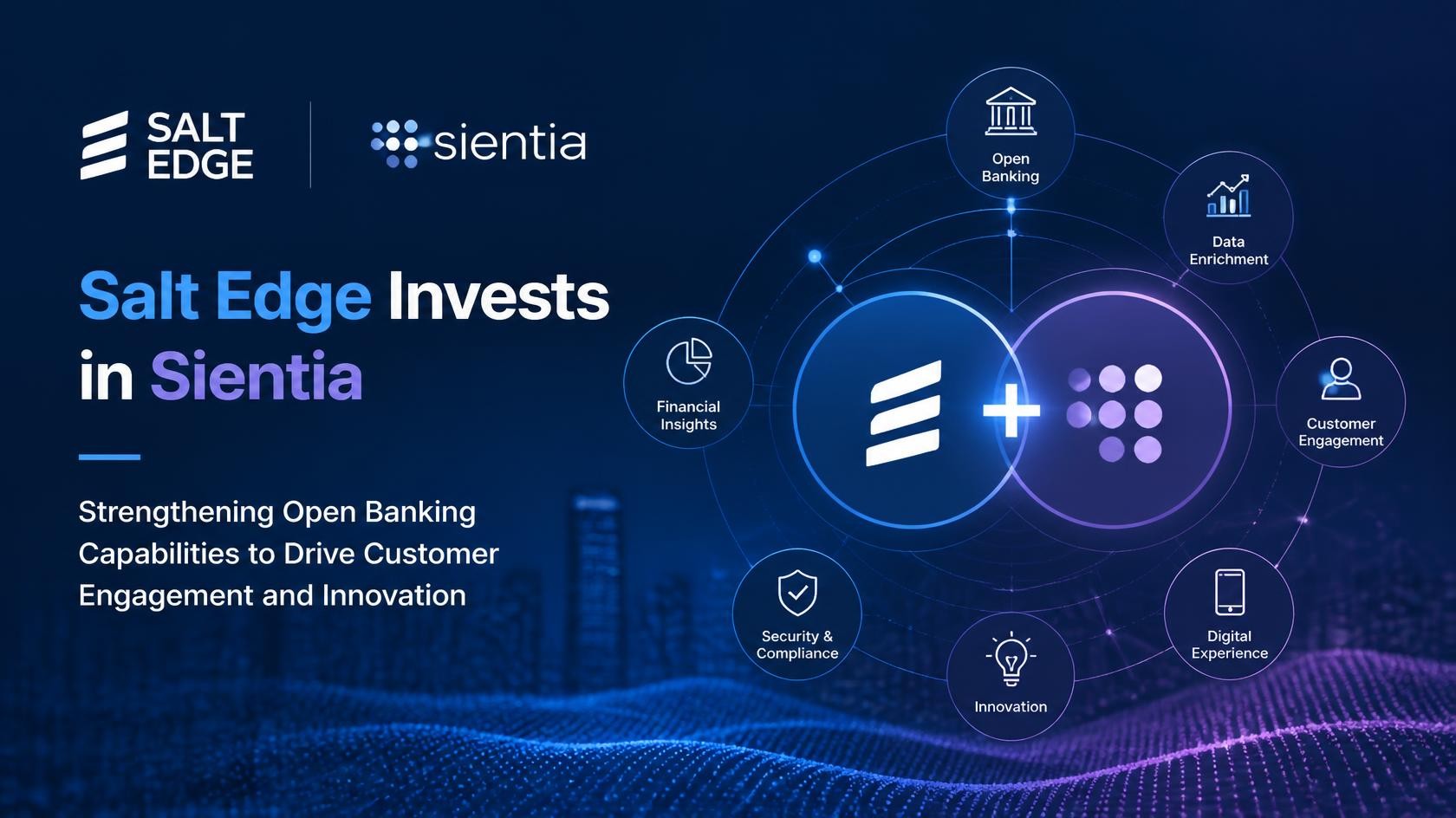
Salt Edge Invests in Sientia to Transform Open Banking into a Customer Engagement Engine
Salt Edge has invested in payment-linked advertising platform Sientia, marking a significant step in the evolution of open banking. Rather than focusing solely on account connectivity and payments, the partnership aims to unlock new opportunities in loyalty programs, personalized rewards, and data-driven customer engagement. The strategic investment reflects a growing industry shift toward turning consent-based financial data into measurable business value while maintaining privacy-first principles.
Open banking has traditionally been viewed as the technology that allows customers to securely share their banking information with authorized third parties. However, as the industry matures, financial institutions and fintech companies are increasingly looking beyond infrastructure to develop innovative customer experiences. Salt Edge’s latest investment demonstrates how open finance is entering its next phase—one where financial data powers marketing, personalization, and long-term customer relationships.
Salt Edge Expands Its Open Banking Vision
Global open banking platform Salt Edge has announced a strategic investment in Sientia, a company specializing in payment-linked advertising and loyalty technology.
The partnership combines Salt Edge’s extensive banking infrastructure with Sientia’s customer engagement platform to create new value-added financial services built on consented transaction data.
Rather than simply enabling account aggregation or payment initiation, the companies aim to transform financial data into personalized experiences that benefit consumers, merchants, publishers, and financial institutions alike.
This investment represents a broader industry trend where open banking is evolving from regulatory compliance into a commercial growth engine.
Why This Investment Matters
The open banking industry has matured rapidly over the past decade.
Most existing solutions focus on three core functions:
- Secure account information access
- Payment initiation
- Financial data aggregation
While these services remain essential, they often operate behind the scenes and generate limited direct customer engagement.
Salt Edge and Sientia are pursuing a different strategy.
Their goal is to use permission-based financial data to deliver highly personalized rewards, cashback offers, loyalty programs, and targeted marketing campaigns based on actual spending behavior.
This approach creates tangible value for consumers while opening new revenue opportunities for businesses.
Moving Beyond Open Banking Infrastructure
Salt Edge has built one of the world’s largest open banking connectivity platforms.
The company currently connects businesses to more than:
- 2,700+ Financial institutions across Europe and the UK
- 5,000+ financial institutions in over 50 countries worldwide
This global infrastructure enables secure access to banking data under customer consent.
Sientia adds another layer on top of that infrastructure.
Its platform analyzes real-time financial transactions and spending insights to help businesses create payment-linked advertising campaigns, personalized rewards, and intelligent loyalty programs.
Together, the two companies aim to move open banking beyond connectivity and into customer engagement.
How the Partnership Works
The partnership combines two complementary technologies.
Salt Edge Provides
- Open banking APIs
- Secure financial data connectivity
- Regulatory compliance
- Bank integrations
- Open finance infrastructure
Sientia Delivers
- Payment-linked advertising
- Loyalty program technology
- Spending behavior analytics
- Personalized customer offers
- Marketing intelligence
The result is an ecosystem where financial data becomes a tool for delivering more relevant customer experiences while maintaining full user consent.
Unlocking New Business Opportunities
The investment has the potential to create value across multiple industries.
For Banks
Banks can strengthen customer relationships through personalized cashback offers, merchant rewards, and loyalty programs directly integrated into digital banking apps.
This increases customer engagement while improving retention.
For Retailers
Retailers gain access to highly accurate spending insights that allow them to deliver targeted promotions based on real purchasing behavior instead of broad demographic assumptions.
Marketing becomes more efficient because offers reach customers who are genuinely interested.
For Advertisers
Traditional digital advertising often relies on cookies and behavioral tracking.
Sientia’s model instead uses customer-authorized banking data, enabling advertisers to create more relevant campaigns while respecting privacy regulations.
For Publishers
Media companies and digital platforms can monetize audiences through highly personalized financial offers without relying exclusively on third-party advertising networks.
For Consumers
Customers receive meaningful rewards in exchange for voluntarily sharing financial data.
Benefits may include:
- Personalized cashback
- Merchant discounts
- Better loyalty rewards
- Relevant financial recommendations
- Improved shopping experiences
Instead of generic promotions, consumers receive offers aligned with their actual spending habits.
Why Privacy Remains Central
One of the biggest differentiators of this partnership is its emphasis on customer consent.
Unlike traditional advertising models that rely on cookies or hidden tracking technologies, open banking requires explicit permission before financial data can be accessed.
This creates a more transparent value exchange.
Customers choose whether to share their data, understand how it will be used, and receive clear benefits in return.
As privacy regulations continue tightening across global markets, this consent-first approach could become a competitive advantage.
A New Growth Phase for Open Banking
Industry experts increasingly believe that open banking is entering a second stage of development.
Phase One
Focused on infrastructure.
- Account aggregation
- Payment initiation
- Compliance
- API connectivity
Phase Two
Focused on value creation.
- Customer engagement
- Loyalty ecosystems
- Personalized marketing
- Financial wellness
- Intelligent commerce
Salt Edge’s investment in Sientia fits squarely into this second phase.
Rather than selling access to banking data, companies are beginning to build products that create measurable business outcomes using that data.
Strategic Benefits for Salt Edge
The investment expands Salt Edge’s role beyond infrastructure provider.
Instead of serving only as the technology layer connecting banks and fintechs, the company now gains exposure to higher-value customer engagement services.
This diversification strengthens Salt Edge’s long-term business model while creating additional opportunities for financial institutions already connected to its platform.
It also reinforces the company’s position as a leading innovator in the growing open finance ecosystem.
What Could Change for the Industry
If the partnership succeeds, it could reshape how businesses think about open banking.
Potential developments include:
- Banks launching integrated rewards ecosystems.
- Merchants offering real-time cashback based on banking activity.
- Financial institutions improving customer retention through personalized engagement.
- Publishers monetizing audiences using permission-based financial insights.
- Advertisers reducing reliance on third-party cookies.
These use cases extend open banking far beyond regulatory compliance.
Instead, they position financial data as a foundation for smarter customer experiences.
Risks and Challenges
Despite its promise, the model faces important challenges.
Privacy Expectations
Consumers may remain cautious about sharing banking information, even when explicit consent is required.
Companies must clearly communicate how data is used and what benefits customers receive.
Regulatory Compliance
Financial data is among the most highly regulated forms of personal information.
Maintaining compliance with PSD2, GDPR, open banking regulations, and future privacy frameworks will remain critical.
Building Consumer Trust
The long-term success of payment-linked advertising depends on trust.
Customers must believe their data is secure, their consent is respected, and the value exchange is worthwhile.
Without transparency, adoption could slow.
The Bigger Picture
Many people still view open banking as a technical infrastructure project.
This investment suggests something much larger is taking shape.
Open banking is becoming an economic platform where secure financial data can power personalized commerce, intelligent marketing, and stronger customer relationships.
Instead of acting merely as digital plumbing for financial services, open banking is evolving into a foundation for entirely new business models.
That evolution could significantly expand the commercial value of open finance over the coming decade.
Conclusion
Salt Edge’s strategic investment in Sientia represents more than a fintech funding announcement, it highlights the next chapter of open banking. By combining secure banking infrastructure with payment-linked advertising, loyalty programs, and personalized rewards, the partnership demonstrates how consent-based financial data can create meaningful value for both businesses and consumers.
As financial institutions continue searching for new ways to improve customer engagement, this collaboration offers a compelling blueprint for the future of open finance. If successfully executed, it could help redefine open banking from a compliance requirement into one of the financial industry’s most powerful customer engagement platforms.
Comments
No comments yet. Be the first to share your thoughts.
Leave a comment