
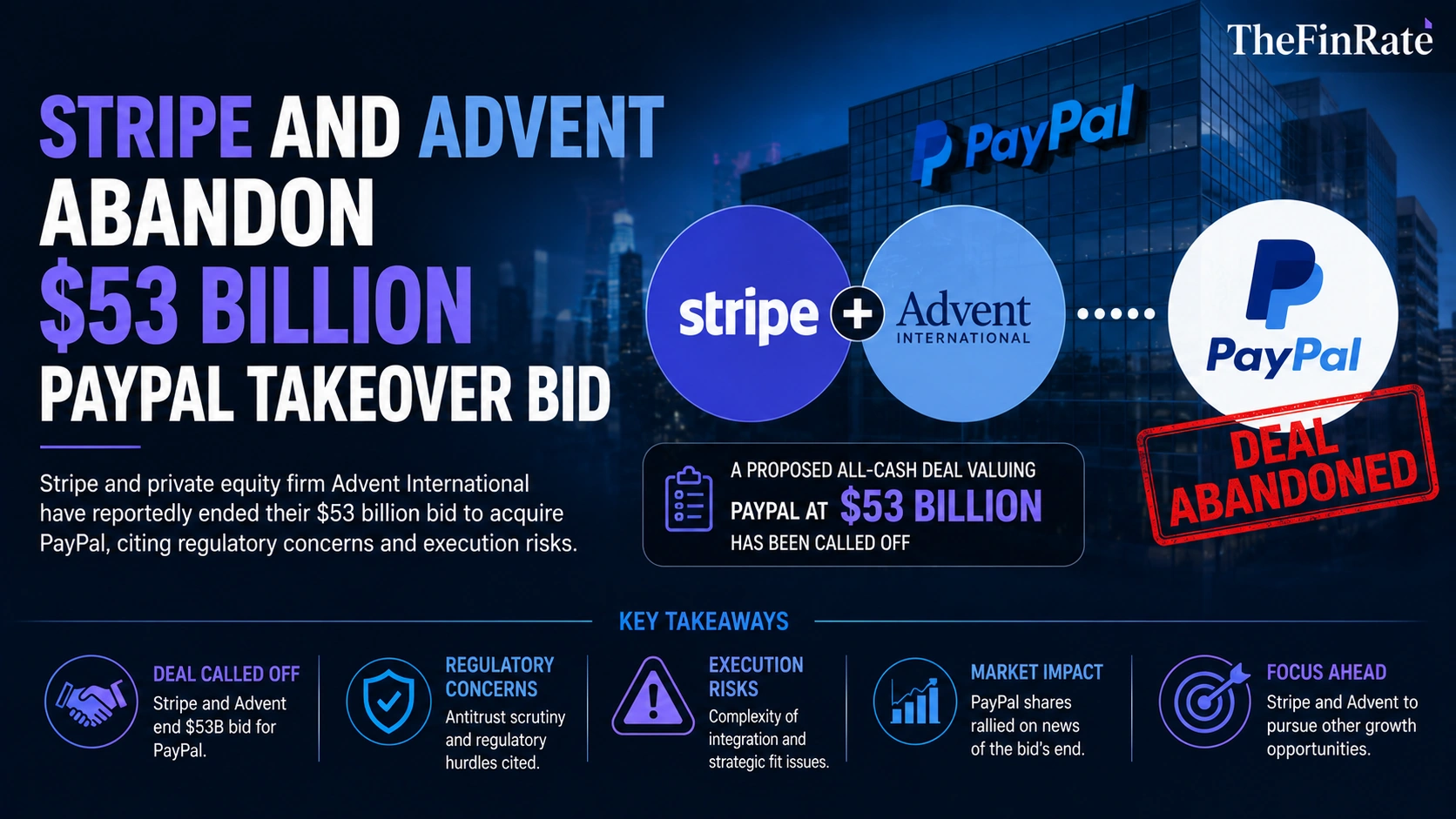
The reported withdrawal of the PayPal takeover bid marks a major setback for one of the biggest potential deals in the payments industry and puts fresh focus on the fintech company’s turnaround strategy.
Stripe and private equity firm Advent International have abandoned their pursuit of PayPal, bringing an end to a reported $53 billion takeover effort that had attracted significant attention across the global payments industry.
The consortium had offered approximately $60.50 per PayPal share, valuing the payments company at more than $53 billion. However, the proposal failed to progress, with the consortium now reportedly no longer pursuing the transaction. PayPal, Stripe and Advent declined to comment on the latest report.
The development triggered an immediate reaction in financial markets. PayPal shares fell roughly 13% in premarket trading on August 28 after reports that the potential acquisition had been abandoned.
For PayPal, however, the collapse of the deal is about more than one failed acquisition. It puts the company’s valuation, competitive position and ongoing turnaround strategy back under the spotlight.
PayPal takeover bid ends after weeks of speculation
The PayPal takeover bid emerged in July when Stripe and Advent International jointly offered $60.50 per share for the payments company.
According to Reuters, the proposal valued PayPal at more than $53 billion and represented a premium of roughly 28% to the company’s share price at the time. The consortium also had approximately $50 billion in committed financing from banks.
The proposed transaction would have brought together two of the most recognizable names in digital payments.
Stripe has built a major payments infrastructure business serving online merchants, while PayPal operates one of the world’s largest digital payments networks. A combination would therefore have created a significantly larger payments platform with extensive merchant and consumer reach.
However, the proposal faced valuation concerns.
PayPal’s board had previously viewed the initial offer as inadequate, according to people familiar with the matter cited by Reuters. The two sides were reportedly unable to bridge the gap over valuation, ultimately leading to the consortium abandoning the pursuit.
PayPal shares fall sharply after deal collapses
The market reaction was immediate.
PayPal shares closed at $61.47 on August 27 before falling to around $53.20 in premarket trading following reports that Stripe and Advent had walked away. Reuters reported that the stock was down about 13% before the market opened.
The decline effectively removed the takeover premium investors had attached to PayPal during the acquisition discussions.
The reaction also demonstrates how heavily the company’s recent share performance had become linked to expectations surrounding a possible transaction.
PayPal shares had gained significantly during the quarter amid takeover speculation and the company’s latest financial developments. The collapse of the deal therefore forces investors to reassess the company on a standalone basis.
From $360 billion to $53 billion
One of the most striking aspects of the PayPal takeover bid is the difference between the proposed valuation and the company’s pandemic-era peak.
PayPal commanded a valuation of approximately $360 billion in 2021, when the surge in online shopping and digital payments dramatically increased investor enthusiasm for fintech companies. The latest takeover proposal valued the business at more than $53 billion.
That represents a dramatic change in how the market values one of the pioneers of digital payments.
The decline reflects several structural changes in the payments industry.
The pandemic-driven acceleration in e-commerce eventually normalized. At the same time, PayPal has faced stronger competition from companies such as Apple and Google, whose payment services are deeply integrated into mobile ecosystems.
As a result, PayPal has been working to reposition its business and restore stronger growth.
PayPal faces a difficult competitive environment
The failed takeover comes at an important point in PayPal’s turnaround strategy.
The company has undergone management changes, workforce reductions and strategic restructuring as it attempts to respond to slower growth and stronger competition.
New CEO Enrique Lores has been overseeing efforts to improve the company’s performance and focus on areas with greater growth potential.
PayPal also recently raised its 2026 profit forecast and outlined additional cost-saving measures, according to Reuters.
The company’s challenge is therefore not simply generating revenue.
It is finding sustainable growth in a payments market that has become increasingly crowded.
Consumers have more payment options. Merchants have more payment infrastructure providers. Big technology companies continue expanding their financial capabilities.
Meanwhile, newer fintech businesses are competing aggressively in areas such as embedded payments, digital wallets, stablecoins and financial infrastructure.
Why the PayPal takeover bid mattered to the payments industry
The proposed transaction was significant because it could have reshaped the global payments landscape.
A combination of Stripe and PayPal would have connected Stripe’s merchant-focused infrastructure with PayPal’s established consumer and merchant network.
Reuters previously estimated that the combined platforms could process around $3.7 trillion in annual payment volume.
| Area | PayPal | Stripe |
|---|---|---|
| Core strength | Consumer and merchant payments | Payment infrastructure |
| Customer base | Consumers and businesses | Primarily businesses |
| Digital wallets | PayPal, Venmo | Limited consumer exposure |
| Merchant infrastructure | Established | Strong |
| Global payments | Extensive | Extensive |
| Strategic opportunity | Scale and consumer reach | Infrastructure and merchant technology |
The potential combination therefore represented more than a conventional acquisition.
It could have created a major global payments platform spanning merchant infrastructure, digital wallets and consumer payments.
The failed deal raises questions about PayPal’s valuation
The end of the PayPal takeover bid leaves investors with an important question: what is PayPal worth as an independent company?
The $60.50-per-share proposal provided a clear reference point for valuation discussions. However, the consortium’s decision to walk away suggests that the buyers were unwilling to increase their offer enough to satisfy PayPal’s expectations.
That creates a difficult situation for the company.
PayPal must now convince investors that its standalone strategy can generate greater long-term value than the price offered by potential buyers.
At the same time, management will need to demonstrate that recent restructuring efforts can translate into stronger growth and improved profitability.
Fintech consolidation faces a reality check
The collapse of the deal also offers a broader lesson for the fintech industry.
Large fintech companies remain attractive acquisition targets, particularly when their valuations fall significantly from previous highs. However, size alone does not guarantee a successful transaction.
Potential buyers must consider regulatory requirements, integration costs, technology infrastructure, competitive pressures and future growth prospects.
For a company as large and strategically important as PayPal, those considerations become even more significant.
The transaction would also have faced regulatory scrutiny given the scale and strategic importance of combining major payment platforms.
As a result, the failed deal could influence how investors and financial institutions approach future fintech acquisitions.
What happens to PayPal now?
With Stripe and Advent reportedly out of the picture, PayPal returns to its standalone strategy.
The company will need to demonstrate that its restructuring efforts can improve competitiveness while maintaining its position in digital payments.
Management’s ability to strengthen its checkout business, improve customer engagement and develop higher-margin financial services will be closely watched.
PayPal’s crypto strategy and Venmo business could also remain important components of its broader growth plans.
At the same time, competition from Apple, Google and other payment providers is unlikely to ease.
That means PayPal will have to compete not only on transaction volume, but also on technology, customer experience and the ability to provide merchants with broader financial services.
What the failed PayPal deal means for fintech
The abandoned PayPal takeover bid highlights a broader shift in the financial technology industry.
The first generation of fintech companies largely focused on disrupting traditional financial services.
The next phase is increasingly about building infrastructure, controlling payment flows and integrating financial services into digital platforms.
Stripe represents much of that infrastructure-led model.
PayPal represents one of the industry’s most established digital payment ecosystems.
The fact that a potential combination between the two could not reach an agreement shows how difficult it can be to reconcile legacy scale with new-generation fintech valuations.
It also suggests that consolidation may continue, but not necessarily at any price.
Future outlook for PayPal
The immediate focus will likely shift from acquisition speculation to PayPal’s operational performance.
Investors will watch revenue growth, transaction volumes, margins, customer engagement and progress under Lores’ turnaround strategy.
The company will also need to demonstrate that it can defend its market position against increasingly powerful technology and fintech competitors.
For now, the failed takeover removes a potential exit route for shareholders and places greater pressure on PayPal’s management to deliver results independently.
The payments company now has to prove that its future value can exceed what prospective buyers were willing to pay.
Final Thoughts
The collapse of the $53 billion PayPal takeover bid marks one of the most significant recent developments in the global fintech sector.
Stripe and Advent International’s decision to abandon the pursuit ends speculation over what could have been a transformative combination in digital payments. The market reaction, meanwhile, demonstrates how closely investors had been watching the potential transaction.
But the bigger story is PayPal’s next chapter.
The company once commanded a valuation of roughly $360 billion. Today, it faces a much more competitive payments market and must convince investors that its standalone turnaround can unlock meaningful long-term value.
For the wider fintech industry, the episode is a reminder that scale, brand recognition and market share are no longer enough.
Growth, technology, profitability and strategic relevance will determine which payment companies lead the next phase of financial innovation.
Advent, Stripe consortium is said to drop pursuit of PayPal, Bloomberg News reports
Comments
No comments yet. Be the first to share your thoughts.
Leave a comment