
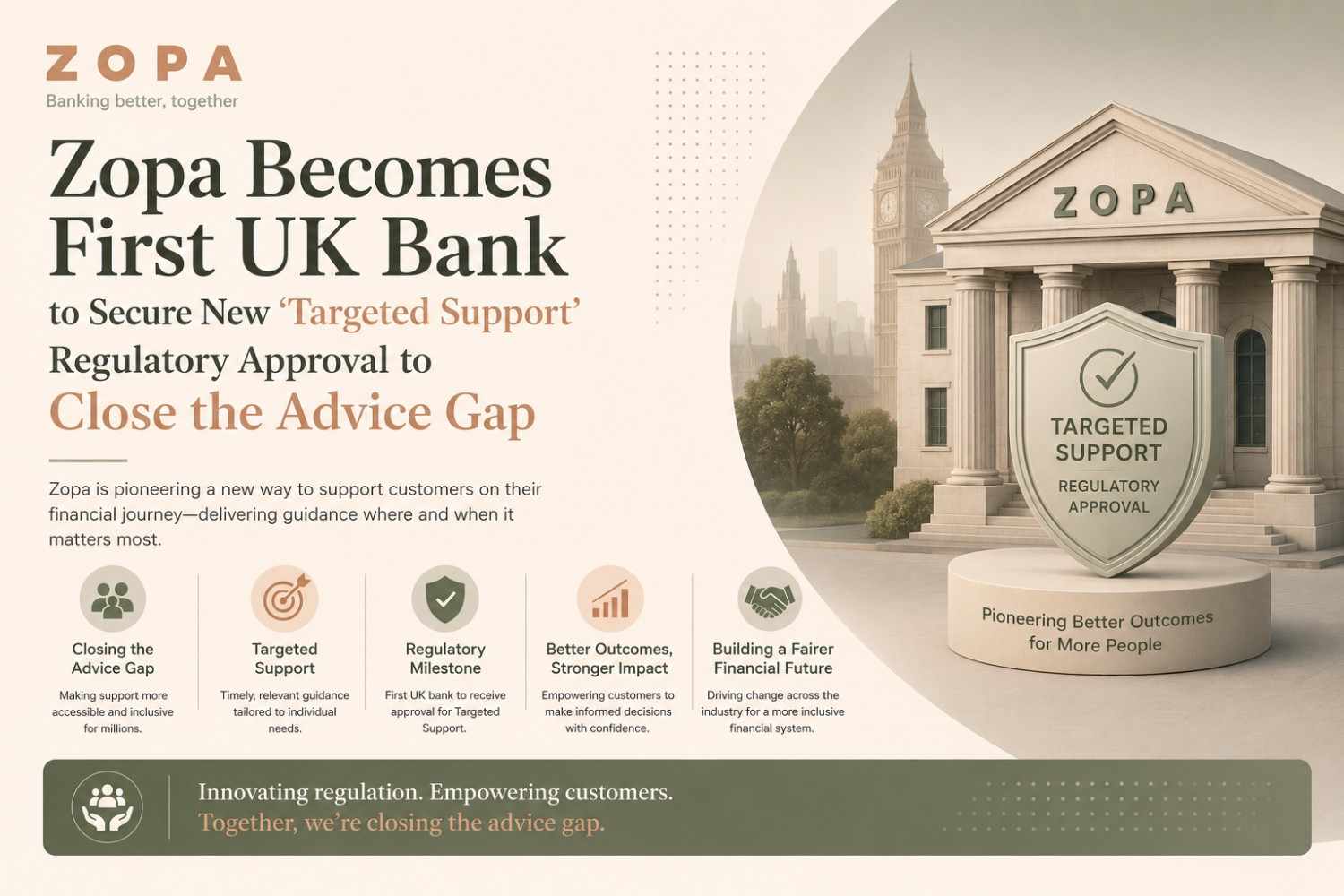
Zopa has become the first UK bank to secure targeted support approval, marking a major milestone in the country’s evolving financial guidance framework.
The approval reflects broader efforts by UK regulators to address the growing financial advice gap affecting millions of consumers. Moreover, the development highlights how banks and fintech firms are increasingly using digital tools to provide more personalised financial support.
As a result, Zopa may now offer targeted customer guidance under the UK’s updated regulatory approach without crossing into fully regulated financial advice.
Furthermore, the move could influence how other financial institutions approach consumer engagement and digital banking support in the future.
Why targeted support approval matters in UK banking
The new targeted support approval framework is designed to help consumers receive clearer financial guidance without requiring full-scale advisory services.
Traditionally, many consumers struggled to access affordable financial advice because:
- Advisory costs remained high
- Financial products became more complex
- Guidance rules limited personalisation
- Many consumers lacked access to advisors
Consequently, millions of people often made financial decisions without professional support.
However, regulators now want firms to provide more useful and timely guidance while still protecting consumers from unsuitable recommendations.
Therefore, targeted support frameworks are becoming increasingly important across UK financial services.
Zopa aims to close the financial advice gap.
Zopa’s approval comes as the UK financial industry faces growing concerns around financial inclusion and consumer decision-making.
Many consumers require help with:
- Savings decisions
- Credit management
- Borrowing options
- Financial planning
- Digital banking tools
Because of this, financial institutions are looking for ways to provide guidance more efficiently through digital platforms.
Moreover, fintech-driven customer engagement tools can help banks deliver support at scale.
As a result, targeted support models may improve access to financial guidance for underserved consumers.
How targeted support approval differs from financial advice
One important distinction within the new framework involves the difference between support and regulated financial advice.
Traditional regulated advice typically includes:
- Personalised investment recommendations
- Detailed financial planning
- Suitability assessments
- Licensed advisory services
However, targeted support approval allows firms to provide more focused guidance without delivering fully individualised advice.
Consequently, banks can communicate more effectively with customers while operating within regulatory boundaries.
Furthermore, regulators believe this approach could encourage broader consumer engagement with financial services.
UK regulators push financial guidance reform.
The approval granted to Zopa reflects wider regulatory efforts across the UK financial sector.
Authorities are increasingly focused on:
- Consumer financial resilience
- Digital banking innovation
- Financial inclusion
- Simplified customer guidance
Because financial products have become more complex, regulators want firms to improve communication and support systems.
Moreover, digital banking platforms are creating new opportunities for personalised engagement at scale.
Therefore, targeted support frameworks could become a major part of future retail banking models.
Digital banking and fintech reshape customer support
The rise of fintech and digital banking has transformed how financial institutions interact with consumers.
Today, banks increasingly use:
- AI-powered customer support
- Data analytics tools
- Automated financial insights
- Personalised digital experiences
As a result, institutions can deliver faster and more scalable customer assistance.
Moreover, fintech platforms are helping reduce operational costs linked to traditional advisory models.
Consequently, targeted support systems may become more accessible to broader consumer groups.
Comparison between traditional advice and targeted support systems
| Feature: Traditional | l Financial Advice, Targeted | d Support Framework |
|---|---|---|
| Personalization level | High | Limited-focused |
| Regulatory complexity | Higher | Moderate |
| Customer accessibility | Lower | Broader |
| Delivery model | Human advisor | Digital-first |
| Operational cost | Higher | More efficient |
This comparison highlights why regulators and banks are exploring alternative customer support models.
Risks linked to targeted support approval systems
Although the new framework creates opportunities, financial institutions still face several challenges.
Key concerns include:
- Consumer misunderstanding
- Regulatory interpretation risks
- Data privacy issues
- Over-reliance on automation
Because support systems are less personalised than full financial advice, firms must ensure customers clearly understand service limitations.
Moreover, regulators will likely monitor how institutions communicate guidance to consumers.
Therefore, transparency and customer protection remain critical priorities.
Zopa strengthens position in UK digital banking.
The approval may also strengthen Zopa’s position within the UK digital banking sector.
As competition intensifies across fintech and challenger banking markets, customer engagement tools are becoming increasingly important.
Furthermore, consumers now expect:
- Faster digital experiences
- Personalised financial insights
- Simpler banking communication
- Accessible financial tools
Consequently, targeted support systems could become a competitive advantage for digital banks.
Additionally, financial institutions that successfully combine compliance with customer-focused technology may gain stronger long-term growth opportunities.
Financial advice gap remains a major industry challenge
The UK financial advice gap continues to affect a large portion of consumers.
Many people still avoid professional financial advice because of:
- Cost concerns
- Complexity fears
- Limited access
- Lack of financial literacy
As a result, regulators and financial institutions are searching for scalable alternatives that improve consumer outcomes.
Moreover, digital support systems may help bridge the gap between self-service banking and full advisory models.
Therefore, targeted support frameworks could play a larger role in future financial inclusion efforts.
Future outlook for targeted support approval in banking
The future of targeted support approval frameworks may significantly influence retail banking and fintech strategies across the UK.
Several trends are expected to shape the market:
- Greater AI-driven personalisation
- Expansion of digital banking support
- Increased regulatory oversight
- Broader financial inclusion initiatives
Furthermore, banks are likely to continue investing in customer engagement technology.
As a result, more financial institutions may seek similar regulatory approvals in the coming years.
Consequently, targeted support systems could become standard across modern digital banking platforms.
Final Thoughts on Zopa and targeted support approval
Zopa’s achievement as the first UK bank to secure targeted support approval represents an important shift within the financial services industry.
As regulators work to reduce the financial advice gap, banks and fintech firms are increasingly exploring scalable ways to provide better consumer guidance.
Moreover, digital banking infrastructure and AI-powered engagement tools are accelerating this transformation.
Ultimately, the success of targeted support systems will depend on how effectively financial institutions balance innovation, transparency, and consumer protection.
Comments
No comments yet. Be the first to share your thoughts.
Leave a comment