
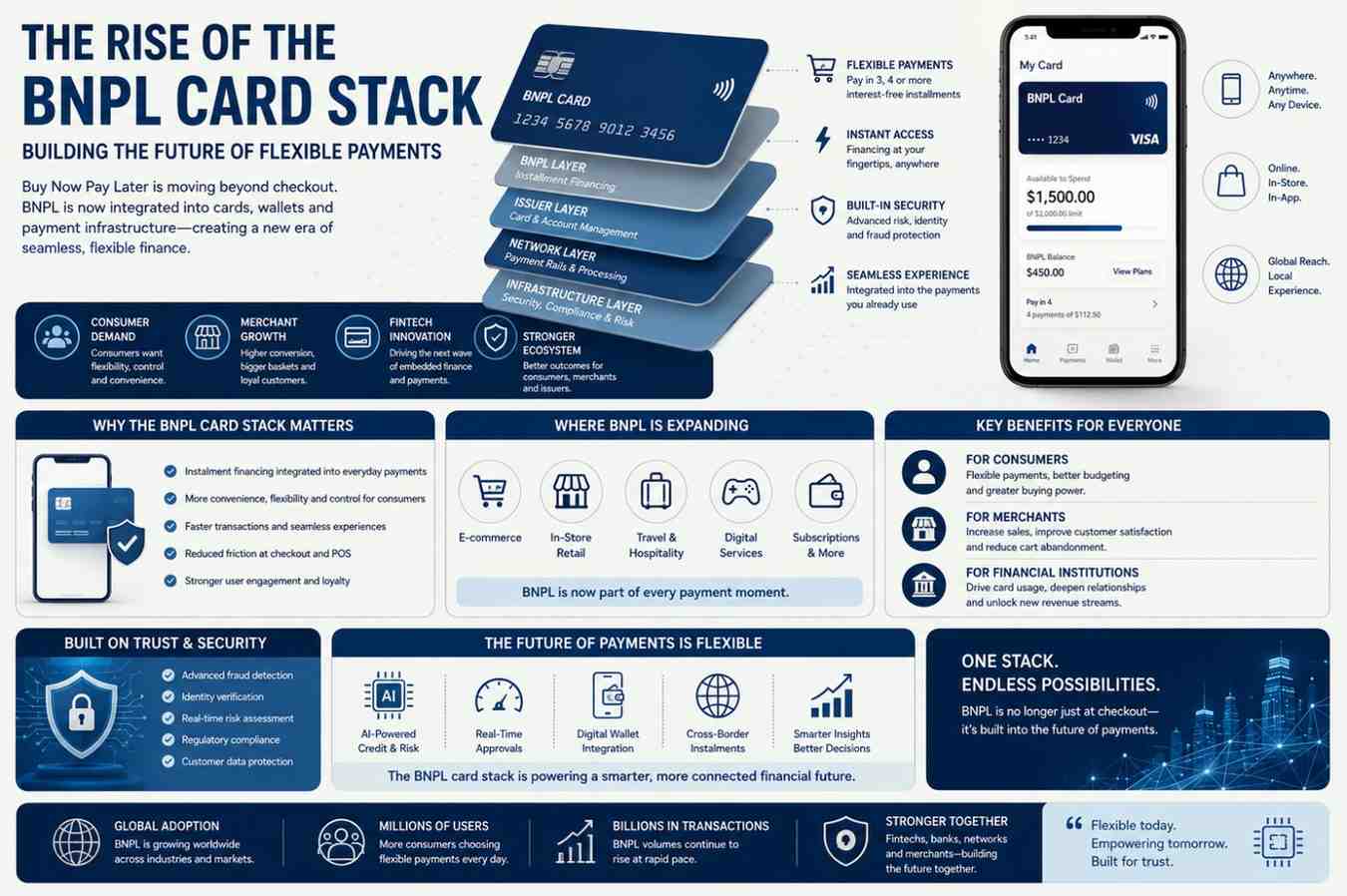
The buy now pay later industry is entering a new phase as BNPL providers increasingly integrate services directly into card ecosystems and digital payment infrastructure. The rise of the BNPL card stack reflects a broader transformation happening across consumer finance, ecommerce, and digital payments.
Over the past few years, buy now pay later platforms have grown rapidly by offering flexible instalment-based payment options at checkout. Initially, most BNPL solutions operated separately from traditional card networks. However, the market is now evolving toward deeper integration within existing payment systems.
Consequently, fintech firms, payment processors, and card issuers are embedding instalment financing directly into debit cards, credit cards, and digital wallets. As a result, the BNPL card stack is becoming one of the most important areas of innovation within modern financial technology.
Moreover, consumer demand for flexible payment options continues to increase worldwide. Therefore, companies are competing aggressively to integrate BNPL functionality into everyday payment experiences.
Why the BNPL Card Stack Matters
The evolution of the BNPL card stack represents a major shift in how consumers access short-term financing.
Traditionally, BNPL services appeared primarily during e-commerce checkout. Customers selected instalment plans directly through merchant websites or shopping applications. However, integrated card-based BNPL solutions now allow consumers to access instalment financing more seamlessly.
Today, users increasingly expect:
- Flexible payment options
- Instant financing access
- Embedded digital finance tools
- Frictionless checkout experiences
- Mobile-first payment solutions
Because of these changing expectations, payment companies are embedding instalment lending directly into the broader payment infrastructure.
Additionally, card-linked BNPL systems may improve:
- Consumer convenience
- Transaction speed
- Payment flexibility
- Merchant conversion rates
- User engagement
Consequently, the BNPL card stack is becoming increasingly important for fintech firms and payment providers competing in digital commerce.
BNPL Providers Are Expanding Beyond E-commerce
Initially, buy now pay later services focused heavily on online shopping transactions. However, the market is rapidly expanding into physical retail, mobile payments, and card-based spending.
Today, consumers can increasingly use BNPL solutions for:
- Everyday purchases
- Travel bookings
- Subscription services
- In-store retail transactions
- Digital wallet payments
As a result, BNPL providers are moving beyond standalone checkout financing toward fully integrated payment ecosystems.
The BNPL card stack supports this transition by enabling instalment financing across a wider range of payment channels.
Moreover, consumers increasingly prefer unified financial experiences that combine payments, financing, rewards, and banking features within a single platform.
Embedded Finance Drives the BNPL Card Stack
Embedded finance has become one of the biggest trends shaping modern fintech innovation.
Companies across ecommerce, banking, and payments are integrating financial services directly into digital platforms and applications. Consequently, consumers can access lending, insurance, payments, and banking tools more seamlessly.
The BNPL card stack represents an important example of this embedded finance movement.
Rather than requiring separate financing applications, integrated BNPL systems allow users to activate instalment plans directly within existing payment methods.
Furthermore, embedded BNPL functionality can improve customer retention and transaction frequency for payment providers and merchants alike.
As digital ecosystems become more connected, embedded financial services are expected to expand even further.
Card Networks and Fintech Firms Are Competing Aggressively
Competition within the buy now, pay later industry continues to intensify rapidly.
Traditional card networks, fintech startups, banks, and payment processors are all investing heavily in instalment payment technology.
At the same time, major financial institutions are launching:
- Card-linked instalment plans
- Flexible repayment tools
- Embedded financing products
- Real-time credit solutions
Because of this competition, the BNPL card stack is evolving quickly across both digital and traditional financial ecosystems.
Additionally, payment companies are focusing on improving:
- User experience
- Approval speed
- Merchant integration
- Risk management
- Consumer engagement
Consequently, innovation within instalment-based finance continues to accelerate.
Consumers Increasingly Demand Payment Flexibility
Changing consumer behaviour is also driving BNPL growth worldwide.
Many shoppers now prefer flexible payment structures that allow them to spread costs over time instead of making large upfront purchases.
Moreover, younger consumers increasingly favour:
- Mobile-first financial services
- Transparent repayment options
- Flexible budgeting tools
- Low-friction payment experiences
Therefore, instalment financing is becoming more integrated into mainstream digital commerce experiences.
The BNPL card stack supports these preferences by allowing consumers to access financing without disrupting normal payment behaviour.
Additionally, integrated financing tools may improve overall customer satisfaction and purchasing confidence.
Regulation and Risk Management Remain Important
Despite strong industry growth, regulators continue monitoring the buy now pay later sector closely.
Governments and financial authorities are increasingly focused on:
- Consumer protection
- Lending transparency
- Credit risk management
- Responsible lending practices
As BNPL services become more integrated into payment ecosystems, compliance and regulatory oversight may become even more important.
Therefore, companies building the BNPL card stack must balance innovation with responsible financial practices.
At the same time, stronger regulation may help improve long-term trust and market stability within the instalment finance industry.
Digital Wallets Accelerate BNPL Adoption
Digital wallets are also playing a major role in the expansion of BNPL services.
Consumers increasingly use smartphones and mobile wallets for daily payments. Consequently, wallet providers are integrating instalment financing directly into payment applications.
This shift allows users to:
- Split purchases instantly
- Access financing during checkout
- Manage repayments digitally
- Track spending more easily
As a result, the BNPL card stack is becoming deeply connected to broader digital wallet ecosystems.
Furthermore, mobile-first financial experiences are expected to remain a major driver of fintech growth over the coming years.
Future Outlook for the BNPL Card Stack
Looking ahead, the buy now, pay later industry is expected to continue evolving rapidly.
Several trends may shape the future of the BNPL card stack, including:
- AI-driven credit analysis
- Real-time financing approvals
- Embedded banking services
- Personalised lending tools
- Cross-border instalment payments
Because of these developments, integrated financing infrastructure may become a standard feature across modern payment ecosystems.
Additionally, partnerships between fintech firms, banks, merchants, and card networks are likely to expand further.
Consequently, the distinction between payments and lending may continue becoming less visible for consumers.
Final Thoughts
The movement of buy now pay later services into the card ecosystem marks a major evolution within digital finance.
The rise of the BNPL card stack reflects broader trends shaping fintech innovation, embedded finance, and modern consumer payments.
As companies continue integrating instalment financing into cards, wallets, and payment infrastructure, consumers are expected to gain more flexible and seamless financial experiences.
Ultimately, the future of digital commerce may increasingly depend on integrated payment ecosystems where financing becomes a natural part of everyday transactions.
Comments
No comments yet. Be the first to share your thoughts.
Leave a comment