
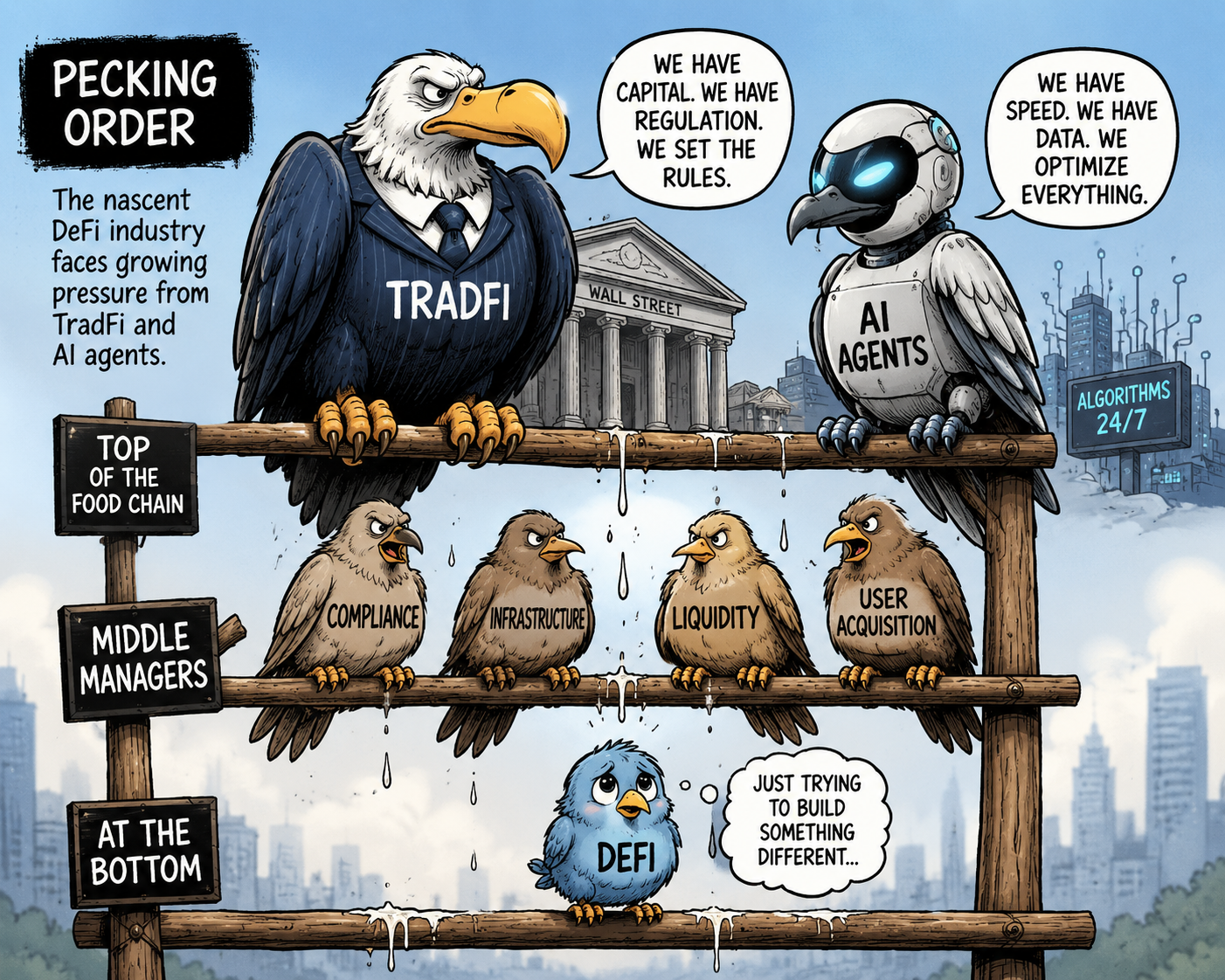
The latest “Pecking Order” cartoon highlights growing DeFi industry pressure as traditional finance firms and AI agents continue expanding their influence across digital markets. Moreover, the cartoon directly shows how DeFi industry pressure is increasing as decentralised finance platforms compete against larger financial institutions and advanced automation technologies.
As the crypto and fintech sectors continue evolving, the balance between innovation, regulation, automation, and decentralisation has become a major topic across financial markets. Therefore, the cartoon presents a symbolic view of how power dynamics are shifting within modern finance.
DeFi industry pressure is explained in the cartoon.
The cartoon uses birds positioned across different levels of a wooden structure to represent the financial hierarchy developing within digital finance.
At the top, large birds representing TradFi and AI agents dominate the structure. Meanwhile, smaller birds below symbolise infrastructure, liquidity, compliance, and user acquisition challenges within the DeFi ecosystem.
At the bottom, a small blue bird labelled “DeFi” appears overwhelmed while attempting to “build something different.” Consequently, the illustration captures the growing competitive pressure that decentralised platforms face today.
Additionally, the cartoon emphasises how traditional institutions and automated technologies increasingly control capital, speed, regulation, and market access.
TradFi expansion increases DeFi industry pressure.
Traditional financial institutions, often referred to as TradFi firms, have steadily increased their presence within digital asset markets over the past few years.
Many large banks and financial companies are now investing in:
- Blockchain infrastructure
- Tokenised assets
- Digital payment systems
- Stablecoin projects
- Crypto trading platforms
As a result, traditional finance companies are competing directly with decentralised platforms that originally aimed to disrupt legacy financial systems.
Furthermore, large financial institutions typically have stronger regulatory relationships, greater capital resources, and broader customer networks. Therefore, smaller DeFi projects may struggle to maintain market share as institutional adoption accelerates.
AI agents create more DeFi industry pressure.
Artificial intelligence technologies are also transforming financial markets at a rapid pace. In particular, AI-powered trading systems, automation tools, and data analysis platforms continue improving operational efficiency across the financial industry.
Today, AI systems can:
- Analyse large market datasets
- Automate trading decisions
- Detect fraud patterns
- Improve customer service
- Optimise investment strategies
Consequently, AI agents are becoming increasingly powerful participants within financial ecosystems.
The cartoon reflects this shift by portraying AI as a dominant force capable of optimising speed, data, and operational control. Meanwhile, decentralised finance projects often rely on smaller teams and community-driven governance structures.
As a result, many DeFi platforms may face growing challenges competing against AI-powered financial systems with greater automation capabilities.
DeFi still supports financial innovation.
Despite the growing pressure from TradFi and AI, decentralised finance continues to represent an important source of financial innovation.
DeFi platforms aim to provide:
- Open financial access
- Decentralised lending systems
- Permissionless transactions
- Smart contract automation
- Community governance
Additionally, many blockchain developers continue building tools designed to reduce dependence on centralised financial institutions.
Therefore, supporters of decentralised finance believe DeFi still offers unique advantages compared to traditional banking systems.
Moreover, some analysts argue that collaboration between decentralised platforms, traditional finance, and AI technologies could eventually create more efficient financial ecosystems.
Regulation adds to the DeFi industry pressure.
Regulatory pressure continues to create uncertainty for many decentralised finance companies.
Globally, governments and regulators are increasing oversight of:
- Crypto exchanges
- Stablecoins
- Digital wallets
- Blockchain transactions
- Decentralised applications
Consequently, DeFi projects must increasingly balance innovation with compliance requirements.
Meanwhile, traditional financial institutions often have larger legal and compliance teams capable of adapting more quickly to regulatory changes. Therefore, the competitive gap between major financial firms and smaller DeFi startups may continue widening.
Liquidity and infrastructure challenges remain.
The cartoon also references important operational challenges facing decentralised finance platforms.
For example, many DeFi companies continue dealing with:
- Liquidity shortages
- Infrastructure limitations
- Security vulnerabilities
- User acquisition challenges
- Market volatility
Additionally, periods of declining crypto prices can reduce investor participation and platform activity.
As a result, maintaining long-term growth and financial stability remains difficult for many decentralised finance projects.
Investor sentiment around DeFi remains mixed.
Investor opinions surrounding decentralised finance continue to vary widely across global markets.
Some investors remain optimistic about:
- Blockchain innovation
- Smart contract development
- Tokenised financial systems
- Decentralised applications
However, others remain cautious due to regulatory uncertainty, market volatility, and cybersecurity risks.
Consequently, the future growth of decentralised finance may depend on how effectively projects adapt to changing market conditions and increasing competition from both traditional finance and AI-driven platforms.
Future outlook for the DeFi industry
Looking ahead, decentralised finance will likely continue evolving alongside traditional finance and artificial intelligence technologies.
Several trends may shape the future market:
- Increased institutional adoption
- Greater AI integration
- Stronger regulatory frameworks
- Expansion of tokenised assets
- Improved blockchain scalability
Therefore, the DeFi industry may eventually shift toward hybrid financial models that combine decentralisation, institutional support, and automated technologies.
Conclusion
The “Pecking Order” cartoon presents a powerful visual commentary on growing DeFi industry pressure. As traditional financial institutions and AI technologies gain influence, decentralised finance platforms must compete within an increasingly complex and competitive financial environment.
Nevertheless, decentralised finance continues driving innovation across digital markets. Ultimately, the industry’s future may depend on its ability to adapt, collaborate, and maintain its core principles while navigating pressure from larger financial and technological forces.
Comments
No comments yet. Be the first to share your thoughts.
Leave a comment