
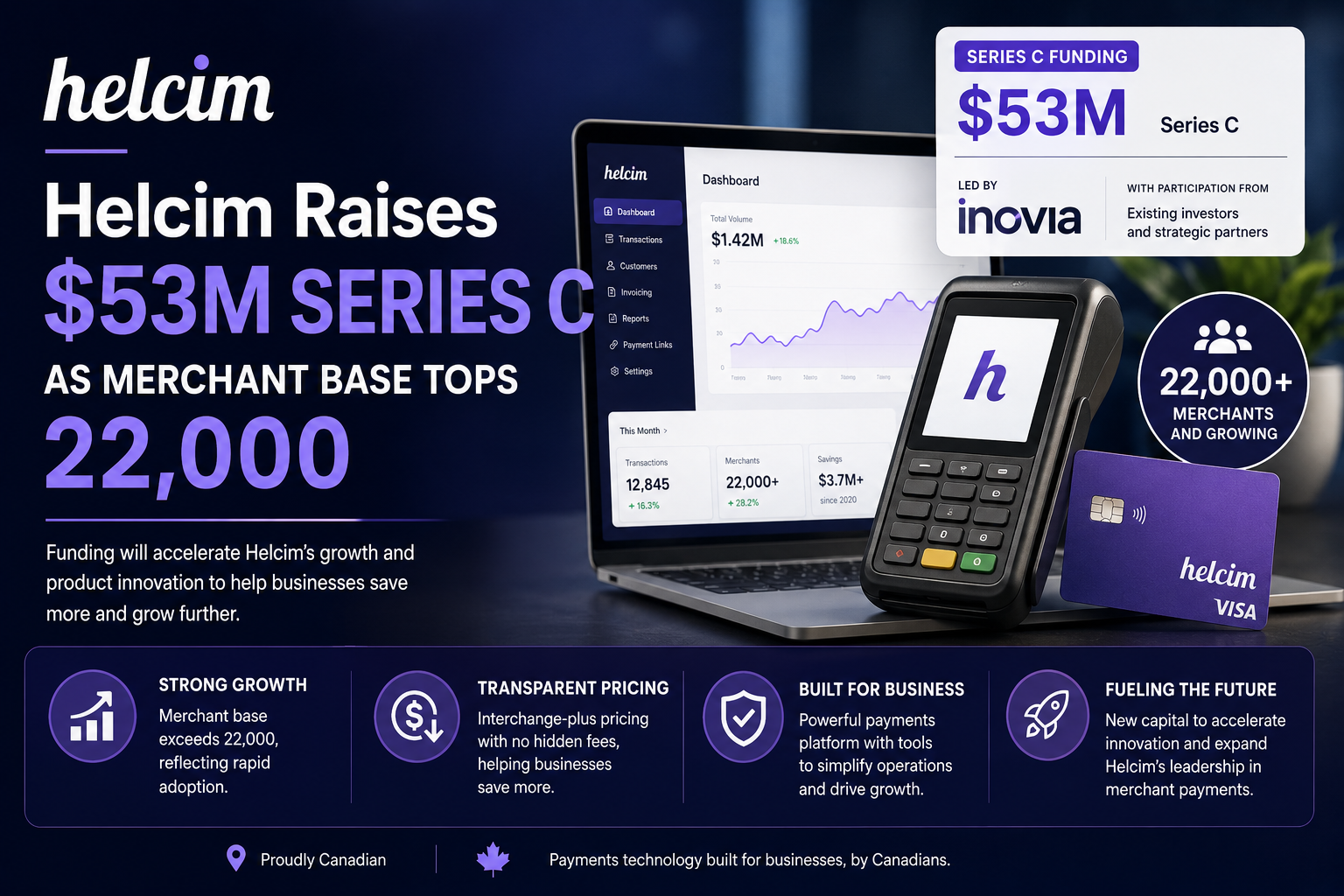
Helcim Series C raises $53M to expand merchant payments platform
Canadian payments technology company Helcim has raised $53 million in Series C funding as it looks to expand its payments platform, software, integrations, and support for small and mid-sized businesses.
The funding round was led by BDC Capital’s Growth Venture Fund, with new investment from Curql Collective and Gold House Ventures. Existing investors also continued backing the company.
Helcim said the new capital comes as it reaches more than 22,000 active merchants, surpasses $150 million in annual revenue, and moves toward processing nearly $10 billion in payments this year.
The company says the funding will allow it to invest further in its products while maintaining its focus on transparent pricing and merchant support.
Helcim funding round follows rapid business growth
The latest Helcim funding round comes after several major business milestones.
The company says it now serves:
- More than 22,000 active merchants
- Over $150 million in annual revenue
- Nearly $10 billion in expected payment volume this year
These figures show the scale Helcim has reached within the merchant payments market.
The company is now using the new capital to support its next phase of growth rather than changing its core focus.
For Helcim, that means expanding payment tools while continuing to target businesses looking for simpler pricing and payment services.
Helcim Everywhere expands payment integration strategy
A major part of the company’s strategy is Helcim Everywhere, which aims to bring its payment services into software and workflows that merchants already use.
The approach is designed to reduce the need for businesses to change their existing systems simply to access a different payment processor.
Helcim also highlighted its Payment Extension, launched earlier this year. The tool allows merchants using supported business software to process payments through Helcim instead of being limited to a processor built into their existing platform.
The company says it is adding new integrations each week.
Merchant payments growth drives technology investment
The merchant payments growth story is becoming increasingly important as businesses expect payment services to work alongside their existing software.
Payment processing is no longer limited to card terminals. Merchants now use a mix of:
- Point-of-sale systems
- Online checkout tools
- Invoicing software
- Booking platforms
- Digital payment integrations
Because of this shift, payment companies are competing not only on transaction processing but also on software, integrations, pricing, and customer support.
Helcim’s latest investment reflects that broader change in the payments market.
Payment technology investment targets products and hardware
The new capital will also support Helcim’s core products and payment hardware.
The company says it plans to continue investing in:
- Point-of-sale technology
- Invoicing tools
- Online checkout
- Smart Terminal hardware
- Merchant payment software
The goal is to make everyday payment tasks easier for businesses while expanding the number of services available through the platform.
Helcim also plans to explore additional tools covering areas such as getting paid, paying vendors, and managing business finances.
Payment Extension challenges processor lock-in
One of the more notable parts of Helcim’s strategy is its focus on reducing payment processor lock-in.
Many business software platforms connect merchants to a specific payment processor. This can limit a merchant’s ability to compare pricing or switch providers without changing its wider software setup.
Helcim’s Payment Extension is designed to give merchants another option while allowing them to keep using their existing business software.
That model could become increasingly relevant as merchants look for greater control over payment costs and technology choices.
Comparison of traditional and integrated payment platforms
| Feature | Traditional Payment Setup | Integrated Payment Platform |
|---|---|---|
| Software integration | Limited | Broader |
| Processor choice | Often restricted | More flexible |
| Payment management | Separate tools | Integrated |
| Merchant control | Moderate | Higher |
| Product expansion | Limited | Wider |
The shift toward integrated payment platforms is changing how merchants evaluate payment providers.
Rather than choosing a processor based only on transaction rates, businesses increasingly consider software, hardware, integrations, support, and financial tools together.
Fintech funding remains focused on payment infrastructure
The fintech funding round highlights continued investor interest in payment infrastructure and merchant technology.
Payment companies are operating in a market where businesses increasingly expect digital tools to connect smoothly with their financial operations.
For investors, companies with recurring merchant relationships and multiple financial products can offer opportunities to expand revenue beyond basic payment processing.
Helcim’s growing merchant base and payment volume give it a larger platform from which to introduce additional services.
Helcim maintains focus on transparent pricing
Alongside its expansion plans, Helcim says it intends to maintain its focus on transparent and affordable pricing.
The company has positioned pricing transparency as a core part of its offering, arguing that merchants should be able to understand the costs associated with accepting payments.
That positioning comes at a time when businesses are paying closer attention to payment fees and the overall cost of financial technology.
For merchants, predictable pricing can be particularly important as transaction volumes increase.
What the $53M raise means for Helcim
The Helcim Series C gives the company additional capital to scale its technology and reach more merchants.
The funding could support three main areas:
- Product development — expanding payment software and business tools.
- Integration growth — connecting the platform with more third-party business systems.
- Merchant support — increasing resources for customer service and operations.
The company also wants to build a broader role in merchants’ financial workflows rather than remaining focused only on payment acceptance.
Future outlook for Helcim
Helcim’s next stage will depend on how effectively it converts its growing merchant base and payment volume into broader platform adoption.
The payments market remains competitive, with banks, fintech companies, processors, and software providers all seeking stronger relationships with merchants.
Helcim’s strategy is to compete through an integrated platform, transparent pricing, software tools, hardware, and wider payment connectivity.
The company’s ability to maintain those advantages while scaling will be important as it moves forward with its new funding.
Final Thoughts
Helcim’s $53 million Series C marks another major step in the company’s growth as it expands its merchant payments platform.
With more than 22,000 active merchants, over $150 million in annual revenue, and nearly $10 billion in expected payment volume, the company enters its next phase with a significantly larger operating base.
The funding also shows where Helcim sees its biggest opportunities: better payment software, wider integrations, merchant choice, and services that extend beyond checkout.
For the wider fintech industry, the company’s growth reflects a broader shift toward payment platforms that combine processing with the software and financial tools businesses use every day.
Comments
No comments yet. Be the first to share your thoughts.
Leave a comment