
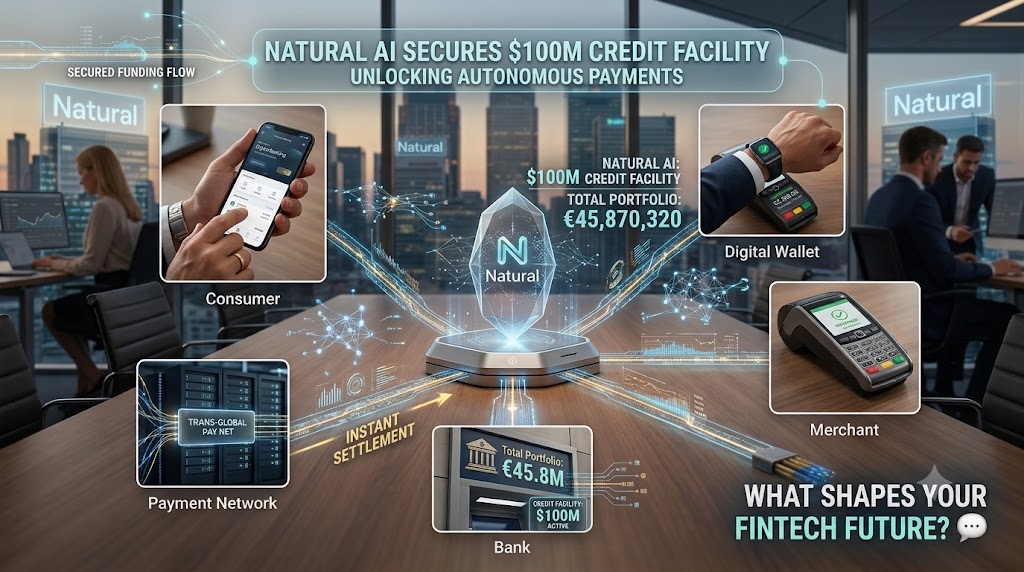
Natural Secures $100M Credit Facility as AI Agents Move Closer to Autonomous Payments
AI agents are moving beyond recommendations and automation. They are increasingly being designed to make financial decisions and complete transactions.
A major example is Natural, a San Francisco-based fintech startup building payments infrastructure for AI agents. The company has secured a $100 million credit facility from Upper90 Capital Management to support its credit and payment products for autonomous systems.
The financing comes shortly after Natural raised a $30 million Series A in July. The latest facility gives the company additional capital to support the financial side of agent-driven transactions as it expands its platform.
Natural Builds Payment Infrastructure for AI Agents
Natural is developing infrastructure that allows AI agents to interact with the financial system.
Today, an AI agent can search for products, coordinate tasks, and make recommendations. However, payments often still require a person to step in and complete the transaction.
Natural is targeting that gap.
Its platform is designed to give agents access to payment and financial capabilities. These include money movement, wallets, multi-bank settlement, multi-currency support, fraud controls, compliance, and agent identity.
The company currently has six products generally available. It plans to expand its product suite further during the remainder of 2026.
Why Natural Raised a $100M Credit Facility
The financing structure is important.
Software companies typically use equity funding to build products and hire teams. Payment infrastructure can also require significant capital to support transactions and credit.
Natural’s new facility will help fund products such as Credit and Charge. These products are designed to allow businesses to provide credit to AI agents and support billing for transactions such as API calls.
The company has already raised more than $40 million in equity, including its $30 million Series A. The new debt facility gives Natural additional funding capacity without requiring another immediate equity raise.
What Are Agentic Payments?
Agentic payments refer to transactions initiated or completed by AI agents rather than directly by people.
For example, a user could ask an AI agent to book a trip. The agent could compare options, select a suitable service, and complete the purchase within predefined spending limits.
A business could also use an agent to manage suppliers. The agent could identify a vendor, approve an invoice, and initiate payment without requiring an employee to handle every step manually.
Natural has previously argued that existing payment systems were designed primarily around human users. AI agents create different requirements around identity, authorization, transaction monitoring, and payment execution.
Security and Trust Remain Major Challenges
The growth of agentic payments also creates new risks.
Traditional payment systems rely heavily on established patterns of human behavior. Banks and payment networks can flag unusual spending based on factors such as transaction size, location, and merchant activity.
AI agents may behave differently.
An agent could make many transactions in a short period or interact with unfamiliar merchants and financial systems. Payment providers therefore need new ways to determine whether an agent is authorized to spend money.
Identity is another challenge.
Financial institutions need to know which person or business controls an agent, what the agent is allowed to do, and who remains responsible for its transactions.
Natural’s platform focuses partly on these infrastructure requirements, including agent identity, fraud, and compliance.
AI Payments Are Already Expanding
Natural is not alone in exploring this market.
Other major payment companies are also developing infrastructure for AI-driven transactions.
For example, Alipay AI Pay has expanded to support autonomous payments by AI agents. Users can authorize an agent to complete purchases after setting up the payment functionality and verifying their identity.
This suggests the industry is moving toward a new payment model where AI can operate within clearly defined permissions.
The goal is not necessarily to remove humans from every transaction. Instead, payment infrastructure could allow people to give agents specific authority while maintaining controls over spending and identity.
From Human Checkout to Machine Commerce
The potential change goes beyond faster payments.
Today’s digital commerce experience is largely built around people. Consumers browse websites, enter payment details, and click checkout buttons.
Agentic commerce could change that process.
An AI agent could discover a product, compare prices, select a supplier, and complete the payment through an API or another machine-readable payment rail.
That would move commerce closer to a machine-to-machine financial system.
Natural’s own research on agentic payments describes several possible transaction models, including agent-to-agent, agent-to-business, and agent-to-consumer payments.
Why This Matters for Fintech
The development could create a new layer of fintech infrastructure.
Payment companies may need to support:
- AI agent identity
- Spending permissions
- Real-time transaction controls
- Automated settlement
- Multi-currency payments
- Fraud monitoring
- Compliance checks
- Transaction tracing
- Agent-to-agent payments
These capabilities could become increasingly important if AI agents begin handling more business and consumer transactions.
The $100 million facility secured by Natural therefore represents more than another startup financing event. It signals that investors and financial infrastructure providers are preparing for a market where AI agents may become active participants in the movement of money.
The Next Stage of Digital Payments
AI agents still represent an emerging payment channel. Most financial transactions today remain controlled directly by people and businesses.
However, the infrastructure is beginning to develop.
Natural’s latest financing gives the company more capital to build its agentic payments platform. Meanwhile, established payment companies are testing their own approaches to machine-driven transactions.
The central question is no longer only whether AI agents can make decisions.
It is whether the financial system can give those agents secure, controlled, and auditable access to money.
If that infrastructure develops successfully, the next evolution of digital payments may not simply involve people paying faster.
It could involve AI agents deciding when a payment should happen, selecting the appropriate payment rail, and completing the transaction on a user’s or business’s behalf.
Comments
No comments yet. Be the first to share your thoughts.
Leave a comment