
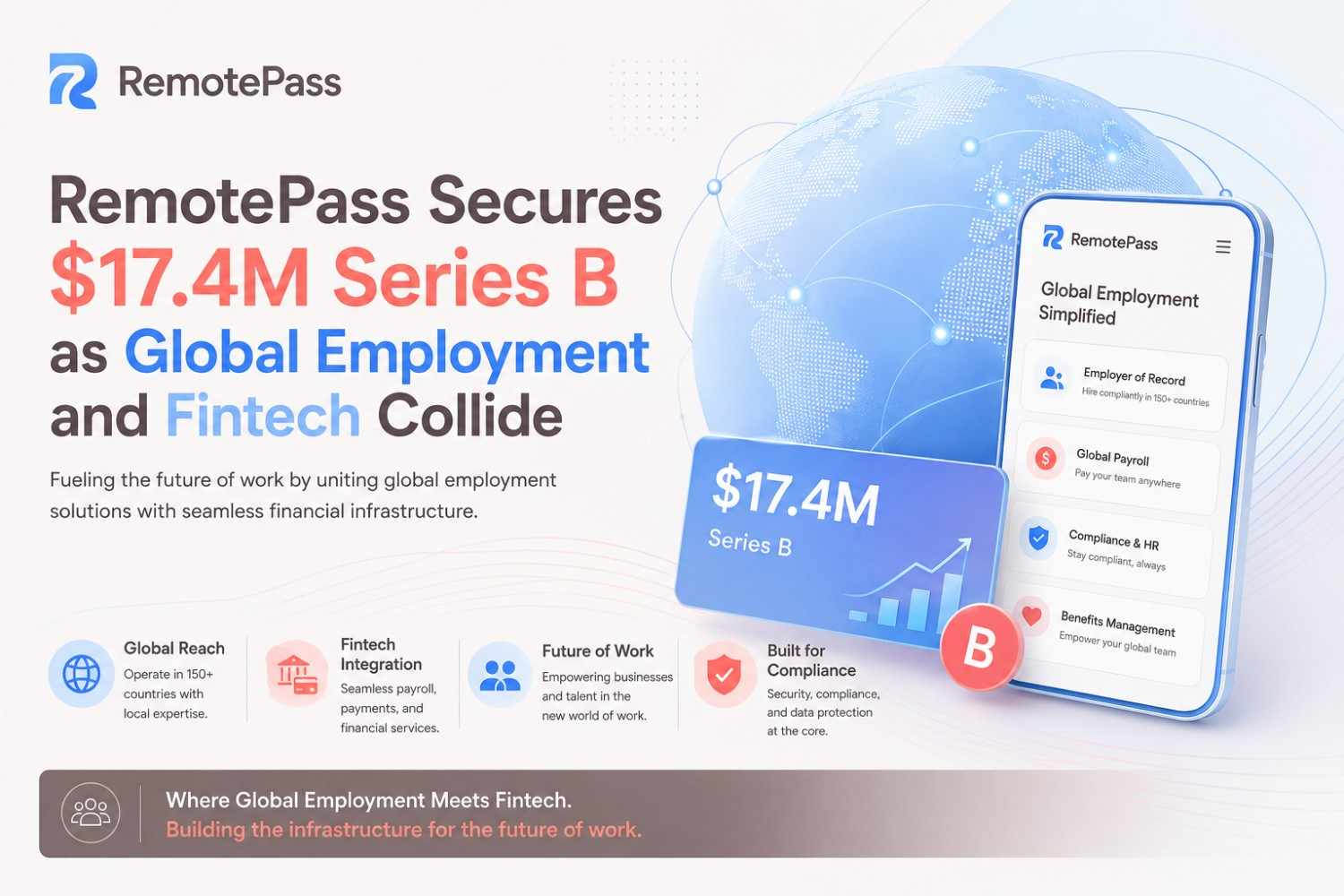
RemotePass has secured $17.4 million in new Series B funding as global employment platforms increasingly merge with fintech infrastructure services.
The latest investment highlights rising demand for platforms that combine workforce management, payroll systems, and cross-border payment tools into a single digital ecosystem.
Moreover, companies operating internationally are searching for more efficient ways to manage remote employees, contractors, and global payments. As a result, fintech-enabled employment infrastructure is becoming a major growth area across the technology sector.
Furthermore, RemotePass plans to use the new capital to strengthen platform capabilities, expand market reach, and improve international workforce payment services.
Why Series B funding reflects growing investor confidence
The new Series B funding round reflects broader investor confidence in platforms operating at the intersection of employment technology and fintech.
Traditionally, businesses used separate systems for:
- Payroll processing
- Contractor management
- International payments
- HR operations
- Compliance management
However, companies increasingly want integrated solutions that simplify workforce administration across multiple countries.
Consequently, fintech-enabled employment platforms are attracting strong venture capital interest.
Additionally, remote work trends continue to create demand for global workforce infrastructure.
RemotePass expands global employment services.
RemotePass focuses on helping businesses manage international hiring and payments through digital infrastructure tools.
Its platform supports:
- Global payroll management
- Contractor payments
- Compliance workflows
- Workforce onboarding
- Cross-border financial operations
Because international hiring has become more common, businesses increasingly require systems that simplify remote workforce management.
Moreover, companies want faster and more transparent payment solutions for distributed teams.
As a result, platforms combining fintech and HR infrastructure are experiencing rapid growth.
Fintech and employment technology continue to converge
The latest Series B funding round highlights how fintech and employment technology are becoming increasingly connected.
Today, workforce platforms are integrating:
- Digital wallets
- Cross-border payment systems
- Expense management tools
- Embedded financial services
Consequently, employment platforms are evolving into broader financial infrastructure providers.
Furthermore, businesses now expect workforce management systems to support real-time international transactions and automated financial workflows.
Therefore, fintech capabilities are becoming central to modern HR technology ecosystems.
Remote work drives demand for global payroll platforms
The rise of remote and distributed workforces has transformed how companies manage employees and contractors.
Previously, businesses often hired primarily within local markets. However, remote work expansion has created demand for:
- International payroll systems
- Multi-currency payments
- Cross-border compliance support
- Digital onboarding infrastructure
As a result, companies are increasingly investing in global employment technology platforms.
Moreover, startups and technology firms are among the largest adopters of remote workforce infrastructure.
Consequently, platforms like RemotePass are benefiting from long-term shifts in employment models.
How Series B funding could support RemotePass growth
The new Series B funding may help RemotePass accelerate product development and operational expansion.
The company is expected to focus on:
- Expanding payment infrastructure
- Improving automation tools
- Strengthening compliance systems
- Entering new international markets
Additionally, RemotePass may invest more heavily in embedded finance capabilities linked to workforce management.
Because businesses increasingly want centralised operational platforms, integrated fintech infrastructure could become a major competitive advantage.
Comparison between traditional HR systems and fintech-enabled workforce platforms
| Feature | Traditional HR Systems | Fintech-Enabled Workforce Platforms |
|---|---|---|
| Payroll processing | Localized | Global |
| Payment systems | Separate | Integrated |
| Contractor management | Manual | Automated |
| Cross-border support | Limited | Advanced |
| Financial visibility | Lower | Real-time |
This comparison highlights why fintech-enabled workforce platforms are gaining traction globally.
Cross-border payments become critical for employment platforms
Cross-border payments are now one of the most important components of global workforce management.
Companies managing international teams require:
- Faster salary payments
- Multi-currency support
- Lower transfer costs
- Transparent transaction tracking
Consequently, employment platforms are increasingly investing in payment infrastructure and fintech partnerships.
Moreover, embedded finance features can improve user experience while reducing operational complexity for employers.
As a result, fintech integration is becoming essential for modern workforce platforms.
Risks linked to rapid employment fintech growth
Although the market opportunity remains strong, companies operating in employment fintech still face several risks.
Key challenges include:
- Regulatory complexity
- Cross-border compliance requirements
- Data privacy concerns
- Payment security risks
Furthermore, international labour regulations differ significantly across jurisdictions.
Because of this, global employment platforms must maintain strong compliance systems and operational oversight.
Additionally, cybersecurity remains a major concern as workforce platforms process sensitive financial and employee data.
Venture capital continues backing workforce fintech.
Investor interest in workforce-focused fintech companies remains strong despite broader market uncertainty.
Many venture capital firms see long-term potential in platforms that combine:
- Payroll infrastructure
- Financial services
- Compliance automation
- Workforce management
As a result, the sector continues attracting significant funding activity.
Moreover, companies serving global remote work ecosystems are viewed as particularly scalable.
Consequently, additional investment in employment fintech infrastructure is expected over the coming years.
Future outlook for Series B funding and employment fintech
The future of employment fintech appears strong as global hiring becomes increasingly digital and distributed.
Several trends are expected to shape the industry:
- Growth in remote work
- Expansion of embedded finance
- Increased payroll automation
- Rising demand for global compliance tools
Furthermore, businesses are likely to continue seeking integrated operational platforms that combine HR and financial services.
As a result, companies like RemotePass may continue benefiting from long-term workforce transformation trends.
Final Thoughts on RemotePass and Series B funding
RemotePass’s $17.4 million Series B funding round highlights the growing convergence between fintech and global employment infrastructure.
As businesses increasingly manage distributed teams across international markets, demand for integrated payroll, compliance, and payment systems is expected to rise.
Moreover, fintech-enabled workforce platforms may become essential tools for companies operating in the modern global economy.
Ultimately, the sector’s future growth will likely depend on how effectively providers balance innovation, compliance, and payment efficiency.
Comments
No comments yet. Be the first to share your thoughts.
Leave a comment