
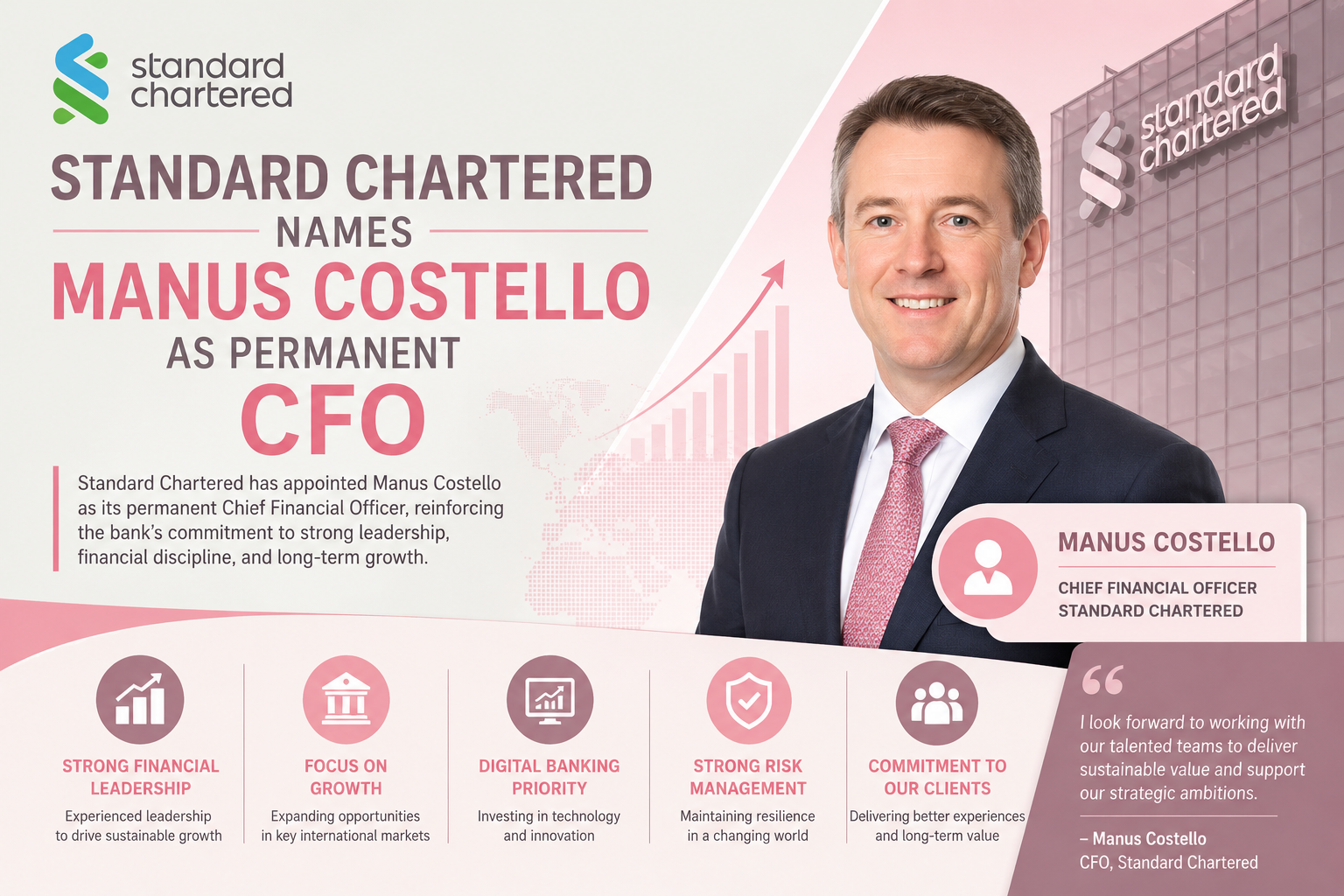
Standard Chartered has officially appointed Manus Costello as its permanent Chief Financial Officer (CFO). Moreover, the move supports the bank’s broader strategy to strengthen financial stability, improve operational efficiency, and support long-term growth across international markets.
Additionally, the appointment signals leadership continuity as the global banking sector continues adapting to changing economic conditions and rising competition. Therefore, investors and analysts are closely watching how the bank’s leadership team will guide future expansion plans.
Standard Chartered CFO role becomes permanent.
Previously, Manus Costello served in the CFO position on an interim basis before receiving the permanent appointment. During that period, he helped manage the bank’s financial operations, investor communication, and strategic planning initiatives.
As a result, Standard Chartered decided to confirm Costello as permanent CFO after reviewing his leadership performance and contribution to the organisation.
Furthermore, the appointment highlights the bank’s confidence in his ability to support future growth while maintaining strong financial discipline across global operations.
Standard Chartered leadership focuses on long-term growth
At the same time, Standard Chartered continues expanding its presence across Asia, Africa, and the Middle East. Therefore, experienced financial leadership remains critical as the bank pursues long-term growth opportunities in emerging markets.
Currently, the bank focuses on:
- Improving operational efficiency
- Expanding digital banking services
- Strengthening risk management
- Supporting sustainable finance projects
- Increasing shareholder value
Consequently, the CFO role remains central to executing these strategic priorities effectively.
Why the Standard Chartered CFO role matters
The Chief Financial Officer plays a major role in managing a bank’s financial health, regulatory compliance, and investor communication.
Typically, a CFO oversees:
- Financial planning and reporting
- Capital management
- Cost controls
- Risk assessment
- Regulatory compliance
- Investor relations
Moreover, as financial markets become more complex, banks increasingly rely on experienced finance leaders to guide long-term decision-making. Therefore, leadership stability in senior finance positions often improves investor confidence and market perception.
Investor reaction to Standard Chartered leadership changes
So far, investors and market analysts have generally viewed the appointment positively. In particular, leadership continuity often helps reassure shareholders during periods of economic uncertainty.
Additionally, the appointment of Manus Costello may strengthen confidence in Standard Chartered’s financial strategy and long-term operational planning.
Meanwhile, analysts expect the bank to continue focusing on profitability improvements, disciplined cost management, and digital transformation initiatives under the current leadership structure.
Banking sector leadership faces market pressure.
At present, the global banking industry continues adapting to several major economic and regulatory challenges.
For example, banks currently face:
- Higher interest rate environments
- Economic uncertainty in global markets
- Increased competition from fintech companies
- Growing cybersecurity risks
- Rising compliance requirements
As a result, financial institutions increasingly prioritise strong executive leadership and disciplined financial planning.
Consequently, experienced CFOs now play a more important role in helping banks manage market volatility and operational risks effectively.
Standard Chartered’s digital banking strategy continues.
Meanwhile, Standard Chartered continues investing in digital banking technologies and modern financial infrastructure. The bank aims to improve customer experience while expanding digital capabilities across retail and corporate banking operations.
In addition, technology investments may help reduce operational costs and improve efficiency over the long term. Therefore, financial leadership will remain important in balancing innovation spending with profitability goals.
Furthermore, digital transformation strategies may help the bank compete more effectively with both traditional financial institutions and fintech companies.
Future outlook for Standard Chartered CFO strategy
Looking ahead, Standard Chartered is expected to continue focusing on growth opportunities across emerging markets while strengthening operational performance.
Several trends may shape the bank’s future strategy:
- Expansion of digital banking services
- Growth in sustainable finance projects
- Increased investment in technology infrastructure
- Stronger focus on risk management
- Greater efficiency across international operations
Consequently, the appointment of Manus Costello as permanent CFO may provide leadership stability as the bank continues executing its long-term strategy.
Conclusion
Overall, Standard Chartered’s decision to appoint Manus Costello as permanent CFO reflects the bank’s focus on leadership continuity, financial discipline, and sustainable growth. As the banking industry faces evolving economic conditions and increasing competition, experienced financial leadership remains essential for maintaining stability and supporting strategic expansion.
Ultimately, with continued investment in digital banking, operational efficiency, and emerging market growth, Standard Chartered aims to strengthen its position within the global financial services sector.
Comments
No comments yet. Be the first to share your thoughts.
Leave a comment