
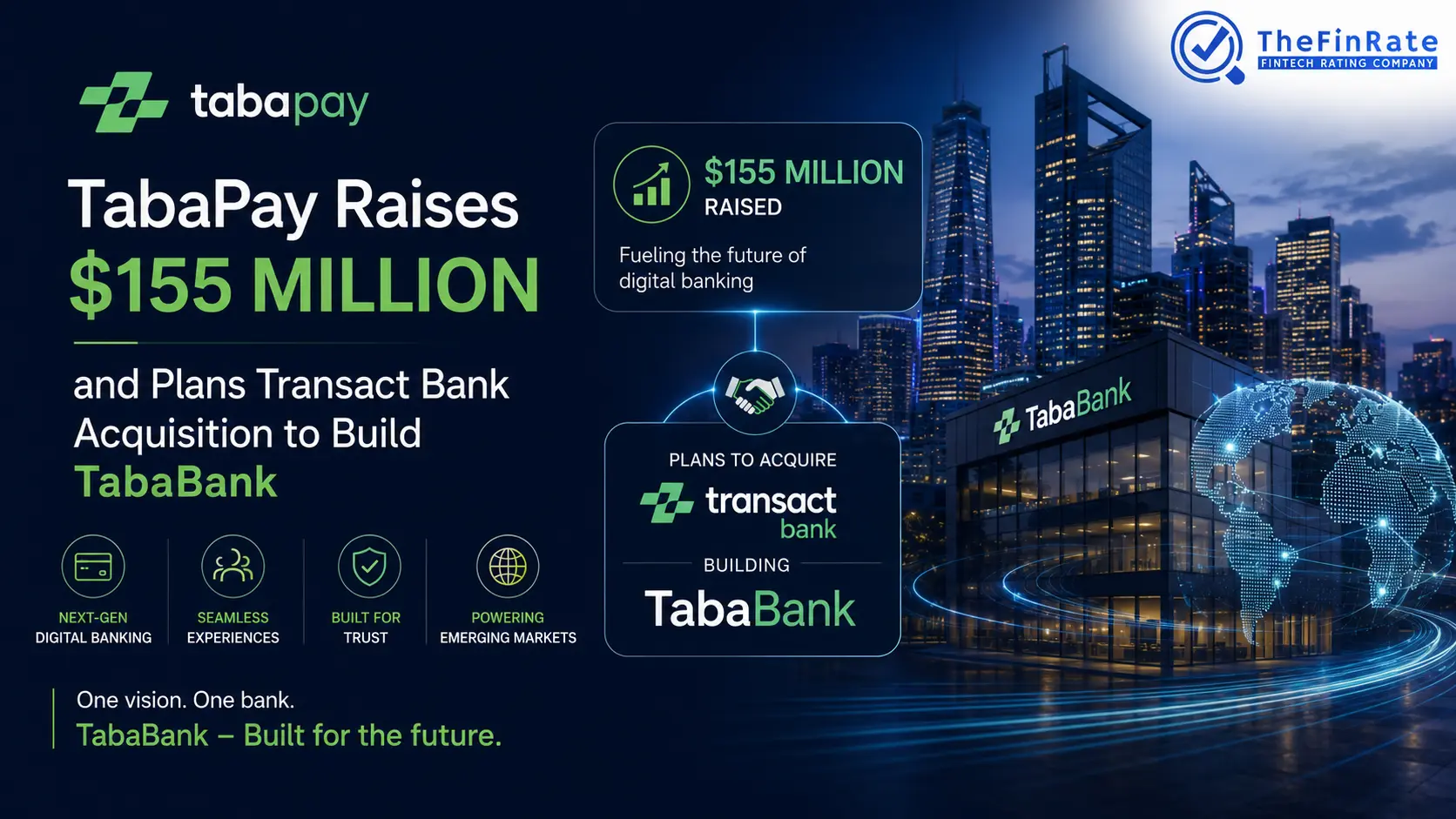
TabaPay Raises $155 Million and Plans Transact Bank Acquisition to Build TabaBank
TabaPay has secured $155 million in strategic growth financing led by FTV Capital and announced plans to acquire Transact Bank, N.A., in a move that could give the payments infrastructure company its own regulated banking operation.
The planned acquisition would see the Denver-based, OCC-chartered and FDIC-insured Transact Bank renamed TabaBank, N.A. and operated alongside TabaPay under a newly registered bank holding company, TabaHoldings, Inc. The transaction is expected to close in the fourth quarter of 2026, subject to regulatory approval.
The financing includes both primary capital for TabaPay and a secondary transaction. FTV Capital partner Robert Anderson has also joined TabaPay’s board of directors.
For TabaPay, however, the bigger story is what comes next.
The company is looking to move deeper into the financial infrastructure stack by combining its payments technology with direct banking capabilities.
TabaPay’s $155 Million Financing Sets Up a Bigger Move
TabaPay already operates a substantial money movement platform for fintechs, lenders and other high-growth businesses.
Through a single API, the company enables instant pay-ins and payouts across card and bank rails. TabaPay says its customers can reduce payment costs by as much as 75%, while its network includes more than 20 partner banks across the United States and Canada.
The company expects to process more than $100 billion in payment volume in 2026. It also ranks as the fifth-largest U.S. card-not-present processor by transaction count and says its infrastructure serves approximately one-third of American households.
The new financing gives TabaPay additional capital to expand that infrastructure while pursuing its planned banking strategy.
That makes the transaction more significant than a conventional growth investment.
It is effectively a bet on vertical integration in payments.
Why TabaPay Wants a Bank
Fintech companies often depend on sponsor banks to access regulated financial services and payment networks.
That model works, but it can also create operational complexity.
Different products may require different banking relationships. Regulatory requirements can add another layer of coordination. At the same time, businesses increasingly want redundancy so that a disruption at one banking partner does not interrupt critical money movement.
TabaPay says TabaBank is intended to address some of these challenges.
Once operational, the bank would complement TabaPay’s existing network rather than replace it.
That distinction matters.
TabaPay will continue working with its more than 20 existing partner banks while adding TabaBank as another banking option within its infrastructure.
TabaBank Would Support Major Payment Rails
The planned TabaBank operation is expected to support a broad range of payment infrastructure.
That includes:
- RTP and FedNow instant payments
- ACH transfers
- Wire transfers
- Card sponsorship
- Visa and Mastercard
- Discover
- Regional card networks
The bank is also expected to provide additional support for complex use cases such as digital banking and debt repayment.
This could give TabaPay more control over how certain money movement products are structured and supported.
It could also reduce some of the dependencies created when a fintech has to coordinate multiple external providers across payments, banking and card sponsorship.
From Payment Infrastructure to Banking Infrastructure
The planned Transact Bank acquisition signals a broader shift taking place across fintech.
Payment companies have traditionally built technology that sits between businesses, banks and payment networks.
Now, some infrastructure providers are moving closer to the regulated financial institutions themselves.
The motivation is straightforward.
Owning more of the infrastructure can mean greater control.
A banking operation can potentially give a payments company more flexibility around sponsorship, product development, redundancy and specialized financial services.
TabaPay’s strategy follows that direction.
If the transaction receives regulatory approval, TabaBank will operate as part of TabaHoldings while TabaPay continues operating its payments platform.
The result would be a more vertically integrated money movement business.
TabaBank Could Expand TabaPay’s Acquiring Capabilities
The planned banking operation could also strengthen TabaPay’s acquiring and sponsorship business.
TabaPay says the $155 million investment is expected to qualify TabaBank to serve as an acquirer across industries and major card networks.
That could expand the company’s ability to support merchants, independent sales organizations, payment facilitators and other platform businesses.
The company also plans to accelerate its product roadmap, including merchant liquidity solutions and potential strategic acquisitions.
In other words, the financing is not simply supporting the bank acquisition.
It is also funding the next phase of TabaPay’s broader infrastructure strategy.
FTV Capital Bets on TabaPay’s Payments Scale
FTV Capital is leading the $155 million financing with a significant focus on TabaPay’s existing scale and profitability.
FTV partner Robert Anderson said the investment reflects the firm’s view that payments infrastructure is becoming increasingly complex and mission-critical.
Anderson has joined TabaPay’s board as part of the transaction.
The investment also gives FTV exposure to a payments company positioned around real-time money movement, a market that continues to evolve as businesses and consumers expect faster settlement and more flexible financial infrastructure.
Regulatory Approval Is the Key Next Step
The Transact Bank acquisition is not yet complete.
TabaPay expects the transaction to close during the fourth quarter of 2026, but the deal remains subject to customary regulatory approval.
That makes the regulatory process an important part of the story.
TabaPay is seeking to combine a large payments infrastructure operation with a regulated bank. The company will therefore need to satisfy the relevant regulatory requirements before the proposed TabaBank structure becomes operational.
Until then, TabaBank remains a planned next stage rather than an operating bank under TabaPay’s ownership.
What the TabaPay Deal Says About Fintech’s Next Phase
The more interesting question is why fintech infrastructure companies are increasingly looking beyond software and payment connectivity.
The answer may be control.
As payment flows become faster and more complex, fintech platforms need reliable access to banking relationships, payment rails, compliance infrastructure and liquidity.
Relying entirely on third-party institutions can create dependencies.
Building or acquiring more of that infrastructure can potentially provide greater resilience and product flexibility.
TabaPay’s strategy reflects that shift.
The company is not abandoning its bank-partner model. Instead, it is adding a regulated banking capability alongside the network it already has.
That creates a hybrid model: payments technology plus banking infrastructure plus a broader sponsor-bank network.
The Bigger Picture for Payments Infrastructure
TabaPay’s planned acquisition comes at a time when financial infrastructure is becoming increasingly fragmented.
Real-time payment networks such as RTP and FedNow are expanding the speed at which money can move. At the same time, fintech companies need to manage card networks, ACH, wires, compliance requirements and multiple banking relationships.
That makes infrastructure increasingly strategic.
For TabaPay, the $155 million financing provides capital to pursue that opportunity.
For FTV Capital, it represents a bet on a scaled payments platform.
And for the wider fintech industry, the proposed TabaBank structure illustrates a larger trend: payments companies increasingly want to own more of the infrastructure behind the money they move.
The transaction still needs regulatory approval.
But if completed, TabaPay will have taken an important step from being primarily a payments infrastructure provider toward becoming a more vertically integrated financial infrastructure platform.
Frequently Asked Questions
How much financing did TabaPay raise?
TabaPay closed a $155 million strategic growth financing led by FTV Capital. The transaction includes primary capital and a secondary transaction.
What bank does TabaPay plan to acquire?
TabaPay plans to acquire Transact Bank, N.A., an OCC-chartered and FDIC-insured bank based in Denver, Colorado.
What will Transact Bank be called after the acquisition?
Following completion, Transact Bank is expected to be renamed TabaBank, N.A.
When is the TabaPay acquisition expected to close?
TabaPay expects the acquisition to close in the fourth quarter of 2026, subject to regulatory approval.
Will TabaPay stop working with its existing bank partners?
No. TabaBank is intended to complement TabaPay’s existing network of more than 20 partner banks across the U.S. and Canada.
Why is TabaPay acquiring a bank?
The planned acquisition is intended to strengthen TabaPay’s control over banking and payment infrastructure, provide additional redundancy and support complex money movement use cases.
What payment rails will TabaBank support?
The planned bank is expected to support RTP, FedNow, ACH, wires and card sponsorship across major card networks including Visa, Mastercard and Discover.
Comments
No comments yet. Be the first to share your thoughts.
Leave a comment