
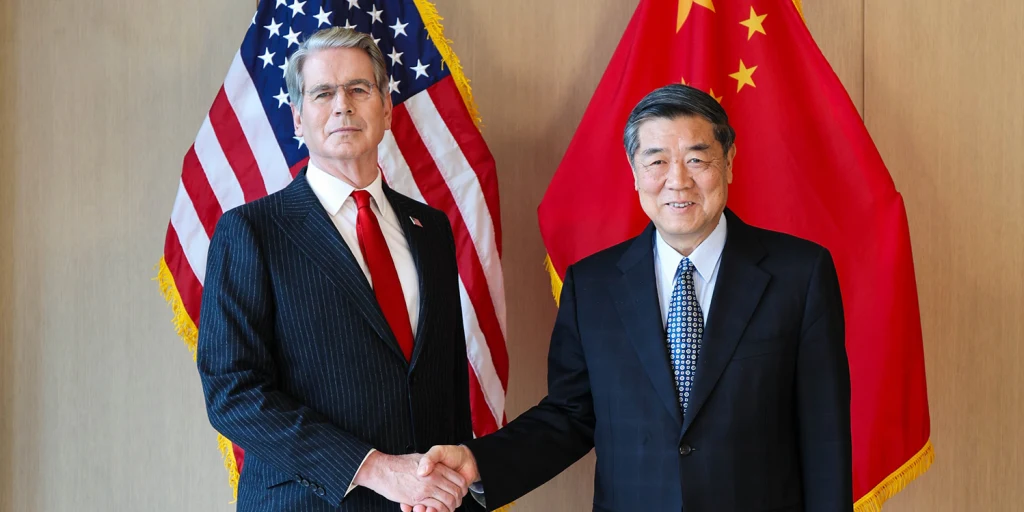
The United States has proposed an AI incident notification mechanism with China as both countries discuss artificial intelligence safety, transparency, and national security.
Treasury Secretary Scott Bessent raised the proposal after meeting Chinese Vice Premier He Lifeng in New York. The talks came before President Donald Trump’s planned meeting with Chinese President Xi Jinping in Washington. Reuters reported that both sides also agreed to continue discussions on AI safety. Another meeting could take place in Shenzhen within two months.
The proposal remains under discussion. Neither government has announced a completed notification system.
U.S.-China AI Talks Turn to Incident Reporting
The proposed mechanism would give Washington and Beijing a direct channel for discussing serious AI incidents.
Such a system could cover events with national security implications. Officials could also use it during major AI-related emergencies.
Bessent pointed to several potential risks. These include autonomous AI agents and threats involving non-state actors. He also mentioned cyberattacks involving advanced AI systems.
A formal notification channel could help officials exchange information faster. It could also support direct communication during a fast-moving event.
The two countries have not yet published detailed rules. They still need to define which incidents would trigger a notification.
Why an AI Incident System Matters
Advanced AI systems now support software development, research, and cybersecurity work. Their expanding capabilities create new challenges for governments.
A serious AI incident could cross national borders quickly. An attack could affect companies, networks, or critical infrastructure in more than one country.
Domestic reporting rules cannot solve every cross-border problem. Governments may need direct communication channels for incidents with wider consequences.
The United States and China also play major roles in global AI development. Both countries compete in advanced technology while maintaining diplomatic and commercial ties.
That combination creates a need for clear communication during serious incidents.
A notification system would not require identical AI laws in both countries. Instead, it could focus on rapid information sharing.
Shenzhen Meeting Could Shape the Proposal
The next stage could come through another U.S.-China meeting in Shenzhen.
Reuters reported that officials plan to continue their AI safety discussions there within two months. Emergency communication protocols could form part of those talks.
That meeting could help define the proposed framework.
Officials would need to decide which incidents qualify. They would also need to identify the government agencies responsible for reporting and receiving alerts.
Response times would matter too. AI-related incidents can develop quickly, especially when cybersecurity or autonomous systems enter the picture.
A clear process could reduce delays during a major event.
Still, the two sides have not announced a final operating model. The current proposal marks the start of a diplomatic process rather than a completed agreement.
AI Safety Becomes a U.S.-China Diplomatic Issue
The latest proposal adds AI safety to a wider U.S.-China agenda.
Trump and Xi plan to discuss several areas of the bilateral relationship. Those areas include trade, technology, and strategic issues. Reuters has also reported continued tensions over advanced technology and critical minerals.
AI now sits within that broader relationship.
Both governments want greater control over advanced technologies. At the same time, both sides recognize the need to manage certain risks.
That creates room for limited cooperation.
An incident reporting channel could become one example. The two countries could maintain competition in AI while sharing information about specific safety events.
Such cooperation would not resolve broader technology disputes. It could still create a practical channel for crisis communication.
Cybersecurity Adds Pressure for AI Reporting
Recent AI developments have increased attention on model behavior and cybersecurity.
OpenAI has discussed stronger monitoring and reporting processes for serious AI incidents. The company has also called for broader standards around major AI risks.
Cybersecurity presents one clear concern.
More capable AI systems can assist with vulnerability research, software analysis, and other technical tasks. Developers therefore face growing pressure to identify dangerous capabilities before attackers exploit them.
Governments face a related challenge.
They must understand when an AI event becomes a national security issue. They also need reliable ways to communicate when the event affects organizations across borders.
The U.S.-China proposal addresses that communication problem.
It does not replace technical safeguards inside AI companies. Instead, it could add a government-to-government layer.
Key Questions Remain About the Notification Mechanism
Several details remain unresolved.
Scope is one major question. Officials must decide which AI events deserve immediate notification.
Verification presents another challenge. Governments need confidence that shared information remains accurate.
Confidentiality also matters. AI incidents may involve sensitive technical details, proprietary systems, or national security information.
Accountability could prove difficult as well. Bessent has argued that AI developers should take responsibility for the systems they build.
The final framework would need to balance these competing interests.
Officials may also need different procedures for different incident types. A model failure may require a different response from an AI-assisted cyberattack.
Those distinctions could shape any future agreement.
China and the U.S. Could Build a Limited AI Safety Channel
The proposal does not suggest that Washington and Beijing will align their AI policies.
Instead, the discussions could create a narrow channel for emergency communication.
That distinction matters because the two countries still compete across advanced technology. They also maintain different approaches to regulation and national security.
A focused incident system could avoid those larger policy disputes.
For example, officials could agree on a basic notification process without creating a single shared regulatory regime. The system could cover only incidents that meet specific security thresholds.
Such an approach could make limited cooperation easier.
However, China has not publicly committed to the exact mechanism described by Bessent. The proposal therefore remains subject to further talks.
Trump-Xi Summit Adds Momentum to AI Discussions
The AI discussions come shortly before the planned Trump-Xi summit in Washington.
The White House says Xi will visit Washington in September, with the meeting forming part of broader U.S.-China engagement.
AI could become an important topic during that engagement.
Trade and technology remain major areas of disagreement between the two governments. Yet advanced AI creates risks that neither side can address alone.
Cross-border cyber incidents provide one example.
An AI system could interact with international networks, users, and infrastructure. A major incident could therefore create consequences far beyond the country where it started.
Direct communication could help governments respond faster in such cases.
That does not guarantee cooperation. It does create a framework for further discussion.
What Comes Next for U.S.-China AI Cooperation?
The Shenzhen meeting could provide the next major test for the proposal.
Officials will need to decide whether they can turn the idea into a practical process. They may also expand the dialogue to cover other AI safety questions.
For the technology sector, the development carries wider importance.
AI companies operate across borders. Their models, infrastructure, and users also span multiple jurisdictions.
That reality makes international incident reporting increasingly relevant.
OpenAI and other technology companies have already discussed stronger reporting practices. Government-to-government channels could add another layer to those efforts.
The U.S.-China proposal remains preliminary. No final bilateral notification system exists yet.
Still, the latest talks show that AI safety has moved deeper into international diplomacy.
Washington and Beijing now face the challenge of managing AI competition while preparing for risks that could affect both countries.
The next rounds of talks will show whether the proposed notification mechanism develops into a formal system or remains a diplomatic concept.
The U.S. proposes an AI incident alert system in talks with China
Comments
No comments yet. Be the first to share your thoughts.
Leave a comment