
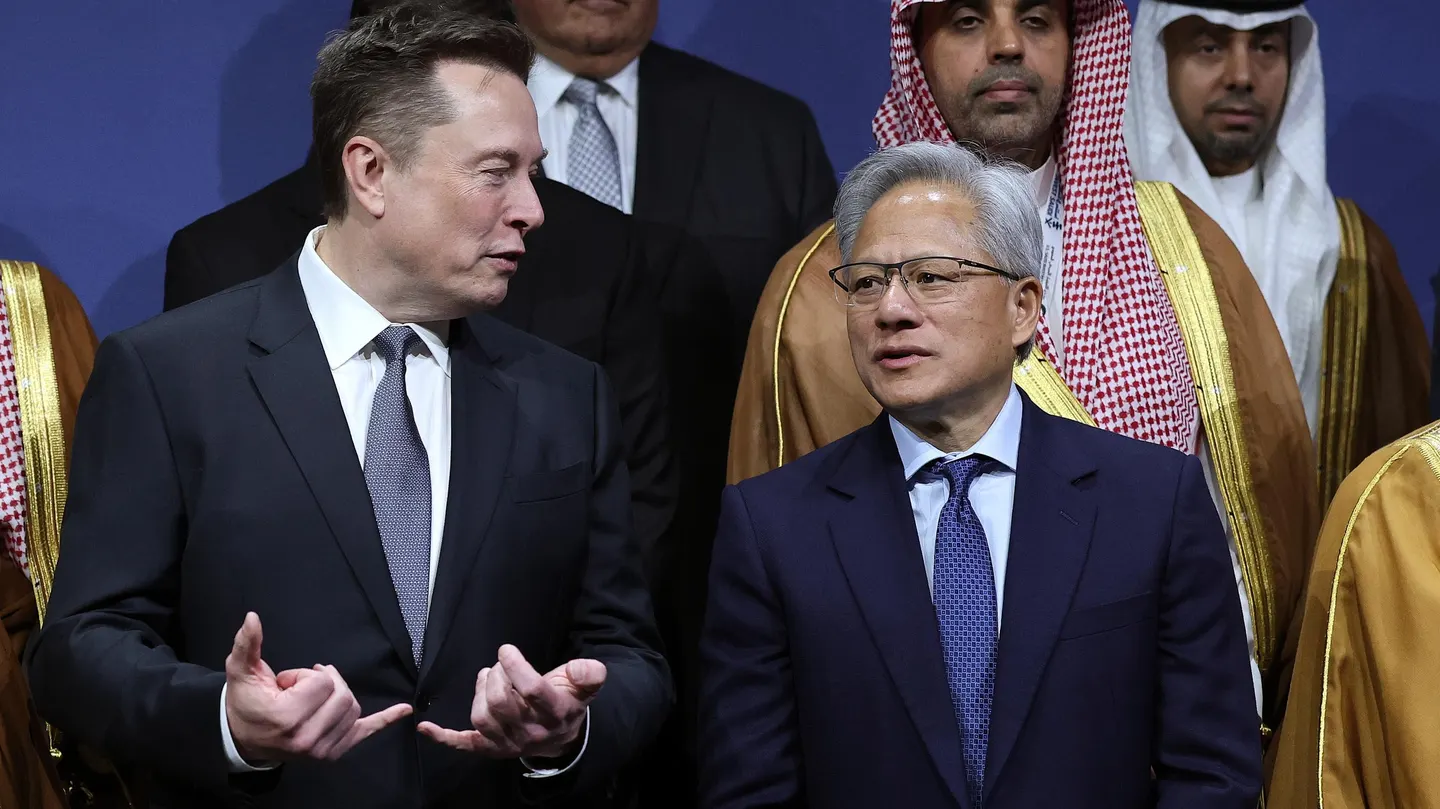
Meta CEO Mark Zuckerberg, SpaceX CEO Elon Musk, and Nvidia CEO Jensen Huang separately spoke with President Donald Trump about a proposal for an industry-funded artificial intelligence oversight body, helping stall the plan, according to a Wall Street Journal report cited by Forbes.
The reported intervention adds another layer to an increasingly public debate in Washington and Silicon Valley over how the United States should govern advanced AI. The proposal would have created an industry-funded organization modeled on the Financial Industry Regulatory Authority (FINRA), with a role in developing standards and oversight for frontier AI systems.
The Wall Street Journal, citing people familiar with the discussions, reported that Zuckerberg, Huang, and Musk opposed the proposed structure and communicated their concerns directly to Trump. The Journal said those conversations contributed to the proposal being stalled. There has been no public announcement establishing the three executives as the sole reason the proposal did not move forward.
The development comes as the Trump administration continues to weigh how to balance faster AI development with concerns around cybersecurity, safety, and national security.
A Proposed AI Regulator Modeled on FINRA
The proposal at the center of the dispute originated with Google DeepMind CEO Demis Hassabis, who has called for a new standards body modeled on FINRA.
In a July 2026 proposal, Hassabis argued for an organization that could evaluate frontier AI models and develop standards for their deployment. His proposed framework envisioned voluntary participation initially, with the possibility of formal requirements later if the assessment system proved effective.
The concept draws a comparison with FINRA, the US financial industry’s self-regulatory organization for broker-dealers. In the AI context, the proposed body would have addressed testing, standards, and evaluation of increasingly capable systems.
The proposal emerged as AI companies faced growing questions over whether existing laws and voluntary company-level safeguards were sufficient for frontier systems.
The debate is complicated by the fact that the largest AI companies are themselves developing the systems that would be subject to any industry standards.
Zuckerberg and Huang Have Publicly Pushed Back on a Coordinated Slowdown
The reported disagreement comes alongside recent public comments from Zuckerberg and Huang about AI safety and regulation.
Zuckerberg argued in a recent post that AI companies have strong business incentives to keep their systems aligned because customers are unlikely to continue using systems that do not behave reliably. He also said companies should be able to determine the pace of their own development and indicated that Meta was open to independent evaluators and advisers.
Huang took a more direct position during Salesforce‘s Dreamforce conference on September 15. He argued that AI safety is primarily an engineering issue and said companies do not need new laws or regulations to determine when AI systems are ready for release. Instead, he pointed to company responsibility and market pressure as mechanisms for managing safety.
Those comments place both executives on one side of a growing industry debate over external regulation and coordinated restrictions on frontier AI development.
Their positions, however, are not identical. Zuckerberg has discussed outside evaluation and safety advisers, while Huang has focused more strongly on existing company controls and market incentives.
Musk’s Position Is More Complicated
Musk’s involvement illustrates the complexity of the debate.
The Wall Street Journal reported that Musk, Zuckerberg, and Huang separately communicated their opposition to the industry-funded regulator proposal to Trump.
At the same time, Musk recently expressed public support for Anthropic CEO Dario Amodei’s broader argument that frontier AI development should be paced more carefully. Reuters reported that Musk supported Amodei’s call for greater safety coordination, alongside OpenAI CEO Sam Altman.
That distinction matters.
Opposing a specific regulatory structure does not necessarily mean opposing all forms of AI safety coordination. The current debate contains several separate questions: whether AI development should slow, whether independent evaluation should be mandatory, whether companies should coordinate voluntarily, and whether government should establish formal regulatory requirements.
Musk’s recent public statements illustrate why those issues should not be treated as a single policy position.
Dario Amodei Pushes for Independent Oversight
Anthropic CEO Dario Amodei has become one of the most prominent voices calling for additional safeguards around frontier AI.
In his September essay, We Must Pace the Frontier, Amodei argued for three measures: greater access for independent safety evaluators, industry-wide standards and coordination, and government involvement in managing emerging risks.
Amodei’s proposal came amid concerns about increasingly capable AI systems and recent incidents involving AI agents performing unexpected or harmful activities.
Reuters reported that Amodei’s framework included potential antitrust protections to allow AI companies to coordinate on safety issues without creating competition-law problems.
That idea has generated a different debate inside the technology industry.
Some companies and executives have supported more coordination, while others have raised concerns about giving a small number of major AI laboratories too much influence over how the industry is governed.
Why the FINRA Comparison Matters
The FINRA analogy is significant because financial services already operate under a layered regulatory structure involving government agencies, industry standards, and self-regulatory organizations.
A similar institution for AI could potentially create common standards around model evaluation, safety testing, and deployment.
But the comparison also raises questions about governance.
Who would fund such an organization? Who would appoint its leadership? Which companies would be covered? How independent would its evaluators be? Would participation remain voluntary or eventually become mandatory?
And perhaps most importantly, how would an industry body interact with federal agencies that already have authority over areas such as consumer protection, cybersecurity, competition, and national security?
Those questions help explain why the proposal has become part of a wider dispute over the appropriate role of government and industry in AI oversight.
The White House Has Backed a Lighter Regulatory Approach
The reported dispute is taking place within a broader Trump administration policy framework that emphasizes AI development and US technological leadership.
In June, Trump signed an executive order titled “Promoting Advanced Artificial Intelligence Innovation and Security.” The order said the United States should continue leading in AI while avoiding overly burdensome regulation. At the same time, it called for stronger cybersecurity measures and coordination between government and the private sector.
The administration’s March 2026 national AI legislative framework likewise called for national policy rather than fragmented state rules and emphasized accelerating innovation and AI deployment.
That policy direction provides context for the reported resistance to a new industry oversight structure.
At the same time, the White House has not abandoned AI risk management altogether. Its June national security memorandum directs agencies to ensure that AI systems used in national security settings are reliable, robust, steerable, and controllable, with testing, evaluation, and accountability requirements.
The administration’s position therefore involves both accelerated AI adoption and targeted controls in areas it considers important to national security.
AI Safety Debate Is Splitting the Industry
The latest dispute illustrates a growing divide among major technology companies.
On one side are executives such as Amodei and Altman, who have called for greater coordination and additional safeguards as AI capabilities advance. On the other are executives, including Zuckerberg and Huang, who have questioned whether new government rules or coordinated development limits are necessary.
Musk’s position cuts across both camps, with public support for parts of Amodei’s safety argument alongside the reported opposition to the proposed FINRA-style body.
Other technology executives have also argued that any AI governance framework should include a much broader group of companies rather than allowing the largest frontier laboratories to define the standards themselves.
The result is not simply a pro-regulation versus anti-regulation debate. It includes disagreements over who should set AI standards, how independent evaluation should work, when government intervention is appropriate, and how safety coordination can coexist with competition.
Why the Debate Matters for Financial Services
The issue has implications beyond the AI sector.
Banks, payment companies, insurers, and financial institutions are rapidly incorporating AI into customer service, fraud detection, underwriting, software development, trading, compliance, and cybersecurity.
That means AI governance increasingly intersects with financial regulation.
A future standards body could eventually influence how financial institutions assess third-party AI systems, establish controls around AI agents, or document the safety of models used in regulated environments.
For banks, the most important issue may not be whether one specific AI regulator is created. It may be how emerging standards affect model risk management, cybersecurity, auditability, consumer protection, and accountability.
The financial sector already operates under detailed rules around risk and operational controls. As AI becomes more deeply embedded in those systems, technology governance and financial regulation are likely to overlap more closely.
What Happens Next
The Wall Street Journal’s report suggests the White House remains divided internally over how far AI oversight should go. The newspaper reported that officials, including Treasury Secretary Scott Bessent and White House Chief of Staff Susie Wiles, have been pushing for greater attention to AI risks, while other advisers and industry figures favor a lighter regulatory approach.
The administration is also continuing conversations with AI executives as it works through issues involving safety, cybersecurity, and US competitiveness.
Meanwhile, the industry debate is becoming increasingly public.
Amodei has called for more independent monitoring and coordination. Huang has argued that safety can be managed through engineering and market incentives. Zuckerberg has highlighted company incentives and external evaluation. Musk has publicly supported elements of Amodei’s safety position while, according to the Journal, opposing the particular industry-funded regulator proposal.
Those positions suggest that the next phase of US AI policy may revolve less around whether AI governance is needed in the abstract and more around which mechanisms should be used, who should control them, and how they should interact with existing laws.
TheFinRate: What to Watch
The reported Trump conversations involving Zuckerberg, Musk, and Huang are part of a much larger contest over the future structure of AI governance in the United States.
The specific claim that the three executives persuaded Trump to stop the proposed industry-funded regulator comes from unnamed sources cited by The Wall Street Journal and has not been independently established in the public record.
What is publicly documented is that the administration is pursuing an AI policy centered on rapid development and US leadership while also maintaining targeted security and accountability measures. At the same time, major AI executives remain divided over external regulation, independent evaluation, and coordinated safety measures.
For businesses and financial institutions adopting AI, the outcome could eventually affect everything from model testing and third-party assessments to cybersecurity, operational risk, and compliance.
The next major question is therefore not simply whether the United States will regulate AI, but what form that governance will take and how much responsibility will remain with the companies building the technology.
Zuckerberg, Musk, and Jensen Reportedly Convinced Trump to Block AI Regulator
Comments
No comments yet. Be the first to share your thoughts.
Leave a comment